The Lamborghini shelf, from the 350 GT to the Aventador SVJ
The VeVe Lamborghini line runs from the 350 GT of 1964 through the Miura, Countach LP 400, Diablo, Gallardo, Huracan STO and Aventador SVJ Roadster. Taken together it reads as a model line rather than a handful of cars, which is why car licences suit collecting so well.
Ferruccio Lamborghini built tractors. Good ones, out of surplus military hardware, starting in 1948, and by the early 1960s he was a wealthy man in Emilia-Romagna with a garage full of fast cars and opinions about all of them. The story everybody tells is that he complained to Enzo Ferrari about a clutch and was told to stick to farm machinery.
Whether it happened exactly that way is between the two of them. What is documented is that Automobili Lamborghini was incorporated in 1963, a factory went up at Sant’Agata Bolognese, and within three years the company had built the car that most people credit with inventing the entire supercar idea.
The first one was a grand tourer, and it was very good
The 350 GT arrived in 1964. A V12 designed by Giotto Bizzarrini, a body by Touring of Milan, and around 120 of them made. It is a handsome, slightly awkward, genuinely fast car, and almost nobody outside the hobby can pick it out of a line-up.
That is what makes it interesting as the first piece in a set. Every collection needs a beginning that is not the famous one. The 350 GT is where the badge starts, and the raging bull on it comes from Ferruccio being a Taurus and liking Spanish fighting bulls enough to name most of his cars after them.
1966, and the engine goes behind the driver
The Miura was shown as a bare chassis at Turin in November 1965. The engineers had built it partly on their own time, and the layout was the point: a V12 mounted transversely, behind the driver, in a road car. Nobody was doing that outside racing.
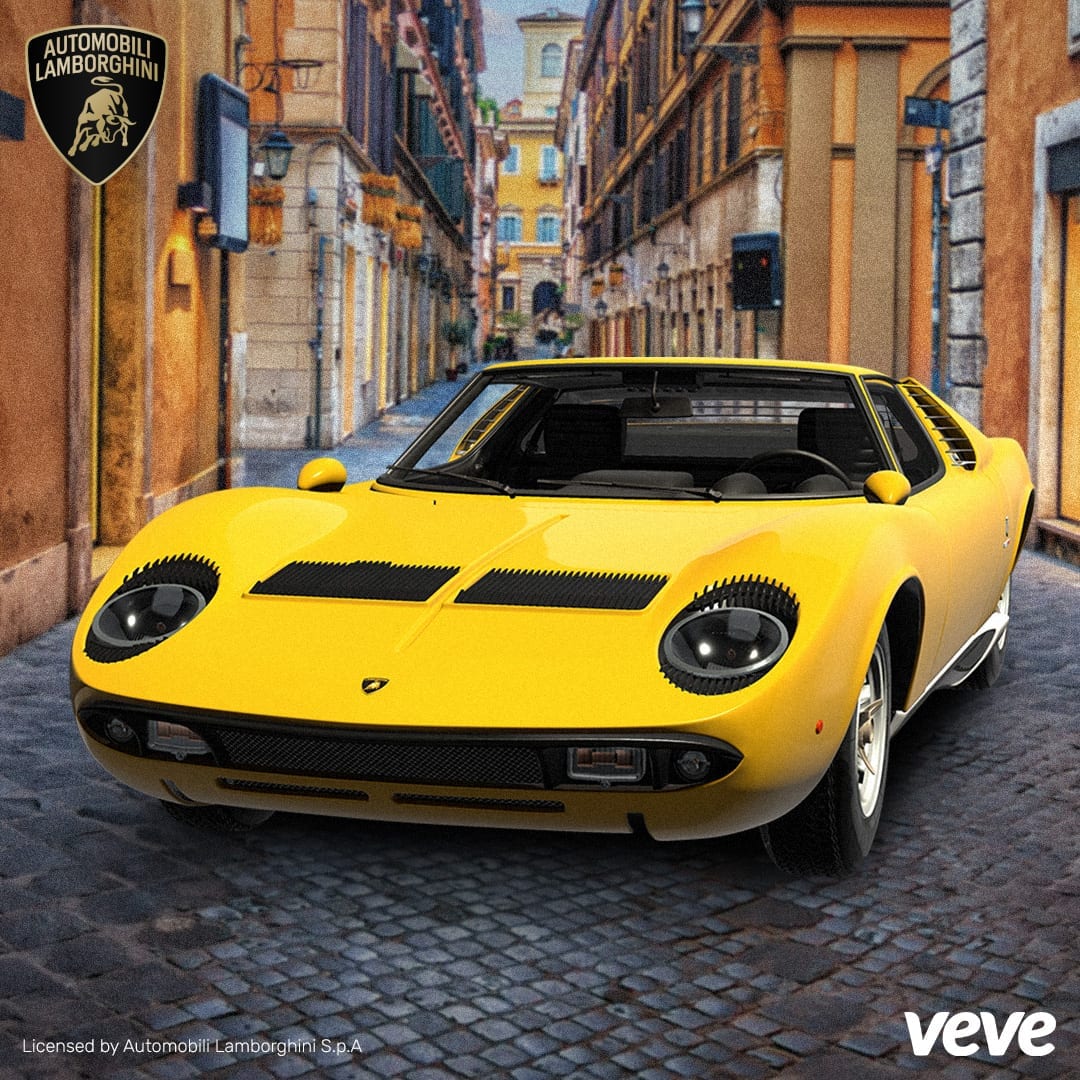
Bertone got the body, and the drawing was done by Marcello Gandini, who was twenty-seven. The finished car appeared at Geneva in March 1966 and stopped the show. It is named after Don Eduardo Miura’s bulls, it was the fastest production car in the world when it launched, and the proportions are still ridiculous in person: low, wide, with a cabin pushed so far forward that the car looks like it is leaning into a corner while parked.
Look at the early cars and you will see the eyelashes, the row of black slats around each headlamp. They are on the P400 and P400S and were dropped for the SV in 1971, which is one of those details that lets a collector date a car from across a room.
The wedge that ended up on bedroom walls
Gandini drew the Countach too, and it looks nothing like the Miura. The LP500 prototype turned up at Geneva in 1971 in bright yellow, and the production LP400 followed in 1974. Where the Miura is all curve, the Countach is folded flat planes and hard angles, and the doors go up instead of out.
Roughly 150 LP400s were made. The word itself is a Piedmontese exclamation, the sort of thing you say when something startles you, and the line about it being what a man said the first time he saw the car has been repeated so often that its origin is now unrecoverable. The car did something no Lamborghini had managed before: it escaped the car world entirely. A generation who could not have identified a single other Italian model had one on a poster above a desk.
The rest of the line, in order
The VeVe Lamborghini releases are officially licensed by Automobili Lamborghini, and they cover a spine of the company’s history rather than a random handful. Running in order:
- 350 GT, 1964. The first production Lamborghini, and the car that proves the tractor man was serious.
- Miura, 1966. Mid-engined V12, Gandini bodywork, the design everyone else spent a decade answering.
- Countach LP 400, 1974. The wedge, the scissor doors, the poster.
- Diablo, 1990. The first Lamborghini to pass 200 mph, and the last one developed before Audi bought the company in 1998.
- Gallardo, 2003. The one that sold. More than 14,000 were built before production ended in 2013, more than every previous Lamborghini model added together.
- Huracan STO, revealed 2020. A road car pulled straight out of the Super Trofeo racing programme, with the aerodynamics left visible.
- Aventador SVJ Roadster, 2019. The coupe version set a 6 minute 44.97 second production car lap at the Nurburgring in July 2018, and the roadster followed with the roof taken off.
Seven cars, fifty-five years, one badge. You can see the whole group on the Lamborghini hub.
Why a model line is such a good collecting object
Two things make cars work on a shelf that most licences cannot offer.
The first is recognition without explanation. A Countach needs no caption. Someone who has never heard of Sant’Agata can still tell that the yellow wedge and the yellow curve are made by the same people, forty years apart, because the design language carries it. That is a rare property. Most character lines need you to already know the character.
The second is that a manufacturer has already done the curation. A model line is a finished set with an agreed order, agreed names and no argument about what belongs in it. Anyone who has tried to define a themed collection from scratch knows how much work that is, and our guide to building a themed collection exists because the decision is genuinely hard. With a marque, the factory made the decision in 1963 and has been updating it ever since.
There is a third thing, which is scale. A car is a big object, and a big object anchors everything near it, which is the argument we made in full in why a vehicle anchors a collection. Put a Miura beside a row of figures and the figures stop being a row.
Brand pieces are a different kind of ownership
Collecting a marque sits closer to collecting Coca-Cola neon than to collecting a superhero. There is no first appearance, no creative team, no continuity to keep straight. What you are keeping is industrial design, and industrial design is judged on whether the object still looks right decades after the people who argued about it retired.
Brand collecting has been doing this for a century, as we covered in brand collectibles and a century-old habit, and cars are its most serious corner. Model cars, dealer promotional pieces, factory brochures and press photographs have had organised markets since the 1960s.
The digital versions have one practical advantage over a diecast shelf, which is that a car rendered in three dimensions can be turned, lit and put into a room at a size the object itself would never allow. If you have been treating your pieces as a grid of squares, the notes on displaying digital collectibles will change how you use them.
Ferruccio sold his share of the car company in 1974 and went back to making wine in Umbria. He had been building sports cars for eleven years. The badge he drew from his own star sign is now on a factory owned by a German group, on cars he would not recognise, and the shape of the thing he authorised in 1966 is still the reference every other manufacturer gets measured against. Not a bad eleven years.