How art toys taught collecting the shape it still uses
Art toys, also called designer toys, began in Hong Kong in the late 1990s with artists like Michael Lau and Eric So, and grew through Medicom's Bearbrick in 2001 and Kidrobot in 2002. The blind box and the chase figure come from that movement, and VeVe carries digital art toy lines including tokidoki, Running Mon and the Roblox Rabbids Takeover.
Somebody had to invent the blind box. It did not fall out of the sky. A specific group of people, mostly in Hong Kong and Tokyo in the late 1990s, worked out that a toy could be a piece of art, that a piece of art could be produced in a run of 500, and that if you did not tell the buyer which one was in the box, the whole thing got considerably more fun.
Everything that happened afterward in collecting, including the digital part, is downstream of that.
Hong Kong, 1998, and a set of figures nobody asked for
The usual starting point is Michael Lau. He was doing illustration work in Hong Kong when he began making customised figures based on the street kids in his comic strip for a local magazine, and by 1999 he was showing them as art. Not toys with an art angle. Art, in the shape of a twelve-inch figure. Eric So was working the same seam at the same time, reskinning existing figure bodies with his own designs.
That is the founding move of the whole movement, and it is worth saying plainly. The idea was that the figure is a canvas, and the artist is the point.
The industry caught up fast. Medicom Toy launched Bearbrick in 2001, a simple blocky bear silhouette in a fixed set of sizes, deliberately featureless. Kidrobot opened in 2002 in San Francisco and did the same thing with Dunny and Munny. The word for what they built is a platform: one mould, one shape, endless artists putting their own surface on it.
If that structure sounds familiar, it should. A single recognisable form, many variants, each one attributable to a specific artist, produced in a known quantity. That is the architecture of most modern collecting, and the art toy people drew it first.
What a platform toy gets right that a character figure does not
A character figure has a ceiling. It has to look like the character. Get it wrong and you have failed at the one job.
A platform toy has no such obligation, and the consequences are enormous. Two collectors can own the same silhouette and nothing else in common. The set is never finished, because a new artist can always be handed the mould. And the collector gets to have taste, publicly, in a way that buying the officially correct version of a licensed hero does not allow.
This is why the format survived four decades of toy industry churn without dying. It has room in it.
The lines VeVe carries, and what each one inherits
The digital art toy pieces on VeVe are not a single style, which is appropriate given the history.
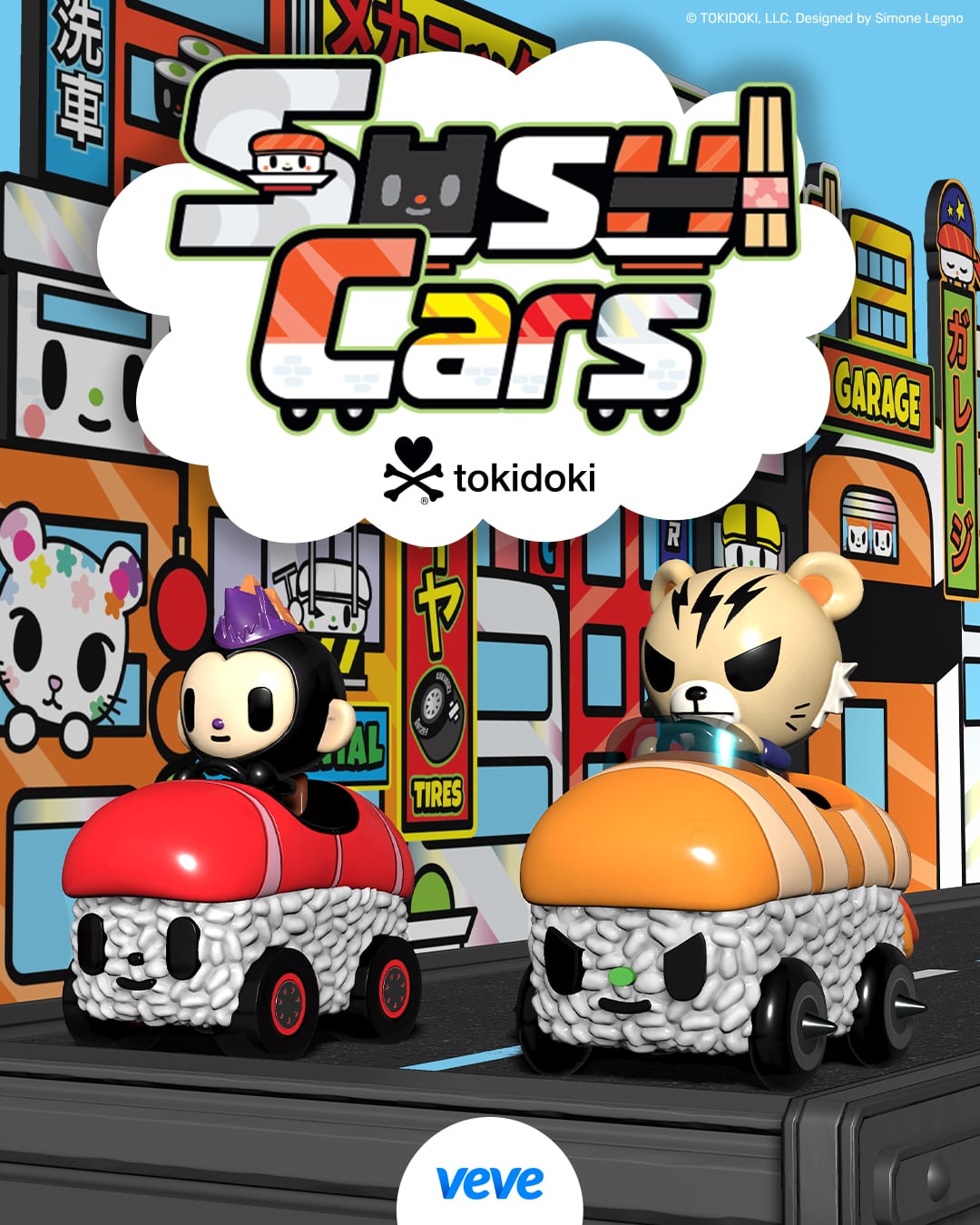
tokidoki is the most direct descendant. Simone Legno founded it in 2005, working out of Los Angeles with an aesthetic that borrowed Japanese character design and ran it through something much brighter and stranger. The Sushi Cars are pure tokidoki logic: take two things with no business being combined, combine them anyway, commit completely. They are also the most obviously collectible shape in the lot, because a set of vehicles is a set, and a set wants completing.
Piet Mondrian x Doodles is the odd one out and the one I find most interesting. Mondrian died in 1944, and his grid paintings have since entered the public domain, which is the reason a collaboration built on that visual language is possible at all. It is a genuinely old idea meeting a genuinely new one. Mondrian spent his last decades reducing painting to horizontals, verticals and three primaries. Doodles is built on flat colour and simple line. The overlap is real rather than decorative.
Ducobi Tiger and Running Mon sit in the vinyl toy tradition more squarely, the sort of thing that would have come out of a Kidrobot show in 2006 and looked completely at home. And the Roblox Rabbids Takeover is the current end of the same pipeline, where a character from French video games ends up inside a platform used mostly by people under 16. Ubisoft’s Rabbids have been screaming since 2006 and have outlasted most of the games they appeared in, which is a very art toy career arc.
The full list of what has been released sits on our character hub index.
The blind box is older than any of this
Worth being clear on the order of events, because a lot of people assume the surprise mechanic came from digital collecting. It did not, and it is not even close.
Blind packaging is at least a century old in the form of cigarette cards and cereal prizes. What the art toy movement did was formalise it into a collecting structure with rules:
- A series is a fixed set of designs, usually eight to sixteen, announced in advance.
- The box does not tell you which one is inside.
- Ratios are published, so you know a given figure appears in, say, one box in twenty.
- One or more chase figures sit outside that ratio at much longer odds, sometimes unannounced entirely.
That last element is the invention. The chase figure gives a cheap, widely produced series a peak, and it gives every single box a reason to be opened rather than shelved. Kidrobot and Medicom ran this model for years before anyone put a collectible on a blockchain. If you want the mechanics in detail, including how it translates to digital drops, we wrote them up in what is a blind box.
The digital version replaces published case ratios with stated rarity tiers, which does the same structural job with considerably less cardboard.
Why art toys reward theme collecting more than franchise collecting
If you collect Star Wars, the theme picks itself and the hard part is stopping. Art toys are the opposite problem. There is no story holding the line together, so you have to supply the through line yourself.
Collectors who do this well usually pick one of three axes: a single artist across different platforms, a single platform across different artists, or a single visual idea across everything. That third one produces the most interesting shelves. A collection of nothing but food-shaped objects, or nothing but things in primary colours, tells you something about the person who assembled it. Our guide to building a themed collection goes through the method.
The physical side of this hobby has produced some genuinely startling results over the years, and the auction history of rare production toys is documented in most valuable action figures if you want the numbers from that market.
The part that has not changed
Strip away the format and the art toy proposition has been identical since 1999. An artist makes a thing. The thing exists in a known quantity. You either got one or you did not, and the people who understand what it is will recognise it instantly, and the people who do not will think it is a small plastic bear.
That last part is doing more work than anyone admits. A collection that everybody immediately understands is not really a collection, it is a display. The art toy tradition has always been slightly private, slightly in-joke, slightly for the people who know. Digital or vinyl, that is still the good part.