Coca-Cola and the brand that taught itself to be collected
Coca-Cola has been an organised collecting category since the 1970s, with dedicated clubs, conventions and printed guides, because the company treated its packaging and signage as design from the beginning. VeVe carries a licensed Coca-Cola Neon Signs digital release, which sits in that same tradition of collecting the advertising rather than the drink.
Nobody collects the drink. That is the odd thing about Coca-Cola as a category: the product is consumed and gone within minutes, and what survives is everything that was built to sell it. Trays. Calendars. Coolers. Clocks. Signs that hung over a counter in 1948 and are now hanging in somebody’s garage in Ohio, wired up and humming.
A company invented in a pharmacy in 1886 accidentally created one of the largest object hobbies in the world, and it did it by caring about how things looked.
The pharmacist, the bookkeeper and the script
John Pemberton mixed the first batch in Atlanta in 1886. He was a pharmacist working on a patent medicine, and the syrup was sold at a soda fountain as a five-cent glass. Pemberton did not name it. His bookkeeper, Frank M. Robinson, did, and Robinson also wrote out the Spencerian script that the company still uses. One man’s handwriting, from 1886, still on every can in every shop on earth.
Pemberton died in 1888 and never saw any of it. Asa Candler assembled control of the business over the next few years, and in 1899 two lawyers from Chattanooga, Benjamin Thomas and Joseph Whitehead, bought the bottling rights for one dollar. Candler apparently did not think bottling mattered. That one-dollar contract is why there were suddenly thousands of independent bottlers stamping their town’s name into the bottom of glass, which is itself a whole sub-hobby now.
The bottle was engineered to be identified by touch
By the 1910s the copycats were a real problem. Anything in a straight-sided bottle with a red label could pass for the real thing at a glance, so in 1915 the company ran a competition among glass makers with an unusual brief: design a bottle a person could recognise in the dark, or recognise from a single broken piece on the ground.
The Root Glass Company of Terre Haute, Indiana won it. The contour bottle was patented in November 1915, and the design brief is the reason it still feels the way it does in a hand. Ribbed. Fat in the middle. Heavier than it needs to be. It is one of the very few pieces of commercial packaging that works as sculpture, and Raymond Loewy, who was not a man given to praising other people’s work, called it a perfect design object.
That decision set the pattern for everything that followed. Once a company decides its packaging is design rather than a container, people start keeping it.
Thirty-three winters of Santa Claus
Haddon Sundblom began painting Coca-Cola’s Christmas advertising in 1931 and kept at it until 1964. The Santa he settled on is warm, heavy, red-suited, obviously enjoying himself, and looks like a real man rather than an elf or a bishop. He was not the first illustrator to draw Santa that way, and the company did not invent the character. What Sundblom did was run the same image, at enormous scale, every December for three decades, until it became the default picture in the head of most of the western world.
The originals are oil paintings. Some hang in the company’s own archive in Atlanta, and Sundblom’s Santa canvases have come up at auction over the years as fine art rather than as memorabilia, which tells you how the category is regarded now.
The hobby got organised early
Coca-Cola collecting has the infrastructure that most brand categories never build. The Coca-Cola Collectors Club formed in 1974 and still runs an annual convention. Allan Petretti’s Coca-Cola Collectibles Price Guide ran through edition after edition and became the reference book that settled arguments about what a tray actually was. Local chapters. Reproduction-spotting guides, because the fakes got good in the 1970s and 1980s and the club had to teach people how to read a lithograph edge.
That is a real hobby, with an apparatus around it, of the kind described in our history of collecting. It predates almost all of the modern licensed collecting business, and it grew out of the simple fact that the company gave shopkeepers beautiful objects for free and then took them back when they got old.
What makes brand collecting different from character collecting is that nobody wrote a story for you. There is no origin issue and no first appearance. The object carries the memory instead, and the memory is usually a room you stood in. We went into that at more length in the piece on brand collectibles and a century-old habit.
Neon was a mood before it was nostalgia
Georges Claude demonstrated neon tube lighting in Paris in 1910. Within about fifteen years the tubes had reached American storefronts, and by the 1940s a neon sign was simply what a place that was open at night looked like. Diners, motels, drugstore counters, bowling alleys. Coca-Cola signage was everywhere in that world because the company put it there, in enormous volume, as part of the deal with the retailer.
Then the world moved to backlit plastic, because plastic was cheaper and did not need a glass bender to repair. The neon that survived became something else: not signage, but a stand-in for a whole era of American street light. That is why a neon sign is now a wanted object in a way a plastic light-up panel from 1979 will never be.
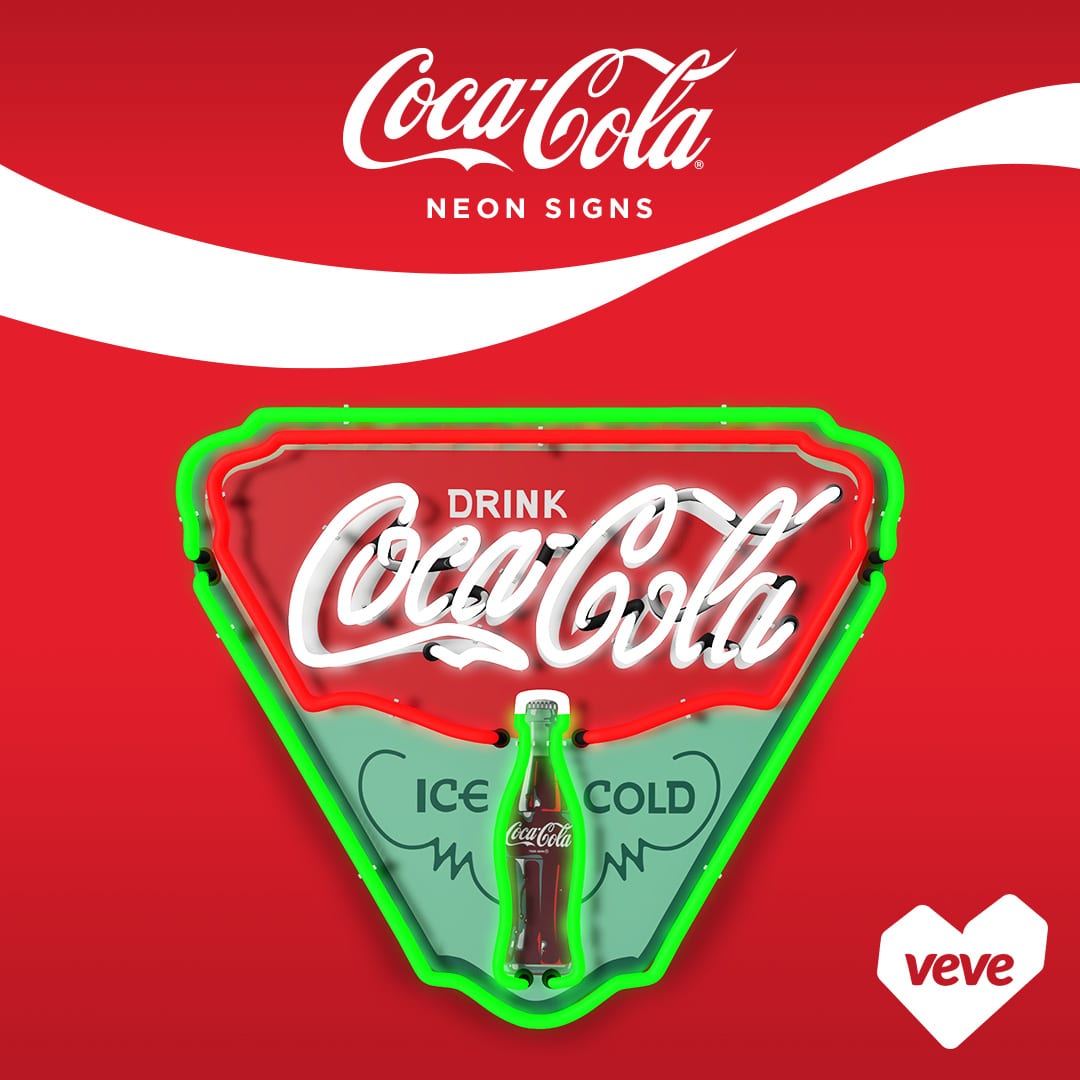
The Coca-Cola Neon Signs release on VeVe is built on exactly that. The piece in this article is a triangular shield sign, green tube around a red outline, the script logo glowing white across the top, and an ice cold bottle standing in the lower panel. It is an accurate rendering of a type of fixture that genuinely hung on walls. A digital version can also do one thing the original could not, which is glow in your living room without a transformer, a power bill, or the risk of a cracked tube.
If you want more of this, the Coca-Cola hub collects what the brand has released on the platform, and the same feed carries a vintage bottles set that runs at the other end of the same history.
Why the licence is the whole thing here
With a character, a bad unlicensed version is an obvious knock-off. With a brand, it is worse, because the logo, the script, the exact red and the shape of the bottle are the entire object. Get any of them slightly wrong and you have made something that looks like a mistake.
Licensed releases go through the trademark holder’s approval, which for Coca-Cola is famously thorough, and that approval is what you are actually getting when a piece of brand art comes through an official channel. We laid out the general case in why official licences matter, and it applies double to brands that have spent a century defending a font.
Set a neon sign next to figures on a shelf and it does something a figure cannot do: it makes the shelf into a place. Signs are backdrops. They imply a wall, a street and a time of night. If you have been arranging pieces and it still reads as a row of objects, that is usually what is missing, and our notes on displaying digital collectibles get into how to use one.
Start a free VeVe account if you want a look at the brand shelves for yourself. New collectors get US$10 in credit toward a first piece, no card required, and the free credit explainer covers how it works.
Pemberton was trying to make a headache remedy. The bookkeeper picked the name because he thought the two Cs would look good written out. A glass company in Indiana solved a counterfeiting problem with a shape. None of these people were building a collecting category, and between them they built one of the most durable ones there is, which is a decent argument that the objects people keep are almost never the objects anybody planned for them to keep.