Why people collect logos, neon signs and supercars
Brand collecting is older than character collecting. Coca-Cola has been producing collectible advertising since 1886, and dedicated clubs and price guides have existed since the 1970s. VeVe carries brand art including Coca-Cola neon signs and Lamborghini, which work as collectibles because logos and machines are instantly recognised by almost everyone.
Before anyone collected superheroes, people collected trays. Serving trays with a woman in a hat holding a glass of something, printed for a soda company, given away to bars and drugstores and then quietly kept by whoever liked the picture. That habit is roughly 140 years old now and it never went away.
Brand collecting is the largest part of this hobby that almost nobody writes about.
Coca-Cola started advertising in 1886 and never stopped
The company sold its first glass in 1886, and the advertising began essentially immediately. Calendars, trays, signs, thermometers, clocks, coolers, bottle carriers, playing cards, pocket mirrors. The output was continuous, it was dated, and it was produced in enormous quantity for a century, which turns out to be the perfect set of conditions for a collecting category.
The Santa Claus work is the piece of this that everyone has seen without knowing it. Haddon Sundblom painted Coca-Cola’s Santa from 1931, and he kept painting him into the 1960s. He did not invent the red suit, which predates him by decades, but he fixed the modern version of the face so firmly that most people alive have never seen a different one.
By the 1970s Coca-Cola collecting had all the machinery of a serious hobby: dedicated clubs, annual conventions, published price guides, specialists who could date a tray by the shade of red. It was organised well before comics collecting had properly sorted itself out.
The thing to understand is that none of those objects were made to be collected. They were made to be nailed to a wall in a diner. The collecting came after, and it came because people recognised the pictures.
Neon signs and the specific ache of a lit-up object
Neon deserves its own paragraph, because it is an unusual case of a technology becoming a mood.
Commercial neon signage spread through American and European cities from the 1920s onward, peaked mid-century, and then got steadily replaced by backlit plastic and eventually LED, which are cheaper, brighter and completely soulless. What is left is a nostalgia object with a very sharp edge to it: a neon sign says diner, motel, garage, closed at 2am, and it says it instantly, with no words required.
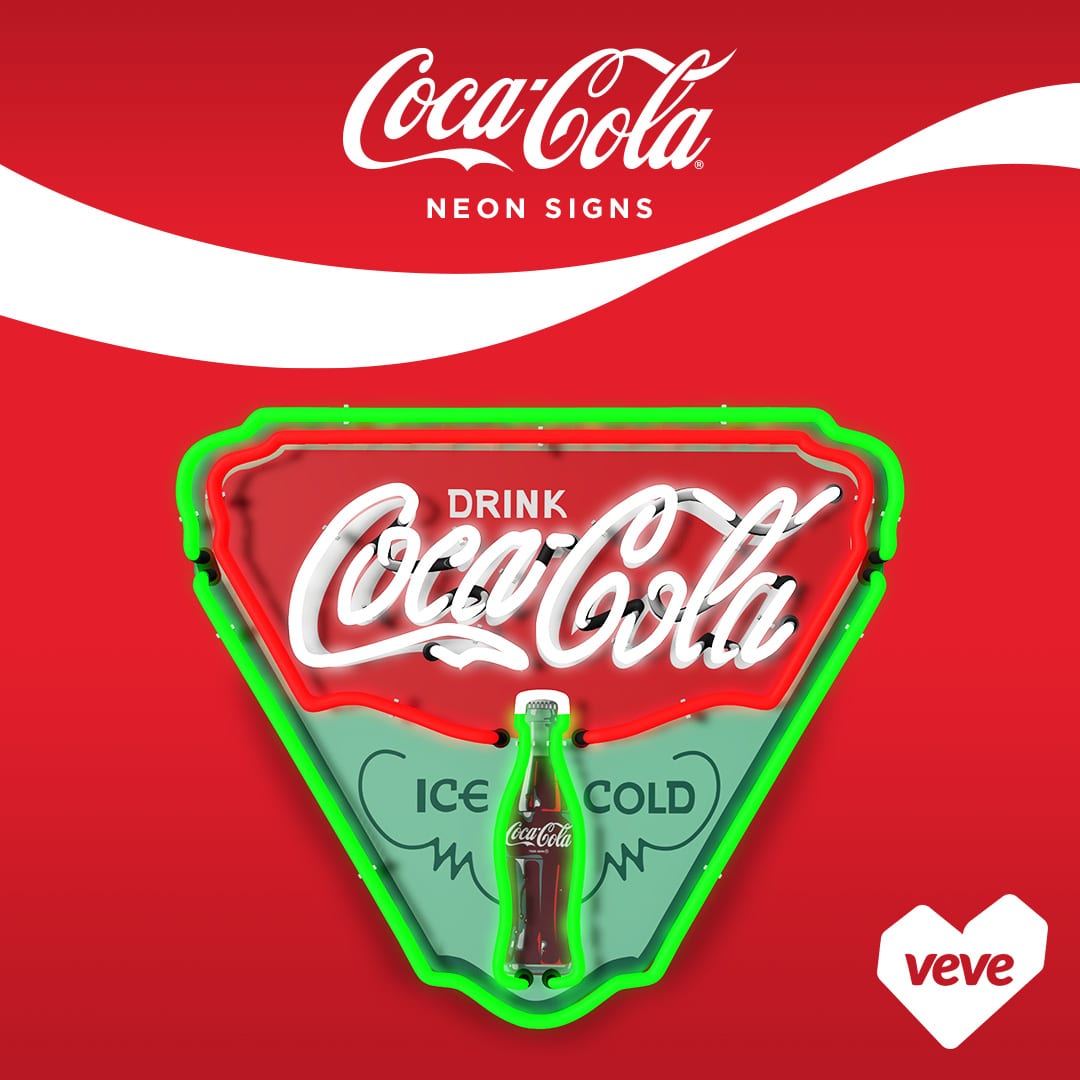
Real neon is glass tubing bent by hand by a person who trained for years. It breaks, it flickers, the transformers hum, and a restored original sign is a heavy, fragile, temperamental thing that costs a fortune to ship. That is precisely why digital versions of the form are interesting. The one problem neon has always had is that you cannot own one unless you have a wall and a budget for it. The Coca-Cola pieces on VeVe take the glow and drop the electrician.
Lamborghini, a tractor company, and the accident that created the supercar
The car side of brand collecting runs on the same fuel and a different engine.
Ferruccio Lamborghini built tractors. He was good at it, he got rich doing it, and the company he founded in 1963 exists because he was unhappy with a clutch. The story has been told so many times it has worn smooth, but the outline is documented: a successful industrialist who owned Ferraris decided he could do it better, hired away good engineers, and started building grand tourers in Sant’Agata Bolognese.
The Miura arrived in 1966 and changed the category. Mid-engine layout in a road car, a body by Marcello Gandini at Bertone, and a shape so low and so wrong for 1966 that it is still the reference point for what a supercar is supposed to look like. Most historians hand the Miura the credit for inventing the whole class.
What makes cars collect well is that they are machines with faces. Every serious enthusiast can identify a Countach wedge or a Miura’s eyelashes from a silhouette at a hundred metres, and the knowledge is genuinely deep: build years, engine displacements, which wing came on which model, why a particular seat trim matters. The Lamborghini art leans on that recognition rather than trying to explain anything.
Why a logo works as a collectible at all
There is a real mechanism underneath this, and it is not just nostalgia.
Three things have to be true for something to collect widely, and brands are unusually good at all three:
- It has to be shared. Millions of people have the same relationship to a Coca-Cola script or a raging bull badge. That shared reference is what makes a collection legible to someone else.
- It has to be specific. A 1950s fishtail sign is not a 1970s dynamic ribbon sign, and a collector knows the difference. Vague things do not collect.
- It has to be instant. No reading, no context, no plot summary. You see it and you have already got it.
Characters need a story before they mean anything. A logo needs nothing. That is why brand collecting reaches people who would never buy a comic, and why it has outlasted several generations of character licensing entirely.
Licensing is the part that makes it possible
None of this happens casually. A brand is a company’s most defended asset, and putting a Coca-Cola script or a Lamborghini badge on anything requires an actual agreement, negotiated, with usage terms and approvals on the art itself. That approval process is why official brand pieces look right and unofficial ones always look slightly off, in ways that are hard to articulate but easy to see.
We go into the mechanics in why official licenses matter, and it applies double here. With a character, a bad likeness is a disappointment. With a brand, an unapproved logo is a lawsuit.
Displaying a thing that was designed to be seen from a road
Brand objects have a display quirk worth knowing. They were made to be read at distance, by someone moving. Signs were sized for a street. Trays were sized for a bar top. Car photography has always been shot low and wide.
So they behave differently to a figure. A neon sign wants to be high on a wall and slightly too big, because that is the geometry it was designed for, and shrinking it to shelf scale kills it. A car wants a low camera and a lot of empty space in front. Our display guide covers placement generally, but the brand rule is simple: give it distance, then give it more.
The oldest collecting instinct there is
Long before there were superheroes, before there were even trading cards, people kept advertising because they liked how it looked. That is the whole of it. There is a long, strange history of ordinary commercial objects becoming treasured ones once the shop that used them closed, and we traced some of that in our history of collecting.
What I like about the brand end of the hobby is how unpretentious it is. Nobody collects a soda logo because it makes them look sophisticated. They collect it because a specific red and a specific white script means something to them that they could not fully explain, and that is a much more honest reason to own an object than most. The rest of the character and brand roster is worth a browse if you want to find your own version of it.