Fantastic Four #6: the first supervillain team-up
Fantastic Four #6, cover dated September 1962 by Stan Lee and Jack Kirby, teamed Doctor Doom with Namor the Sub-Mariner against the Fantastic Four, the first supervillain alliance of the Marvel age. Doom betrays Namor and ends the issue adrift in space. VeVe carries a licensed digital edition of the issue.
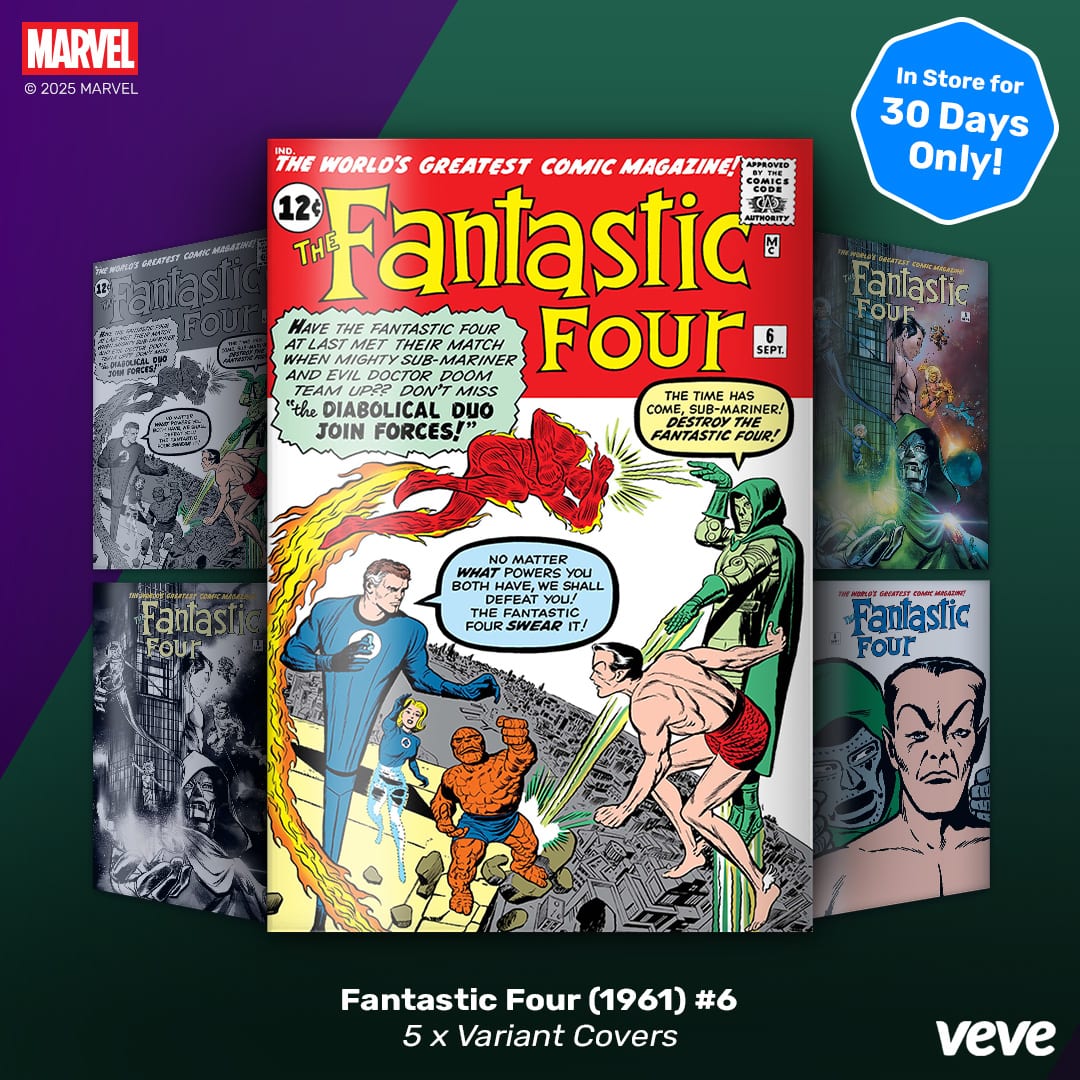
Doctor Doom’s plan in this issue is to attach a magnetic grabber to the Baxter Building and pull the whole thing, tenants included, into space. Kirby draws a New York office tower torn out of its own foundations and hauled toward the sun, four floors of it still furnished. It is an absurd image and it is the kind of absurd image nobody else in 1962 was putting on paper.
Cover dated September 1962, Stan Lee writing, Kirby drawing. The title is “Captives of the Deadly Duo” and the duo is Doom and Namor the Sub-Mariner, working together for exactly as long as it takes Doom to decide he no longer needs a partner.
Two villains, five months, one alliance
The timing is worth laying out because it shows how fast this book was moving.
Namor came back in issue four, cover dated May 1962. Bill Everett had created him in 1939 for Timely Comics, the company that became Marvel, and after a strong run in the 1940s and a short-lived revival in the mid-fifties he had been off the racks for years. Johnny Storm finds him in a Bowery flophouse with no memory, throws him in the harbour, and the character wakes up angry about a kingdom that has been irradiated in his absence. That single issue told readers that Marvel’s new comics and Marvel’s old comics were the same world, which is where continuity as we understand it begins.
Doctor Doom arrived in issue five, July 1962. Victor von Doom is a scientist, a sorcerer, a head of state and Reed Richards’ old university rival, a combination of attributes that should not work and has never stopped working.
Then issue six puts them in a room together. Five months from a team with no rogues gallery to a villain alliance.
Why an alliance between people who despise each other is better material
Doom and Namor have nothing in common except a grudge. Doom wants the Fantastic Four humiliated because Reed Richards was better than him at school and never apologised for it. Namor wants the surface world to answer for what it did to Atlantis, and he wants Sue Storm, which he says out loud and which the book treats as a real and inconvenient complication rather than a joke.
Put two villains with a shared goal in a story and you get a longer fight scene. Put two villains with incompatible goals in a story and the plot writes itself, because the interesting question stops being whether the heroes win and becomes when the partnership breaks and who breaks it.
It breaks when Doom reveals he never intended to bring Namor along. Namor was useful for getting the device onto the building, and once the building is moving Doom is happy to let him burn with everyone else. Namor turns on him. Doom ends the issue flung out of the ship and drifting through space, which is a fairly definitive exit for a character Marvel had used exactly twice.
He came back four issues later with an explanation involving an alien race called the Ovoids and a mind-transfer technique, which is the sort of thing Kirby could introduce in two panels and nobody would question. That return is covered in our piece on Fantastic Four #10.
What this did to the shape of superhero comics
Every crossover event on the shelf today is downstream of the observation made in this issue: villains are more interesting when they have relationships with each other.
Before 1962 the standard model was one hero, a list of enemies, and a rotation. The enemies existed in isolation and none of them knew each other. Marvel started treating the villain side of the ledger as a population with its own politics, and within two years the Masters of Evil and the Sinister Six were both operating on that principle. The Spider-Man villains guide gets into what that did to that side of the line.
Namor benefited more than Doom did. Doom was always going to work. Namor came out of this issue as something the genre did not really have yet: a character who fights the heroes, fights the villains, and cannot be sorted into either column. He is a monarch defending a country. His grievances are legitimate. He is also arrogant, violent and unwilling to compromise, and Marvel has spent six decades declining to resolve that. He shows up as an ally in the Avengers, as an antagonist in the X-Men, and as a wildcard everywhere else. Go deeper on the Namor character page.
The collecting picture for early Fantastic Four
The physical market for these books is shaped by distribution, not demand.
A 1962 comic was a twelve-cent newsprint pamphlet on a wire rack in a drugstore. Unsold copies did not come back intact: distributors stripped the covers for return credit and destroyed the interiors, so a good share of any print run never reached a reader at all. The copies that survived were the ones a child liked enough to keep, which means they were read, folded, and stored flat under a bed for a decade before anyone invented the idea of a bag and board.
Doom’s first appearance in issue five is the key of this stretch and carries the highest prices, with issue four close behind it for Namor’s return. Issue six sits a tier below both and is, to my eye, the better comic. Graded census figures for all three in the top condition tiers run in the low dozens, which is the practical definition of scarce for a book that was printed in the hundreds of thousands. When one reaches Heritage or ComicConnect in high grade, the number reflects that census more than it reflects the story inside.
Reading it as a licensed digital edition
VeVe publishes officially licensed digital comics, and Fantastic Four #6 is in that line. A licensed digital edition is a numbered copy of the complete issue: every page, read full screen in the app, with the edition number recorded on chain so anyone can verify which copy sits in your collection.
The thing that surprises people who grew up with reprints is how much better Kirby reads at native page size on a bright screen. The 1962 colour separation was crude by design, four colours on cheap newsprint, and modern reprints on glossy stock tend to flatten it. Scanned at full resolution and lit from behind, the crudeness becomes deliberate again. The rest of the licensed line is in our comics section, and Fantastic Four #1 and issue three cover the two issues either side of this stretch.
Two men who will never get along
Marvel has put Doom and Namor on the same side perhaps a dozen times since 1962, and it works every time for the same reason it worked the first time. Neither of them is lying about what he wants. Doom genuinely believes the world would be better run by Doom. Namor genuinely believes the surface owes Atlantis a debt. Both are, in their own framing, the reasonable party.
Whatever else the Fantastic Four brought to comics, that was the real invention: antagonists who think they are right. The Fantastic Four page has more on the team, and the wider Marvel franchise hub covers where these characters turn up next.