Fantastic Four #1: Where the Marvel Age Started
Fantastic Four #1, cover dated November 1961 by Stan Lee and Jack Kirby, introduced Mister Fantastic, the Invisible Girl, the Human Torch and the Thing, and began the Marvel Age of Comics. VeVe carries licensed digital editions of Fantastic Four #1, #3, #6, #7, #9 and #10, readable in the app.
Superhero comics in 1961 were in a rut and everybody involved knew it. DC had revived the genre a few years earlier with new versions of the Flash and Green Lantern, the formula worked, and Marvel’s predecessor company was mostly publishing monster books and westerns. The instruction handed to Stan Lee was, by most accounts, straightforward: make a superhero team like the one selling for the competition.
What arrived instead, cover dated November 1961, was a comic about four people who could not stand each other.
What Fantastic Four #1 actually did
The plot is thin. Four civilians take an unauthorised rocket flight, get hit by cosmic rays, come back changed. Reed Richards can stretch. Sue Storm turns invisible. Johnny Storm bursts into flame. Ben Grimm becomes an orange rock creature. They fight the Mole Man.
The plot is not the point. Three things in that issue broke the mould.
They have no secret identities. The Fantastic Four are public from the first issue, which sounds small and reorganises everything. No double life, no disguise, no protecting a civilian existence. They are a public entity with an address.
They argue. Ben Grimm resents Reed Richards for the accident that transformed him, and the resentment is real and it does not resolve. Johnny and Ben needle each other constantly. This was genuinely new. Superhero teams before this were professional associations. The FF are a dysfunctional family who happen to have powers.
And Ben Grimm does not want this. The Thing is a tragedy from page one, a man trapped in a body he hates, and Kirby drew that misery into every panel. A superhero who is miserable about being a superhero was an idea nobody had committed to before.
Everything people call the Marvel formula comes out of those three decisions: flawed heroes, public consequences, ongoing interpersonal mess. Spider-Man arrives less than a year later and the machinery is already built.
The Lee and Kirby working relationship
Jack Kirby’s contribution to that first issue and the hundred that followed is difficult to overstate and was, for decades, badly understated.
The Marvel Method meant Kirby was handed a plot premise, sometimes barely more than a sentence, and drew the entire issue: pacing, staging, design, characters, story beats. Lee then wrote dialogue over the finished pages. Under that process, an enormous amount of what we call storytelling was Kirby’s, done at the drawing board, before a word of script existed.
The credit for that was contested for a long time and the record has been substantially corrected since. When people describe the Fantastic Four run from 1961 to roughly 1970 as the single most inventive stretch in superhero comics, they are largely describing Kirby’s imagination with Lee’s voice on top of it.
The issues that built the Marvel universe
Fantastic Four #1 is the cornerstone, but the run spent its first five years introducing concepts that the rest of Marvel is still using.
Fantastic Four #4, in 1962, brought back Namor the Sub-Mariner. Namor had been created by Bill Everett in 1939 for Timely Comics, the company that became Marvel, and had been gone for years. Johnny Storm finds him as an amnesiac derelict and restores his memory. That single issue connected Marvel’s 1960s output to its 1930s output and established that this was one continuous universe with a history. Everything about Marvel continuity traces to that move.
Fantastic Four #5, also 1962, introduced Doctor Doom. Victor von Doom is the ruler of Latveria, a scientific genius, a sorcerer, and Reed Richards’ university rival, which is an absurd combination of traits that somehow produced the best villain in the medium. Doom is not motivated by money or chaos. He is motivated by the conviction that he should be running things and by an old humiliation he has never let go of. Sixty years of writers have failed to improve on him.
Fantastic Four #48, in 1966, opened the three-issue stretch known as the Galactus Trilogy and introduced both Galactus and the Silver Surfer. A being who consumes planets, preceded by a herald on a surfboard, drawn by Kirby at the peak of his cosmic period. The Surfer in particular was a Kirby invention added to the pages without being in the plot, which is a fairly precise illustration of how that collaboration worked.
Why FF #1 sits where it does in collecting
Silver Age collectors treat Fantastic Four #1 as the starting line, and the reasoning is structural rather than sentimental.
Action Comics #1 in 1938 begins superheroes. Fantastic Four #1 in 1961 begins Marvel, and Marvel is the publisher whose characters now dominate film, television and merchandise worldwide. Every Marvel first appearance that collectors chase, every character with a franchise, sits downstream of this issue.
It is also genuinely scarce in high grade. Comics in 1961 were ten-cent newsprint pamphlets sold from spinner racks, read by children, and then thrown away. Nobody bagged them. Nobody boarded them. The survival rate for any early-1960s book in clean condition is low, and Fantastic Four #1 is among the most documented and most examined books of its era for exactly that reason. Physical copies in high grade are a recognised centrepiece of Silver Age collections.
Reading the run on VeVe
The licensed digital editions on VeVe cover the early stretch: Fantastic Four #1, #3, #6, #7, #9 and #10.
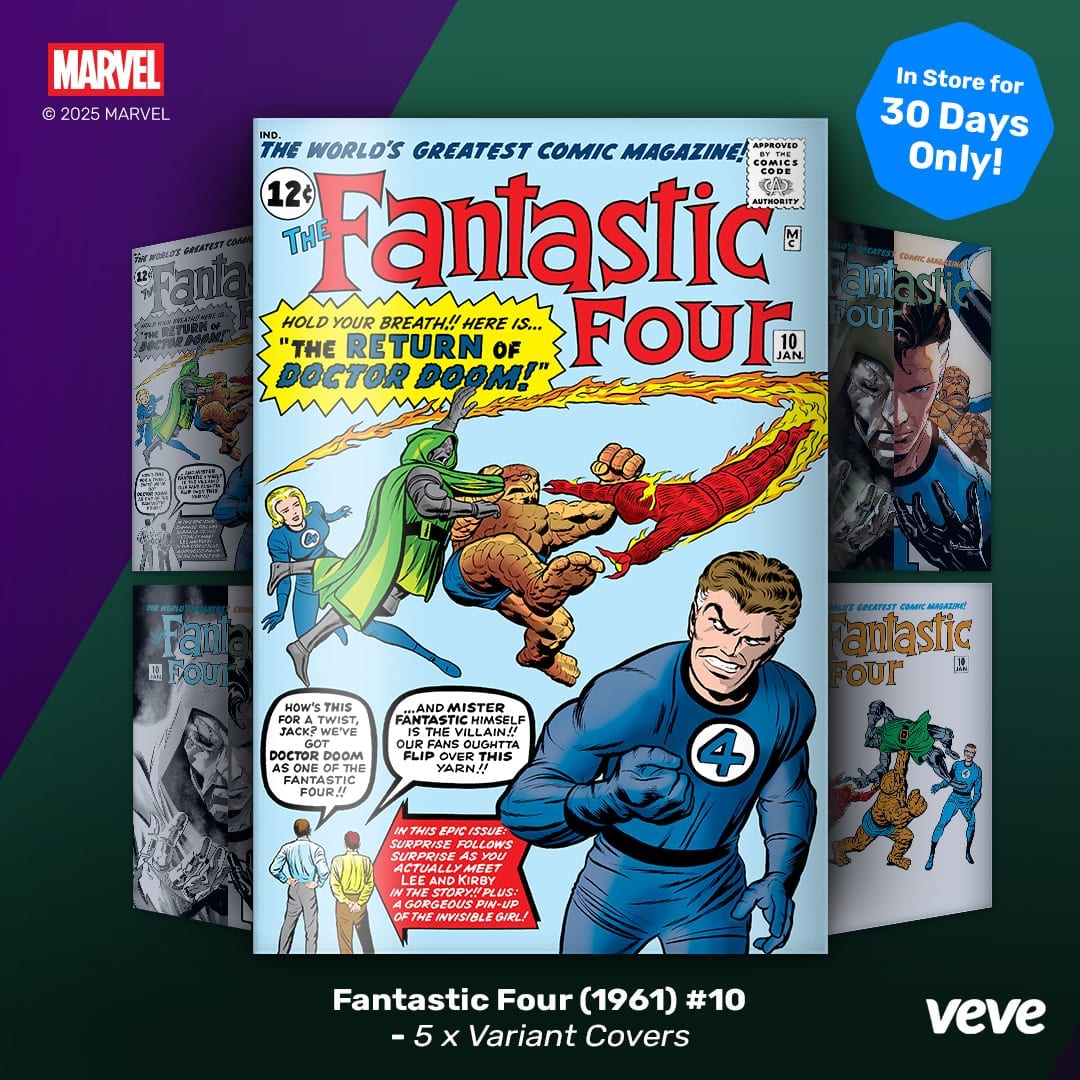
Number 3 is the issue where they get the costumes, the Fantasti-Car and the Baxter Building, which means the team as everyone pictures it is assembled there rather than in the first issue. Number 6 pairs Doctor Doom and Namor against the team, the first major villain team-up in Marvel’s new era. Numbers 7 and 9 push into the cosmic and the strange, with Namor returning in 9. Number 10 is the one where Lee and Kirby appear in the story as themselves, which was a running gag that also happened to tell readers exactly who was making the book.
Reading these in the app is a different experience from reading a reprint. The colour separation, the panel density, the ad-free pacing of the original page layouts, all of it survives, and the pages are genuinely built for the screen rather than photographed and shrunk. We covered how that works in the comics section, and if the underlying technology is unfamiliar, what a VeVe collectible is covers the ownership side.
There is a Human Torch figure in the Marvel lineup as well, which is the natural companion piece if you have read the run. Johnny Storm is the member who crosses over most: he is in Spider-Man’s orbit constantly, and his 1961 revival was itself a callback to the original android Human Torch from 1939. Browse the rest on the characters page.
Collecting Fantastic Four #1
New collectors get US$10 in free credit on VeVe with no card required. If you have never read a 1961 Marvel comic in its original form, that credit will get you further into this run than you expect.