Fantastic Four #10: the issue where Doom visits the Marvel offices
Fantastic Four #10, cover dated January 1963 by Stan Lee and Jack Kirby, put both creators into the story as characters working at their drawing boards when Doctor Doom walks into the Marvel offices. Doom then swaps minds with Reed Richards. VeVe carries a licensed digital edition of the issue.
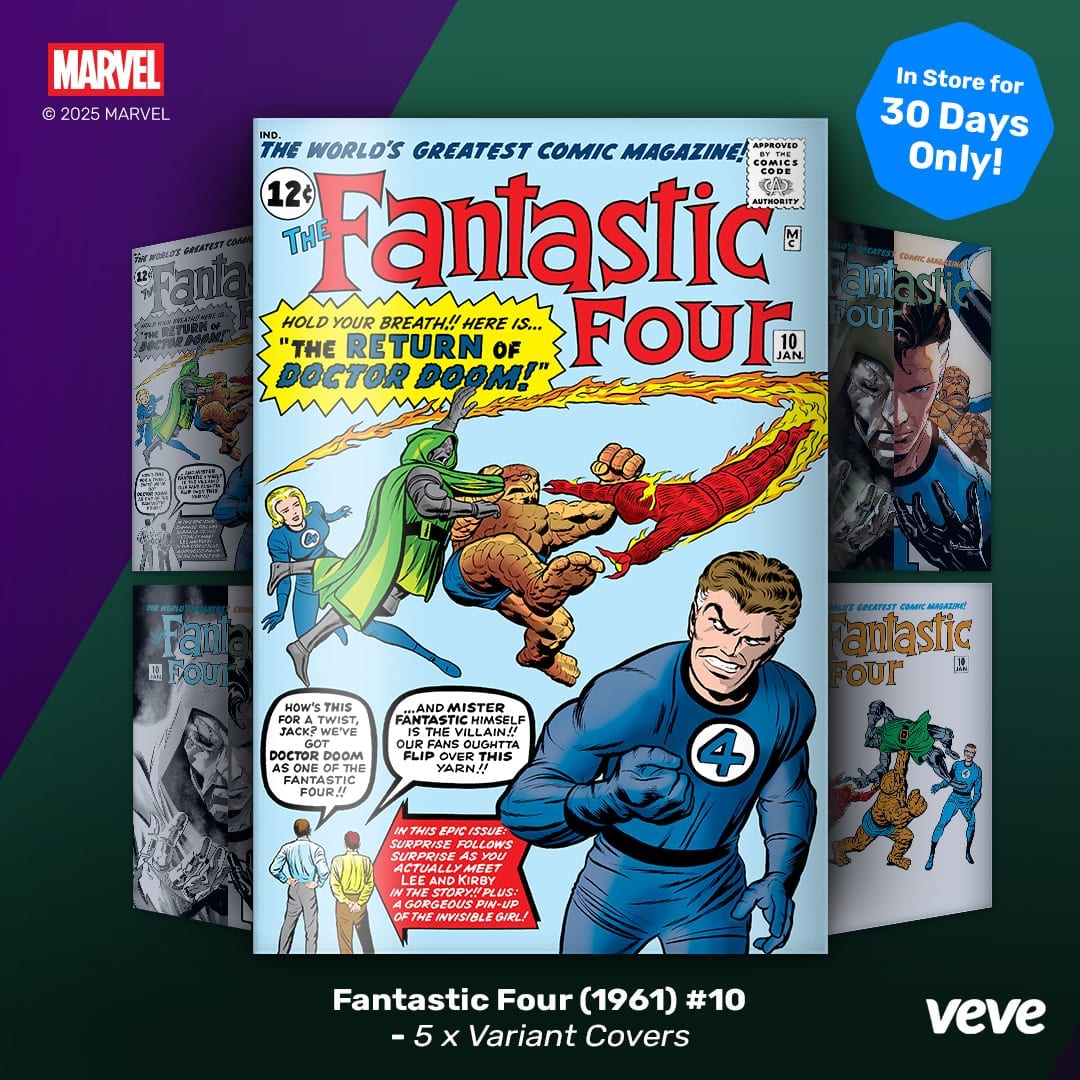
Doctor Doom walks into the Marvel Comics office and asks Stan Lee and Jack Kirby to arrange a meeting with Mister Fantastic. They are at their desks when he arrives. Kirby drew himself drawing, which is a strange thing to look at in a comic that also cost twelve cents and was aimed at children.
Cover dated January 1963. The cover itself puts Lee and Kirby in the picture. Nobody in mainstream American comics was doing this, and the people who would make a career of it were not born yet.
What actually happens in the issue
Doom survived being thrown into space at the end of issue six, which the book explains by way of an alien race called the Ovoids who picked him up, kept him alive, and taught him a mind-transfer technique. That technique is the plot. Doom uses the creators to get a message to Reed Richards, gets Reed alone, and swaps bodies with him.
So the back half of the issue is Doom wearing Reed’s face, giving the team orders, while Reed is stuck inside Doom’s armour trying to convince his own friends that he is not the man who has been trying to kill them since last summer. Ben Grimm punches him. Repeatedly. The resolution turns on the Thing knowing Reed well enough to notice that something is off, which is the sort of beat this book was already better at than anything else on the racks.
The mind-swap was not new even in 1963. What is new is the frame around it. The creators are in the story, they are characters, and they are treated by Doom as people who have access to the Fantastic Four because they publish the comic about them. The fiction eats its own production.
Twenty years before anyone called it meta-fiction
Comics got very interested in self-reference later. Animal Man in 1990, Sandman, the whole postmodern wave that treated the reader and the writer as objects inside the story. Grant Morrison walking into the last issue of Animal Man is the moment most people point at when they talk about the medium turning the camera on itself.
Fantastic Four #10 does a smaller version of the same trick in 1963 with no theory behind it at all. Lee and Kirby were not making a statement about narrative. They were doing a bit, and the bit worked because of the specific way that comic was being made.
Here is the thing to understand. Marvel in 1963 was eight titles a month produced by a tiny staff, and Lee could not write full scripts at that volume. So the company ran on what got called the Marvel Method: Lee gave Kirby a premise, sometimes a page of notes and sometimes a conversation, and Kirby went away and drew the entire issue. Pacing, staging, character design, plot beats, the lot. Lee then wrote dialogue onto the finished art.
Under that system the creators really were closer to inhabitants of the story than authors above it. Kirby was inventing characters at the board mid-issue. Lee was discovering what happened in a comic by reading the pages that came back. Drawing yourself into the thing is almost a documentary choice.
The voice that turned readers into members
The other half of what issue ten represents is the Marvel house voice, and that mattered commercially more than any single plot.
Marvel’s letters pages did not read like a corporate mailbox. They read like a conversation with two men who had names, desks and opinions. Readers wrote to Stan and Jack rather than to a publisher. Creators were credited on splash pages at a time when much of the industry still treated artists as interchangeable labour. Within a couple of years the company had a Bullpen page full of in-jokes and nicknames, and a fan club, the Merry Marvel Marching Society, that launched in 1964 and sold memberships to children who wanted to feel like staff.
That is the real engine. A kid reading Fantastic Four #1 in 1961 bought a comic. A kid reading issue ten in 1963 was a member of something, and members buy every issue. Marvel built the modern relationship between a franchise and its audience two years before it had a hit film division or a licensing arm, and everything that followed is built on top of that habit. We traced where it led in the licensing empire behind what we collect.
Doom knocking on the door of the office that publishes his comic is the joke version of that idea. The book is telling you there is no wall between the readers, the makers and the story.
The physical copies, and why so few are clean
Early Fantastic Four issues survive badly, and the reasons are structural rather than romantic.
- These were newsprint pamphlets on wire spinner racks, bought by children, read until the staples gave out.
- Unsold copies were never returned whole. Distributors stripped the covers for credit and destroyed the rest, so a share of every print run met the pulper instead of a reader.
- Nothing in 1963 suggested storing one carefully. Bags, boards and long boxes belong to the 1970s.
- The copies that lasted lasted because someone loved them, which is exactly the treatment that ruins a grade.
Issue five is the key of this run because Doom debuts there, and issue four carries Namor’s return. Issue ten sits well below both in the market and is more fun than either. Graded census counts for the top tiers across all of these books run in the low dozens, and when one surfaces at Heritage or ComicConnect the number it brings is mostly a statement about that census. The broader picture on what Silver Age books do at auction is in the most valuable comics ever sold.
What the licensed digital edition gives you
VeVe publishes officially licensed digital comics, and Fantastic Four #10 is in that line. The description is plain: a numbered copy of the complete issue, read page by page at full screen, with the edition number written to a public ledger so anybody can check which copy you hold and where it has been.
It is a genuinely good way to read this specific issue. The panels where Kirby draws his own drawing board are small, dense and full of detail that gets lost in a shrunken reprint, and at full screen you can read the labels on the things on his desk. The rest of the line is in our comics section, issue three covers where the team got its look, and why official licenses matter explains why the licensed part is doing real work.
The four people in the middle of it
The self-reference is the headline and it is not the reason the issue holds up. Underneath the gag there is a story about Ben Grimm being the only member of the team who can tell that his friend has been replaced, and about Reed Richards discovering how little his intellect is worth when nobody will listen to him.
Lee and Kirby could do the clever thing and the human thing on the same page without treating either as the point. That is why the Fantastic Four kept working long after the novelty of the format wore off. More on them at the Fantastic Four character page, or across the wider Marvel hub.