Fantastic Four #3: the costumes, the car and the Baxter Building
Fantastic Four #3, cover dated March 1962 by Stan Lee and Jack Kirby, gave the team their blue uniforms, the Fantasti-Car and the Baxter Building headquarters, with the Miracle Man as the villain. It is the issue where the Fantastic Four became the team most readers picture, and VeVe carries a licensed digital edition of it.
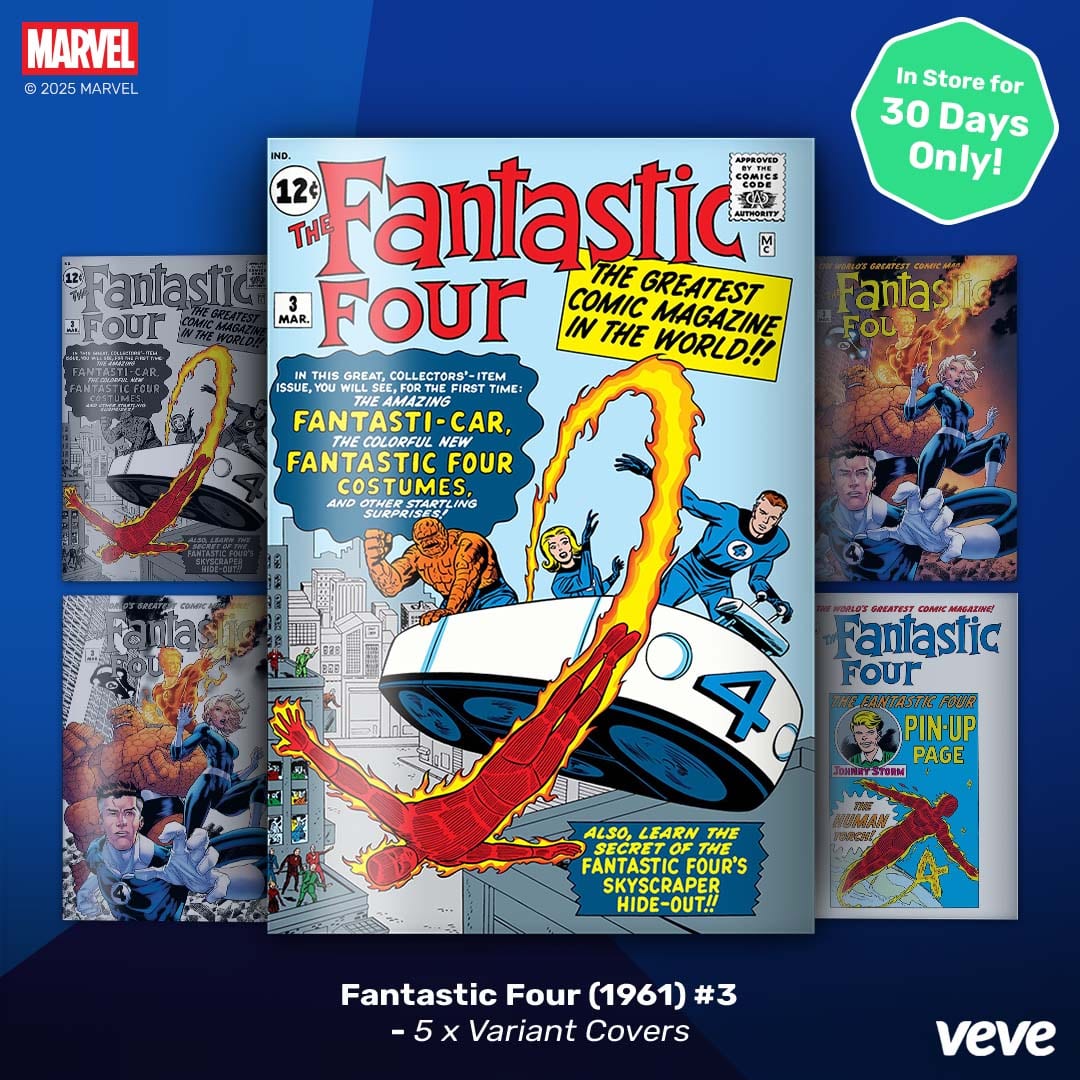
Sue Storm has the idea. Two issues in, the Fantastic Four had beaten a subterranean warlord and repelled a shape-shifting alien invasion while dressed in whatever they had on that morning, and it was starting to look ridiculous on the page. So in the third issue she tells the others they need uniforms. By the last page the team has blue outfits, a flying car and a rented floor near the top of a midtown office tower.
Cover dated March 1962, twelve cents, written by Stan Lee and drawn by Jack Kirby. The cover banner started calling the book the world’s greatest comic magazine around this point, which was a boast at the time and a description within four years.
The villain is a stage magician and he barely matters
The Miracle Man is a performer who invites the Fantastic Four to a show, makes an impossible display of power, and then goes on a rampage through New York. He animates a giant movie-prop monster from outside a cinema. He steals an army tank. Reed Richards works out that none of it is real: the man is a hypnotist, and the entire city has been looking at things that were never there.
As a villain he is thin. Kirby draws him well, the tank sequence moves, and Marvel never did much with him afterward for good reason. What matters in issue three is everything happening around the plot.
The team gets uniforms. Reed builds the Fantasti-Car, an open-topped flying vehicle that splits into four sections, and which readers nicknamed the flying bathtub almost immediately because it looks exactly like one. The Baxter Building gets named and occupied, upper floors of a real-feeling Manhattan office block where the elevator and the landlord are part of the setup. And in the last panels Johnny Storm loses his temper and quits the team, which sets up the following issue, where he finds an amnesiac drifter in a flophouse and restores the memory of Namor the Sub-Mariner.
Three of those four things are still load-bearing sixty years later.
Why the costumes were a bigger decision than they look
Superhero comics had costumes before 1962 and nobody thought twice about them. The Fantastic Four version is interesting for its reluctance. Ben Grimm hates his. The uniforms arrive as a practical concession rather than a transformation, and the book is candid that the team is doing it because the public expects it. That reads as a joke and it was also a fairly accurate description of what Marvel was doing to the book.
Fantastic Four #1 is the more important comic and the harder one to love. It is four people who are miserable about their situation, with a plot borrowed from the monster books Marvel had been publishing all decade. Issue three is where the series works out how to be a serial. Give the cast a look so they read at a glance. Give them a place to come back to, so stories can start somewhere other than a splash panel. Give them hardware. Give them a reason to argue that outlives any one issue.
That is a franchise, assembled by accident, three months in.
The Baxter Building deserves particular credit. Before it, superhero headquarters were secret and remote: caves, satellites, a mountain fortress. The Fantastic Four rent office space in the middle of the city and everyone knows it. Their neighbours complain. Reporters turn up. Marvel’s entire habit of setting its books in a New York with a street address traces back to this decision, and it is the single clearest separation between the Marvel of 1962 and everything on the racks next to it.
Eight titles a month
Here is the business context, because it explains the object you are holding.
In 1957 Martin Goodman’s Atlas line collapsed when its distributor, American News Company, exited the business. Goodman signed with Independent News, which was owned by the parent company of Marvel’s largest competitor, and the deal capped him at eight titles a month. Eight. The company that would produce the Fantastic Four, Spider-Man, Thor, the Hulk, Iron Man and the X-Men over the next five years did it under a distribution ceiling set by its rival.
That cap is why the early Marvel books are so densely packed. There was no room for filler and no room for a title to find its feet across a year. It also explains the cross-pollination: if you only have eight slots, every character has to visit every other character to keep the whole line alive. The Human Torch quitting at the end of issue three was not just a character beat. It was Marvel learning that a member of one book could go wander into another.
What survives from a 1962 spinner rack
The collecting reality for early Fantastic Four issues is the same as for every Silver Age book, and it is unkind.
These were newsprint pamphlets sold from wire spinner racks in drugstores and groceries. They were bought by children, read repeatedly, folded into back pockets, traded, and thrown out. Nothing about the object suggested keeping it. There were no bags, no boards, no supply of long boxes, and nobody had told anyone that a twelve-cent comic would be worth attention in sixty years.
What is worse for supply is the returns system. Unsold copies were not shipped back. Distributors stripped the covers off, returned the covers for credit, and destroyed the rest. A meaningful share of every print run was pulped before it ever met a reader, and the copies that survived survived because a kid liked them enough to keep them, which is the opposite of the condition you want.
So when a high grade early Fantastic Four issue reaches a Heritage or ComicConnect auction, the price is a function of three things stacked on each other: how many were printed, how few came home, and how many of those were treated well by an eleven-year-old. Graded census counts for these books in the top tiers run in the low dozens. The wider story of what those numbers do at auction is in our roundup of the most valuable comics ever sold.
What the licensed digital edition is
VeVe publishes officially licensed digital comics, and Fantastic Four #3 is one of them. The practical description is simple enough: it is a numbered edition of the full issue, read page by page at full screen in the app, with your edition number recorded publicly on chain so anyone can check which copy you hold. You are not buying a file that sits in a folder. You are holding a specific numbered copy of a licensed edition, and the record of that is readable by anyone who wants to look.
The reading experience is the part people underrate. Kirby’s 1962 page layouts were built for a small format with heavy panel density, and on a phone screen at full brightness the colour separation and linework hold up far better than most reprints on glossy paper. Our comics section covers the rest of the licensed line, and how to read digital comics on VeVe walks through the app side if you have never opened one.
Start a free VeVe account. New collectors get US$10 in credit toward a first piece, no card required. Details on that are on our free credit page.
The part that lasted
Strip out the uniforms and the vehicle and the office lease, and what makes issue three work is still Ben Grimm being furious. He hates the costume. He hates being looked at. He goes along with it because the others want him to, and Kirby draws the resignation in his shoulders better than any dialogue could carry it.
That is the thing the Fantastic Four have that no other team has. They are not colleagues. Sixty years of writers have rebuilt the book a dozen times, and the version that works is always the one where four people who are stuck with each other put on matching clothes and go to work. Read more about them on the Fantastic Four character page, or see where the rest of the Marvel line sits.