Amazing Spider-Man #316 and McFarlane's second Venom cover
Amazing Spider-Man #316, written by David Michelinie and drawn by Todd McFarlane, brings Venom back into Peter Parker's life after issue #300 first gave the symbiote its name and face. VeVe's licensed digital edition of the issue dropped Thursday 17 September at 8AM PT for $6.99, limited to 1,000 editions.
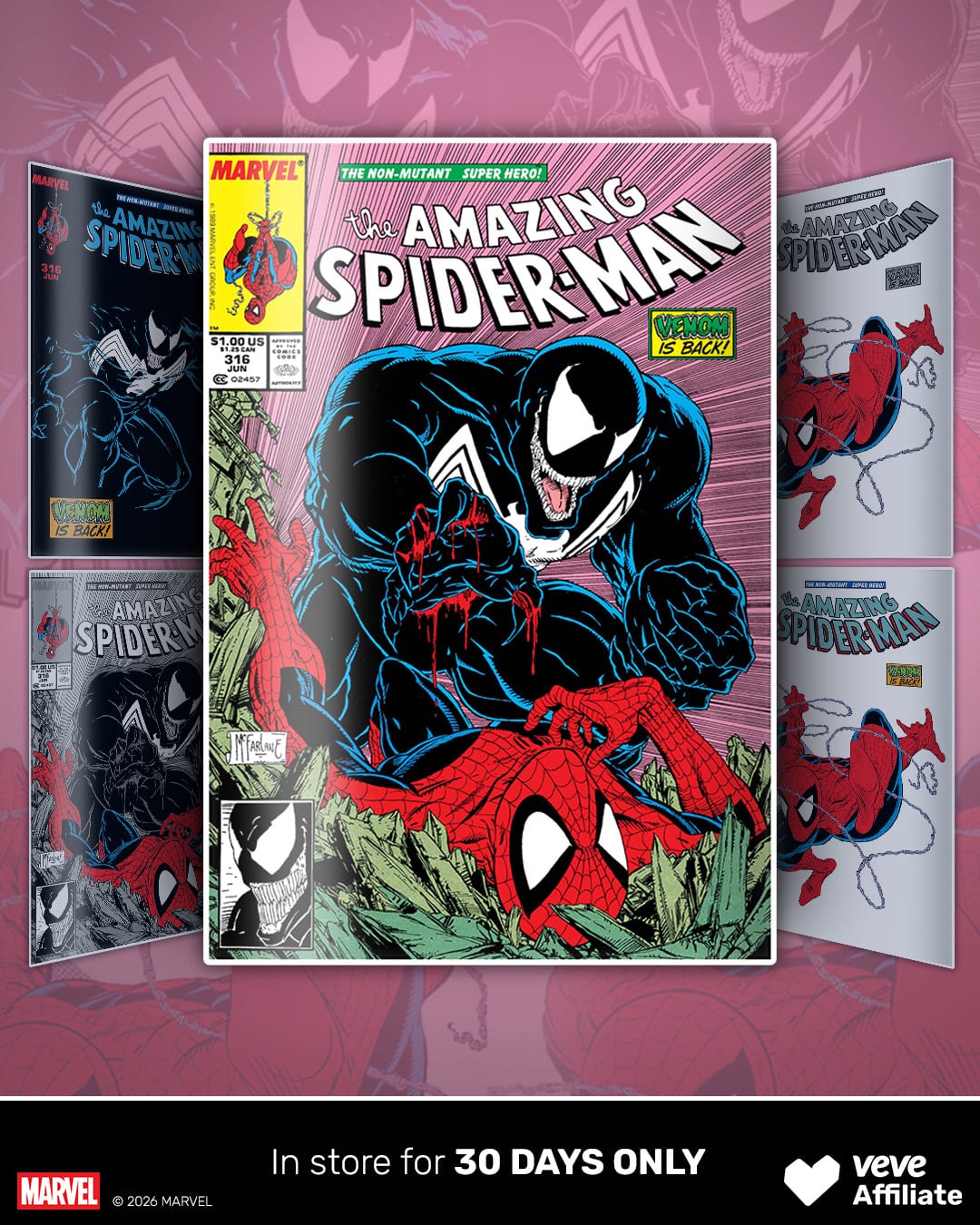
Venom does not sneak back into Amazing Spider-Man #316. He arrives the way McFarlane always drew him, taking up more of the page than the hero does, teeth first.
A rematch nobody asked Peter to want
Michelinie and McFarlane had already spent issue #300 giving Eddie Brock a motive and a shape. Number 316 is the sequel nobody could avoid writing, because a villain built entirely around hating one specific man does not stay away once he has found him again. The book puts Brock and the symbiote back on a collision course with Spider-Man, and it does it without wasting pages re-explaining who Venom is. By this point Marvel knew readers already had the origin memorized.
McFarlane’s cover, one more time
The cover is the reason this issue gets talked about on its own rather than folded into “the Venom saga” as a footnote. McFarlane draws the symbiote’s face crowding in from the edges again, the same trick that made #300 instantly recognizable on a spinner rack, but tighter and meaner the second time. Spider-Man is small in the frame. Venom is the frame. It is a cover built to be picked out from across a comic shop, and it worked exactly that way in 1989.
The pencil style that trained a generation of artists
By 1989 McFarlane’s Spider-Man had already stopped looking like anyone else’s Spider-Man. The crouch is lower, the eye lenses are bigger, the webbing is hand-inked rather than the tidy dotted convention older books used. Issue #316 is McFarlane late in his Amazing Spider-Man run, close to the point where he would leave for his own Spider-Man #1 and then help found Image Comics. The confidence in his linework here shows exactly why publishers were about to let him do whatever he wanted.
Why the second Venom cover still gets collected
Origin issues get the historical weight. Follow-up issues like #316 get collected because the character had already proven he sold, and McFarlane knew precisely how to draw a cover that sold him again. It sits in a run of Spider-Man issues from the late 1980s that collectors treat as a connected block rather than a single key, alongside the black suit’s original debut in #252 and the naming of Venom itself in #300.
The licensed digital edition
VeVe’s edition of Amazing Spider-Man #316 dropped Thursday 17 September at 8AM PT, priced at $6.99 as a blind box, limited to 1,000 total editions and available for 30 days through the VeVe Store. The five rarity tiers ran Common, Uncommon, Rare, Ultra Rare, and Secret Rare, each carrying its own cover variant, with edition numbers recorded publicly as they were claimed. Reading it in the app means McFarlane’s linework at full screen size, page by page, which a 1989 newsstand copy never offered.
That is worth understanding on its own terms rather than as a stand-in for a physical collection. A licensed digital edition is a numbered copy of an officially authorized release, tracked the same way regardless of how many hands it passes through, and the rarity tier system is what determines how scarce any given cover actually is.
Start where the story does
If issue #316 sends you looking for where the whole thing began, start a free VeVe account and browse the Marvel comics catalog. New collectors get US$10 in credit toward a first piece, no card required, detailed on the free credit page.
Reading the saga in order
Collectors who come to #316 cold usually end up wanting the surrounding issues too, and that instinct is worth following. The full arc runs from the black suit’s quiet debut in #252 through the naming and origin in #300 and into the direct sequel here, and reading them in that order shows how deliberately Marvel built toward a villain rather than inventing one overnight. It is a rare case of a comics company treating a costume change as a long game instead of a one-off gimmick, and #316 is the payoff for readers who noticed the setup.
The rematch that proved the character
Villains rarely survive their debut story. Venom did, and #316 is the issue that confirmed it was not a fluke. McFarlane got to draw the symbiote a second time knowing exactly how much room it deserved on the page, and he gave it all of it.