Star Trek on VeVe and the fandom that invented the convention
Star Trek first aired on NBC in September 1966 and was cancelled after three seasons, then rebuilt itself through syndication and an unusually organised fandom. Its props and filming models became one of the earliest serious screen-collecting categories, and VeVe carries a licensed Star Trek Discovery line under the CBS Studios rights.
NBC cancelled it. That is the fact every other fact about Star Trek collecting hangs off. The show went on air on 8 September 1966, ran 79 episodes, lost money, annoyed its network and finished in June 1969 with a third season the audience had already had to fight for once.
Then it went into syndication, played five nights a week in every market in America through the early 1970s, and quietly became the most valuable property the studio owned. Almost nothing in the history of collecting starts from a position that unpromising.
The letters came first
In 1967 the show was heading for cancellation after two seasons. Bjo and John Trimble, two fans from Los Angeles, organised a letter-writing campaign that produced enough mail to get a third season commissioned. It did not save the show for good, but it did something more consequential: it proved to a group of people, most of whom had never met, that they were a group of people.
Five years later the same instinct produced a convention. The January 1972 event in New York was planned by a small committee who expected a few hundred attendees, hired a hotel accordingly, and were met by something in the region of three thousand. The organisers ran out of everything. Every media convention that has happened since is downstream of that weekend, including the ones that now fill halls in Anaheim and London.
The point for a collector is that the infrastructure came early. Dealer tables, fanzines, a trading culture, people who knew what a genuine piece looked like and argued about it in print. That is decades ahead of most licensed properties, and it is the reason Star Trek material has documentation that other 1960s television simply does not. The wider version of this story is in our history of collecting.
Ships, not people
Star Trek collecting has always leaned on hardware, and the reason is that the ships were the best designed thing on the show. Matt Jefferies drew the Enterprise as a deliberate rejection of rockets and fins, and the result was a shape that reads correctly from any angle, which is a hard thing to do.
AMT put out a plastic Enterprise kit in 1966, while the show was still struggling in the ratings, and it stayed in production for decades. Generations of people built one badly, painted it worse, and hung it from a bedroom ceiling on fishing line. That kit did more for the show’s survival than most of the third season.
The serious market arrived later. Christie’s held a dedicated Star Trek sale in New York in October 2006, timed to the fortieth anniversary, which brought in roughly 7.1 million dollars across the auction. The filming model of the Enterprise-D from The Next Generation sold for 576,000 dollars. Costumes, set pieces and props went for figures that surprised the people who had described the whole thing as a television show for teenagers.
The original eleven-foot filming model of the Enterprise is not in private hands at all. It sits in the Smithsonian National Air and Space Museum, restored and back on display since 2016, which is the clearest statement anyone has made about where the object belongs.
None of that history is a prediction about anything. It is documented fact about a physical market, and it matters here because it explains why ship models are the centre of gravity in this franchise and not a side category. If you want the general argument for hardware over characters, we made it in why a vehicle anchors a collection.
Discovery, and a franchise that kept building
Star Trek has produced thirteen feature films and a long run of series since The Motion Picture opened in 1979. Discovery premiered on 24 September 2017 as the show that restarted the television side after a twelve-year gap, ran five seasons, and finished in 2024.
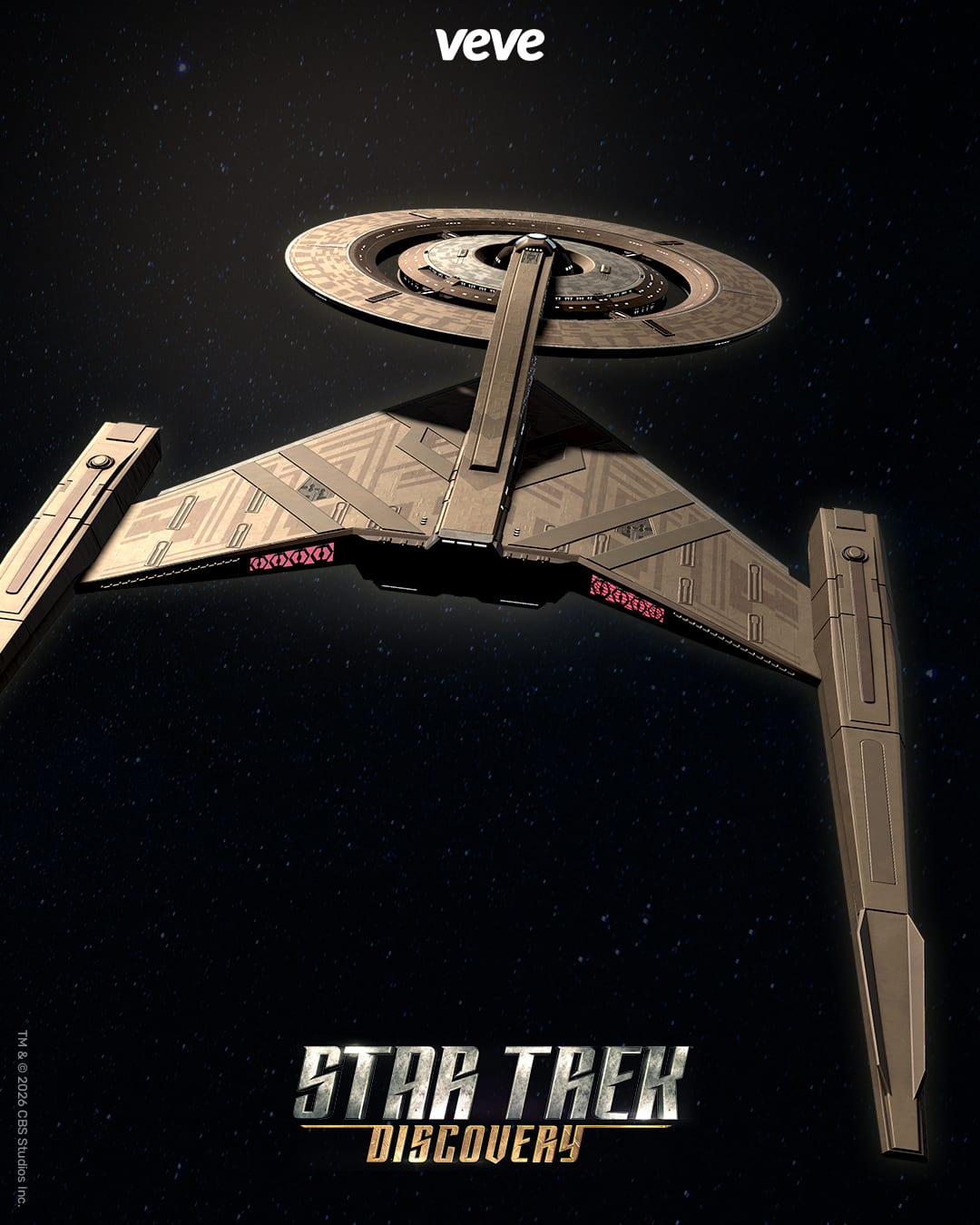
It also did something specific that matters to anyone who collects ships. Discovery redesigned almost everything. Starfleet vessels, Klingon vessels, Romulan vessels, all rebuilt with modern effects work rather than with 1960s plywood constraints. Fans argued about it, loudly, for years. Whatever you think of the choices, the result is a set of designs built to be rendered in three dimensions at high resolution, because that is how they were made in the first place.
That is a useful difference. A model of the original Enterprise is a model of a physical object that somebody hand-built in a workshop in 1965. A Discovery-era ship was born as geometry. Rendering it faithfully is a different kind of job.
The licensed line, and what the rights actually mean
The Star Trek pieces on VeVe are released under CBS Studios, which sits inside Paramount Global and holds the franchise rights. Look at the corner of the release art and you will find the notice spelled out. That is not decoration. It is the thing that separates a licensed release from a fan render.
The rights holders have spent sixty years defending this property, and the approval process for a Star Trek ship covers hull markings, registry numbers, proportions and details that a casual viewer would never check but a fan absolutely will. Getting a Klingon hull wrong is the sort of error that gets found within about four minutes of a drop going live. We laid out why that process is worth caring about in why official licences matter.
The Star Trek Discovery hub collects what has come through, including a Romulan Bird of Prey, and the broader Star Trek franchise page is the place to start if you are new to the line.
A ship is a good digital object for a practical reason as well. Physical starship models are awkward things to own. They are large, fragile, need a stand, collect dust in every seam, and any display of more than three of them starts to look like a hobby shop. A rendered ship can be turned, lit from any angle and placed in a room at whatever scale the room can take, which is a freedom the physical version never had. Our notes on displaying digital collectibles get into how to use that, and the same reasoning shows up in what makes an action figure valuable from the other direction.
Start a free VeVe account if you want to look through the Star Trek shelves yourself. New collectors get US$10 in credit toward a first piece, no card required, and the free credit page explains the mechanics.
What the Trimbles did in 1967 was not fan service and it was not nostalgia. The show had been on air for two years. They were arguing for something that existed in the present tense, and the thing they were arguing for has since outlived its network, its creator, most of its original cast and several corporate parents. Whatever else Star Trek collecting is about, it is about a group of people who worked out earlier than anyone else that if you want a thing to survive, you have to organise.