Running Mon and the case for the indie drop
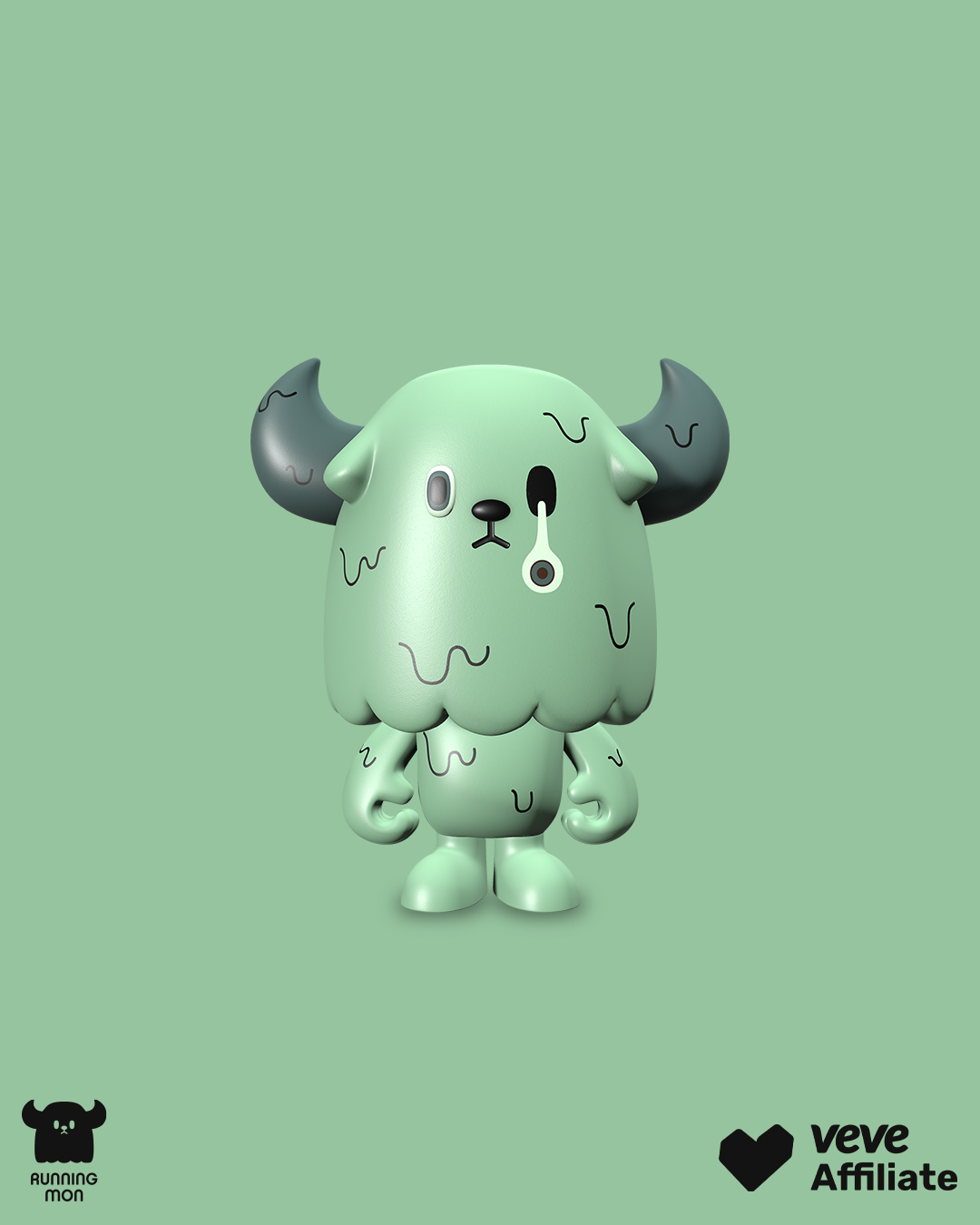
Running Mon is an independent character line on VeVe rather than a studio-licensed property. Series 2 includes Frankenstein Mon, Jeoseung Saja Mon, Jiangshi Mon, Nightshade Cheshire, Skeleton Mon and Slime Mon, drawing on Korean, Chinese, Victorian and video game folklore.
The Jeoseung Saja does not carry a scythe. He carries a list. That one detail separates the Korean messenger of the afterlife from the hooded skeleton most Western readers picture when somebody says grim reaper, and it is the kind of thing a character line either knows or does not.
Running Mon knows. That is most of why the line is worth a look.
What this actually is, stated plainly
Running Mon is a small independent character line on VeVe. It is not a studio property. There is no film behind it, no publisher, no forty-year back catalogue, no licensing department signing off on each design. It sits in the catalogue next to Marvel, Star Wars and Disney material, which is an odd neighbourhood for an indie line and is precisely the interesting part.
I am also not going to invent a biography for whoever draws these. I do not have one I can stand behind, and a profile built on guesswork about a person is worse than no profile at all. The work is legible on its own, so let us talk about the work.
Series 2, and what each one is drawing from
The second series runs six characters: Frankenstein Mon, Jeoseung Saja Mon, Jiangshi Mon, Nightshade Cheshire, Skeleton Mon and Slime Mon. Read as a set, it is a folklore tour that does not stay in one hemisphere.
Start with the Korean one, because it is the most specific. The Jeoseung Saja is a messenger of the afterlife whose job is to collect the dead and escort them to Jeoseung, and he is traditionally shown as a pale-faced man in a black gat, the wide-brimmed horsehair hat of the Joseon era, with black robes to match. He is not a monster. He is a civil servant with a register of names, and if your name is on it he is polite and unavoidable. Korean television has been reworking that image for years, most famously in the 2016 drama Guardian: The Lonely and Great God, and the silhouette is now recognisable across East Asia on sight.
Jiangshi Mon comes out of Chinese folklore, and the name translates roughly as stiff corpse. A jiangshi is a reanimated body locked in rigor mortis, which is why it moves by hopping with its arms held straight out in front of it. The standard look is Qing dynasty official’s robes and cap with a yellow Taoist talisman stuck to the forehead, the paper strip that controls the thing. Hong Kong cinema turned it into a genre in the 1980s, with Mr. Vampire in 1985 as the anchor, and the hopping posture has been shorthand ever since.
Lewis Carroll supplies the next one. The Cheshire Cat arrives in chapter six of Alice’s Adventures in Wonderland in 1865, and John Tenniel’s illustration of a grin that stays behind after the cat has gone is one of the most durable images in English children’s literature. Nightshade is the plant, deadly nightshade, purple-black berries and a long career as a poison. Pairing a vanishing cat with something toxic is a fair reading of a character whose defining quality is unsettling cheerfulness.
Frankenstein Mon is really two sources wearing one coat. Mary Shelley published Frankenstein in 1818 and her creature is articulate, self-taught and quotes Milton. The flat head, the heavy brow and the neck bolts come from somewhere else entirely: Jack Pierce’s makeup design for Boris Karloff in Universal’s 1931 film. Almost every Frankenstein-inspired design since has been quoting Pierce rather than Shelley, and this one is no exception.
The skeleton belongs to the calavera tradition, the skeleton as costume rather than as horror, running from medieval danse macabre imagery through to Jose Guadalupe Posada’s etchings in early twentieth-century Mexico. It is the one design that works in every culture, because it is what everybody has underneath.
Then there is the slime, which is the outlier and the joke. The slime is the entry-level enemy of Japanese role-playing games, standardised by Dragon Quest in 1986 with a design by Akira Toriyama, and it has meant the first fight in the first dungeon for forty years. Putting it in a folklore set is a small wink at where the last two generations actually learned their monsters.
An independent line on a licensed platform is genuinely unusual
Most platforms that hold big entertainment licences carry only big entertainment licences. The economics push that way. A studio deal requires legal work, approvals and minimum commitments, and once a platform has built that machinery, pointing it at a solo artist is a lot of overhead for a much smaller release.
So when a licensed platform also carries independent creators, it is doing something that costs it something. VeVe’s art-led and creator-led strand is where those releases live, alongside the designer toy collaborations and one-off art pieces, and Running Mon is one of the clearest examples of it.
The parallel is the art toy world, where the whole movement was built on artists who owned their own characters and produced in short runs without a studio anywhere in sight. That history is the right frame for reading an indie line, not the comics one. Nobody asks which issue a Bearbrick first appeared in.
Why take a small line seriously
A few honest reasons, and none of them are about what the piece does later.
- The design constraints are tighter. Six characters is a set you can actually hold in your head, unlike a franchise with four hundred pieces and no end.
- Nobody had to approve it. An indie character can be strange in ways a licensed one cannot, because there is no brand guideline saying the cat has to be friendly.
- The folklore is real research. Getting the gat right on a Jeoseung Saja or the talisman right on a jiangshi means somebody looked it up.
- A themed set holds together. If you are building a collection around a theme rather than a franchise, a folklore line is a natural spine.
The mechanics are the same as anything else in the app. Each piece is a numbered edition, the edition number is recorded against your account, and the rarity tiers work the way they do across the rest of the catalogue. The Running Mon hub has what is in the line.
What an indie release will never have is the thing that makes a grail in the traditional sense, which is a decade of shared history and a few million people who already care. That is fine. Not everything on a shelf needs to be a landmark, and a shelf made entirely of landmarks is exhausting to look at.
The reason to know what a jiangshi is before you look at Jiangshi Mon is the same reason it helps to know what a Kirby crackle is before you look at a Kirby page. The design is an argument about a source. You can only see whether it lands if you know what it is arguing with.