Doodles and the Mondrian collaboration explained
Doodles is a web3-native art brand launched in October 2021 by illustrator Scott Martin, who works as Burnt Toast, with Evan Keast and Jordan Castro. Its collaboration with the estate-managed legacy of Piet Mondrian pairs Burnt Toast's pastel character style with the Dutch painter's primary-colour grid, a visual language that entered the public domain in most of the world after 2015.
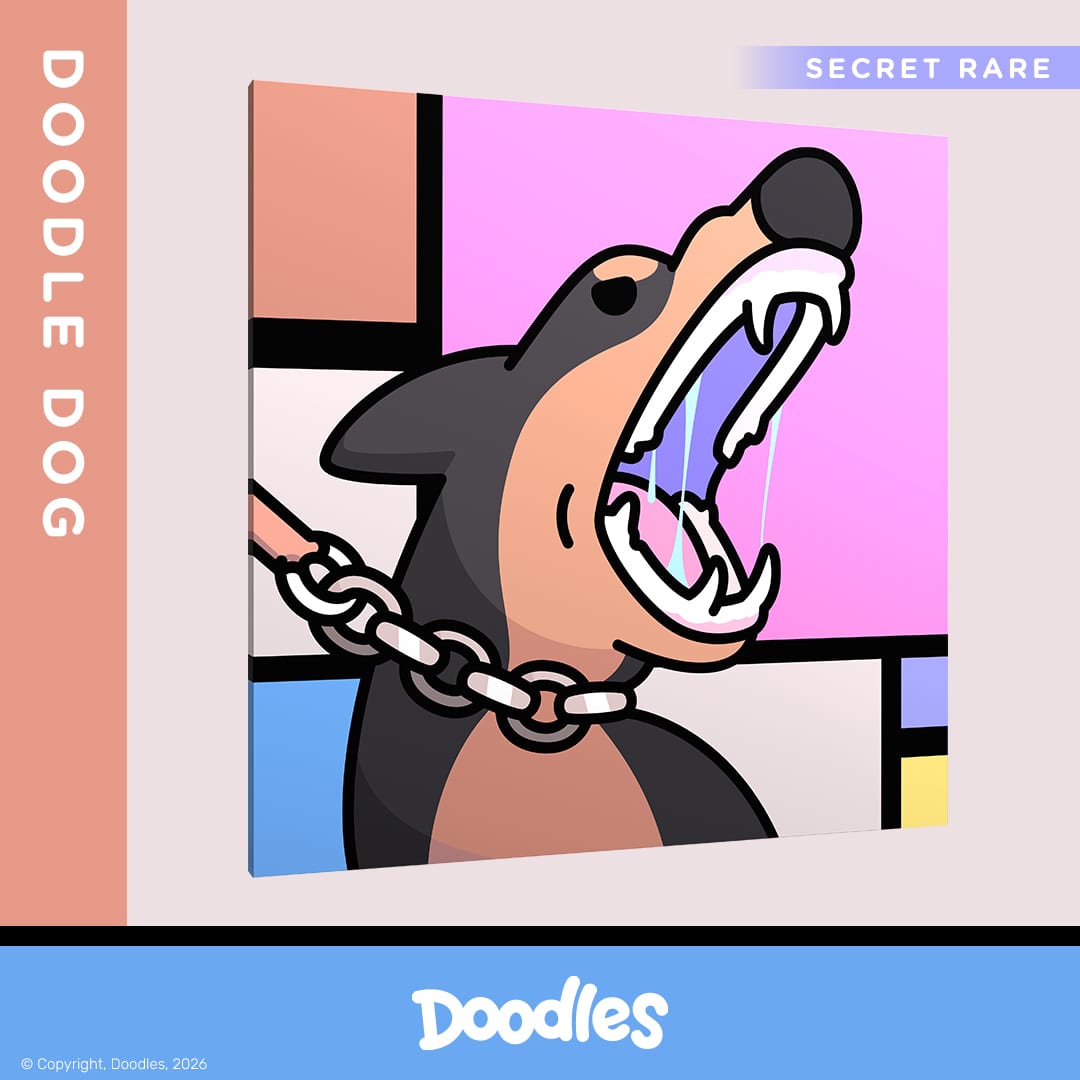
Piet Mondrian died in a New York apartment in February 1944, halfway through a painting he never finished. Seventy-seven years later a Canadian illustrator who signs his work Burnt Toast put out ten thousand pastel cartoon characters on a blockchain. Those two facts have ended up in the same sentence, and the collaboration that came out of it is more coherent than the pitch makes it sound.
It takes a minute to explain why. Worth the minute.
What Doodles actually is
Doodles launched in October 2021: a set of 10,000 illustrated characters, each assembled from a pool of traits, put out by three people. Scott Martin is the artist, working under the name Burnt Toast. Evan Keast and Jordan Castro handled the rest, both of them coming out of the CryptoKitties world, which is the closest thing the space has to a founding generation.
The art is the reason the thing stuck. Burnt Toast’s style is a specific, disciplined look: soft rounded shapes, thick uniform outlines, a pastel palette that stays deliberately narrow, faces built from about four marks. Nothing in it is fussy. Put a Doodles character next to a hundred other cartoon avatars and you will pick it out on shape alone, which is a harder trick than it sounds and the only trick that really matters for a character brand.
The project raised outside venture funding in 2022, brought in a chief executive from the music industry, and moved into music, animation and live events. Pharrell Williams took a brand role in 2023. That trajectory is unusual. Most internet art projects from 2021 are either gone or coasting.
A web3-native art brand versus a licensed studio property
Here is the distinction that makes the rest of this legible, and it is worth understanding in general because it explains half of what shows up in digital collecting.
A licensed property comes from somewhere else. Marvel, Disney and Lucasfilm own characters that were built in comics or on film across decades, and a digital collectibles platform pays for permission to make a piece of that character. The story, the design and the audience all predate the collectible. Our piece on why official licences matter covers what that permission actually buys.
A web3-native brand runs the other way. The collectible is the original artefact. There is no film the character is from, no back issue where it first appeared, no studio that owns it. The art was made for this context first and any cartoon, song or toy comes afterwards. That is closer to how designer toys worked from the late 1990s onward, where the figure was the primary work rather than the merchandise, and the artist owned it outright. The art toy lineage is genuinely the right comparison, more so than anything from comics.
Neither model is better. They fail differently. A licensed property comes with a guaranteed audience and no creative freedom. A native brand has total freedom and has to build the audience from zero. Doodles built one.
Mondrian, and why a 1920s painter is available for this at all
Piet Mondrian was born in the Netherlands in 1872 and spent the first twenty years of his working life painting landscapes, windmills and trees. The trees are the hinge. Across a run of canvases starting around 1908 he pared a single tree down further and further, branches becoming lines, until what was left was an arrangement rather than a picture.
In 1917 he was part of founding De Stijl, a Dutch movement and a journal, with Theo van Doesburg. Mondrian called his own version Neoplasticism, and the rules he set for it were severe: straight lines at right angles only, a white or grey ground, black dividing lines, and colour restricted to red, blue and yellow. No curves, no diagonals, no green. He held to it for twenty-five years, loosening only near the end, when he got to New York and the grid started swinging. Broadway Boogie Woogie, painted in 1942 and 1943, is a Mondrian grid with the traffic put back in.
The reason a partnership around that visual language is possible in 2026 is legal rather than artistic. Mondrian died on 1 February 1944. In most of the world copyright runs for the life of the artist plus seventy years, which put his paintings out of copyright from 2015 onward. That is why the grid has been on dresses, mugs, album covers and shop fronts for decades and why Yves Saint Laurent could build a whole 1965 collection of cocktail dresses out of it in the first place. The name is managed carefully by the estate; the pictures themselves belong to everybody.
Why the pairing works better than it reads
Both of these things are systems, not pictures.
Mondrian did not compose a painting the way a landscape painter composes one. He set a fixed vocabulary of elements and then recombined them until the balance was right. Every canvas is the same handful of components in a different arrangement. That is the entire method.
A generative character set does the same thing from the other direction. You define a set of traits, a set of palettes, a set of shapes, and you produce ten thousand arrangements from them. The individual character is a permutation of a constrained system. So is the individual Mondrian.
Put those together and the collaboration is not a cartoon wearing a famous painting as a costume. It is two constraint systems sharing a grid, and the palette does most of the joining work, because Burnt Toast’s pastels and Mondrian’s primaries are both deliberately short lists. The one place it could have gone wrong is scale. Mondrian’s compositions collapse if you crowd them, and a character sitting inside the grid has to occupy a cell rather than float on top of it.
A few things worth noticing when you look at the art:
- Whether the black lines stay true right angles, or bend to accommodate the character
- Whether the colour blocks stick to red, blue and yellow, or borrow from the pastel range
- Whether the character sits in the composition or on it
What a collector gets out of an art-led release
This is the part where a lot of writing about digital collecting goes wrong, so let me be plain: the interesting thing here is not what the piece does later. It is what it is.
An art-led release gives you an object whose appeal is the design work, not the fame of the character. That changes how you collect. You are not completing a roster or chasing a first appearance. You are picking work you want to look at, which is how people have collected prints and posters and designer toys for a very long time. VeVe’s creator-led and art-led strand is where most of that sits.
The mechanics are the same as anything else on the platform. Each piece is a numbered edition with the number recorded against your account, and if you are new to how any of that works, what VeVe is covers the platform, what digital collectibles are covers the basics and the glossary covers the vocabulary.
Mondrian spent a quarter of a century proving that you could make an enormous amount out of three colours and a right angle. A brand founded seventy-seven years after his death runs on roughly the same bet. Whether a pastel cartoon earns a place inside that grid is a question you can answer by looking, which is the only way anyone has ever answered it.