What to do with a drop that has no franchise behind it
A single-piece release has no franchise, no back catalogue and often very little public information about its creator. You evaluate it on the artwork itself, on what the platform's own listing states, and on nothing else, which is a genuinely different skill from collecting a licensed character line.
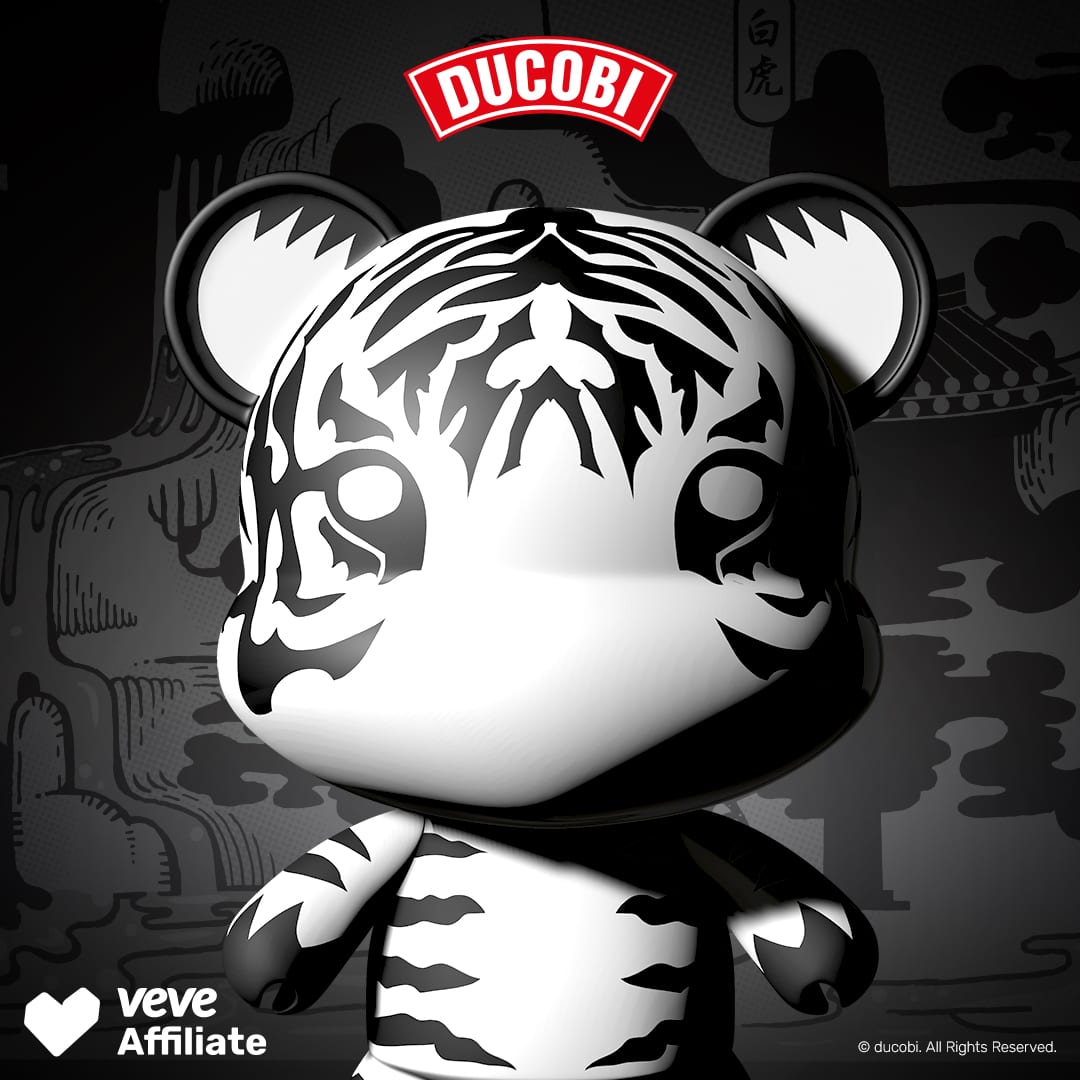
Here is everything I can tell you for certain about this one. The VeVe creative feed carries a single entry called “Ducobi - Tiger”. The artwork is signed with a copyright notice reading “ducobi”. That is the extent of what I have verified, and I am not going to pad it out with a biography I made up.
Which turns out to be a useful place to start, because a release with nothing behind it is a category of its own, and most collectors have no practised way of handling one.
What the piece actually is
The art is worth describing properly, because it is the only thing here that is fully knowable.
The figure is monochrome. Black and white, no colour anywhere except a small red banner carrying the wordmark. The body is a rounded vinyl-toy silhouette with a large head and small round ears, the standard platform shape that has been running through the designer toy world since the early 2000s. Over that shape sit tiger markings, drawn as flat black cut-outs rather than painted fur, and they are the best thing about the piece. The stripes across the brow are worked into something close to a symmetrical pattern, more woodblock print than animal.
The background is a dark, stylised scene of rock forms and cloud shapes with what looks like architecture behind them, kept almost to silhouette so the figure stays forward. In the upper corner there is a small cartouche holding two characters that read as “white tiger”, which in Chinese cosmology is one of the four directional guardians rather than just an animal.
That is a lot of deliberate decision-making for one figure. Whatever else is unknown, somebody made specific choices about palette, pattern and framing, and those choices hold together.
The form of a single-piece release
Most of what a licensing platform carries arrives as a line. A character has films behind it, a publication history, a hub page, other characters it belongs next to. You are never really evaluating one object, you are deciding where an object goes in a structure you already understand.
A one-off does none of that work for you. It arrives, it is complete, and there is no second piece coming to give it context. Independent and artist-led drops behave this way often, which is why we wrote about them separately in the indie artist drop and in the broader artworks and creator programme piece.
The mistake people make is treating this as a smaller version of franchise collecting. It is a different activity. In franchise collecting most of your judgement is about fit. In single-piece collecting all of your judgement is about the object, because there is nothing else in the frame.
Not knowing is a condition, not a signal
This is the part worth being blunt about. When information is scarce, collectors tend to fill the gap themselves, and the stories they fill it with are usually flattering. A quiet release becomes an undiscovered artist. A short name with no search results becomes a mystery. That is a story the collector wrote, not a fact about the piece.
The honest version is duller and more useful. Scarcity of information means one thing: you have less to go on. It does not mean the thing is rare, important, overlooked or anything else, and it is not a statement about what a piece is worth. I am not making one of those, and neither should the voice in your head.
What it does change is where your attention should go. With a licensed character you can lean on forty years of published material. Here you cannot lean on anything, so you look at the work.
Reading a piece on the art alone
A few questions that actually help, in the order I use them:
- Does it read at thumbnail size? Good design survives being small. If the piece turns to mush at the size of an app tile, that is a real limitation, not a matter of taste.
- Does it survive rotation? A digital collectible is a three-dimensional object you can turn. Illustration that was composed for one flat angle often falls apart at forty-five degrees.
- Is the palette a decision? Monochrome, two-colour and heavily limited palettes are usually the sign of someone who chose. Full-spectrum renders are more often the sign of someone who did not.
- Is the detail structural or decorative? Markings that follow the form of the body are drawing. Markings sprayed over the top are texture.
- Would you still like it with a different name on it? This is the one that catches people. Take the wordmark off and ask again.
None of that requires knowing who made something. It is the same eye you would use standing at a table at a toy fair, which is where this whole tradition comes from. The lineage runs through the art toys and designer collectibles guide, and the platform-toy silhouette on this figure is a direct descendant of it.
What a licensed platform carrying a one-off tells you
A platform that has cleared Marvel and Star Wars approvals is running a machine built for very large rights holders. Contracts, brand guidelines, review cycles, the lot. Putting a single art piece through that same machine is not the obvious use of it.
It does mean the piece has been through the platform’s own process rather than appearing from nowhere, and that the ownership record works exactly as it does for a licensed character, which is the whole subject of how blockchain provenance works. The parts of a release that are documented stay documented whether or not the artist has a Wikipedia entry.
So the practical advice is narrow. Read the listing in the app, because it is the authority on what a given release includes and where it sits in the rarity tiers. Understand what the mint number on your copy does and does not mean. Then go back to looking at the artwork, because that is the part nobody else can do for you.
Collectors talk a lot about grails, and the anatomy of a grail usually turns out to involve a character everyone already loves. A one-off cannot get there that way. It has to work on being good, which is both a harder test and a cleaner one.
There is something I like about a release that refuses to explain itself. A tiger, drawn in two colours, standing in front of a flattened backdrop with its own name in a red box above its head. You can spend a long time on a shelf full of things you were told to want. Occasionally it is worth keeping one thing you simply looked at and decided about yourself.