Rabbids, Roblox, and what a crossover drop actually is
A crossover drop is a single licensed release that carries two properties at once, in this case Ubisoft's Rabbids and the Roblox platform. It works because the two audiences overlap without being identical, and because each side brings a context the other cannot supply on its own.
The Rabbids were supposed to lose. Ubisoft started building a Rayman platformer in the mid 2000s in which the screaming rabbit things would be the enemy, the project turned into a collection of party minigames somewhere along the way, and Rayman Raving Rabbids shipped alongside the Wii in November 2006. Within a few years the villains had their own games, their own television series and a crossover with Mario, and Rayman had not had a major release in some time.
That is an unusual career. It also explains why a Rabbids licence behaves differently from a superhero one on a collecting platform.
A character with no dialogue travels further than one with a lot
The Rabbids do not speak. They scream, mostly, and the entire personality is delivered through the face and whatever costume they have been jammed into. No continuity, no canon to violate, no origin issue anyone needs to have read.
That is a licensing property of unusual convenience. You can put a Rabbid in anything. Ubisoft has done exactly that for close to twenty years: Rabbids Invasion ran as an animated series from 2013, Mario plus Rabbids Kingdom Battle arrived in 2017 as a tactics game co-developed with Nintendo, and Sparks of Hope followed in 2022. Getting Nintendo to lend Mario to another publisher’s characters is a genuinely rare thing, and it happened because the Rabbids are flexible enough to sit next to anything without breaking it.
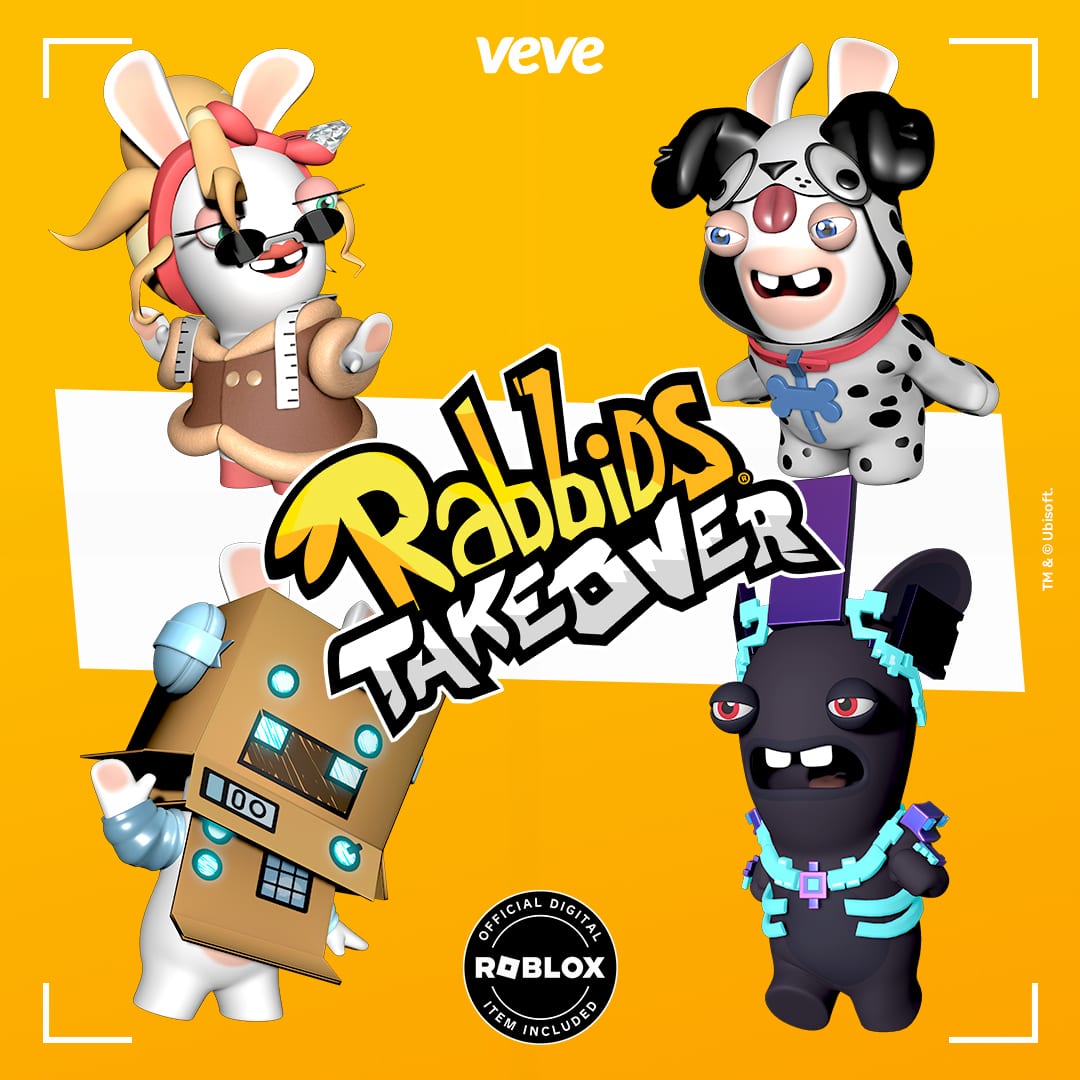
The release creative for the Roblox Rabbids Takeover shows that flexibility plainly. Four Rabbids, four costumes, none of which need explaining: one in sunglasses and a bandana, one zipped into a dalmatian suit, one wearing a cardboard box painted as a robot, and one kitted out in glowing cyan hardware. Nothing about the set requires you to know the games.
What a crossover drop is doing
A crossover release is one object carrying two licences. It sounds like a marketing exercise and sometimes it is, but the interesting version does something structural: it puts a character into a context the character does not own.
Roblox is the context here. The platform launched in 2006, the same year as the first Rabbids game, built by David Baszucki and Erik Cassel around the idea that the users would make the games. That is the whole model, and it is why Roblox reports daily active user numbers in the tens of millions and went public through a direct listing in March 2021. It is not a game. It is a place where games happen.
So a Rabbids piece with Roblox attached is saying something slightly different from a Rabbids piece on its own. The release creative carries a badge reading “Official Digital Roblox Item Included”, which means the drop reaches across into that platform rather than sitting entirely in one app. Check the drop details in the VeVe app for exactly what any given release includes, because that varies and the listing is the authority on it.
The general shape is worth understanding even if you never buy one, and we walked through the wider category in video game collectibles and what collectors should know.
Two audiences that overlap without matching
Crossovers fail when the two properties share the same audience, because then the second licence adds nothing. They work when the overlap is partial.
Someone who has played Mario plus Rabbids may well not spend time on Roblox. Someone building obstacle courses on Roblox at the age of eleven may have no idea that the Rabbids came out of a Rayman spin-off in 2006. The release gives each group a reason to look at the other, which is the actual job.
You can watch the same logic run through the art toy world, where collaborations between an artist and a brand have been standard practice since the early 2000s. We traced that lineage in the art toys and designer collectibles guide, and the Rabbids sit closer to that tradition than to a film tie-in. They are a vinyl-toy shape with a screaming face, essentially, and they have been sold as physical figures for years.
Why a platform carrying Marvel also carrying this is worth noticing
Here is the part that tells you something. A licensing platform that has Marvel and Star Wars on it has already cleared the hardest approval processes in entertainment. Those two licensors are famously exacting about how their characters are rendered, sized, lit and described.
A gaming crossover landing on the same shelf means the platform is being treated as general-purpose rather than as a comics thing that also does other stuff. Ubisoft did not have to put the Rabbids anywhere near Spider-Man, and Roblox does not need a distribution partner to reach players. Both showed up anyway.
That is the direction licensed collecting has been going for a while. The category used to be organised around publishers. It is increasingly organised around audiences, which is why a set of screaming rabbits can share a platform with a Klingon ship and a Lamborghini without anything feeling out of place. The reason it holds together is that every piece went through the same approval, and the value of that process is the whole argument in why official licences matter.
Ubisoft is already here in a much more serious mood
The Rabbids are not Ubisoft’s only presence. Assassin’s Creed is on the same platform, and that line is about as far from a screaming rabbit as a single publisher can get: Altair from the 2007 original, Ezio, Edward Kenway, Connor, Bayek, Kassandra, Basim, and the Valhalla material.
Holding both is a good test of a licensor’s range. Assassin’s Creed pieces are historical, armoured, weighty, and they ask you to know which century you are looking at. The Rabbids ask nothing at all. Same company, founded by the Guillemot brothers in Brittany in 1986, running two lines that could not be less alike.
If the historical end is more your thing, the Assassin’s Creed collectibles guide covers the characters and the eras they come from.
There is a decent case that the Rabbids are the most successful accident in modern game design. They were built to be beaten, they ate the franchise that created them, they talked Nintendo into a co-production, and they have now turned up on a licensing platform alongside a Roblox tie-in. Everything on the Rabbids hub traces back to a studio deciding that the enemies in a platformer should be funny. Nobody gets to plan that.