Amazing Spider-Man #50 and the costume in the trash can
Amazing Spider-Man #50, cover-dated July 1967, is the first appearance of Wilson Fisk, the Kingpin, and the source of the famous image of Peter Parker walking away from his costume in a trash can. Stan Lee wrote it and John Romita Sr. drew it, and the cover has been restaged in comics and on film ever since.
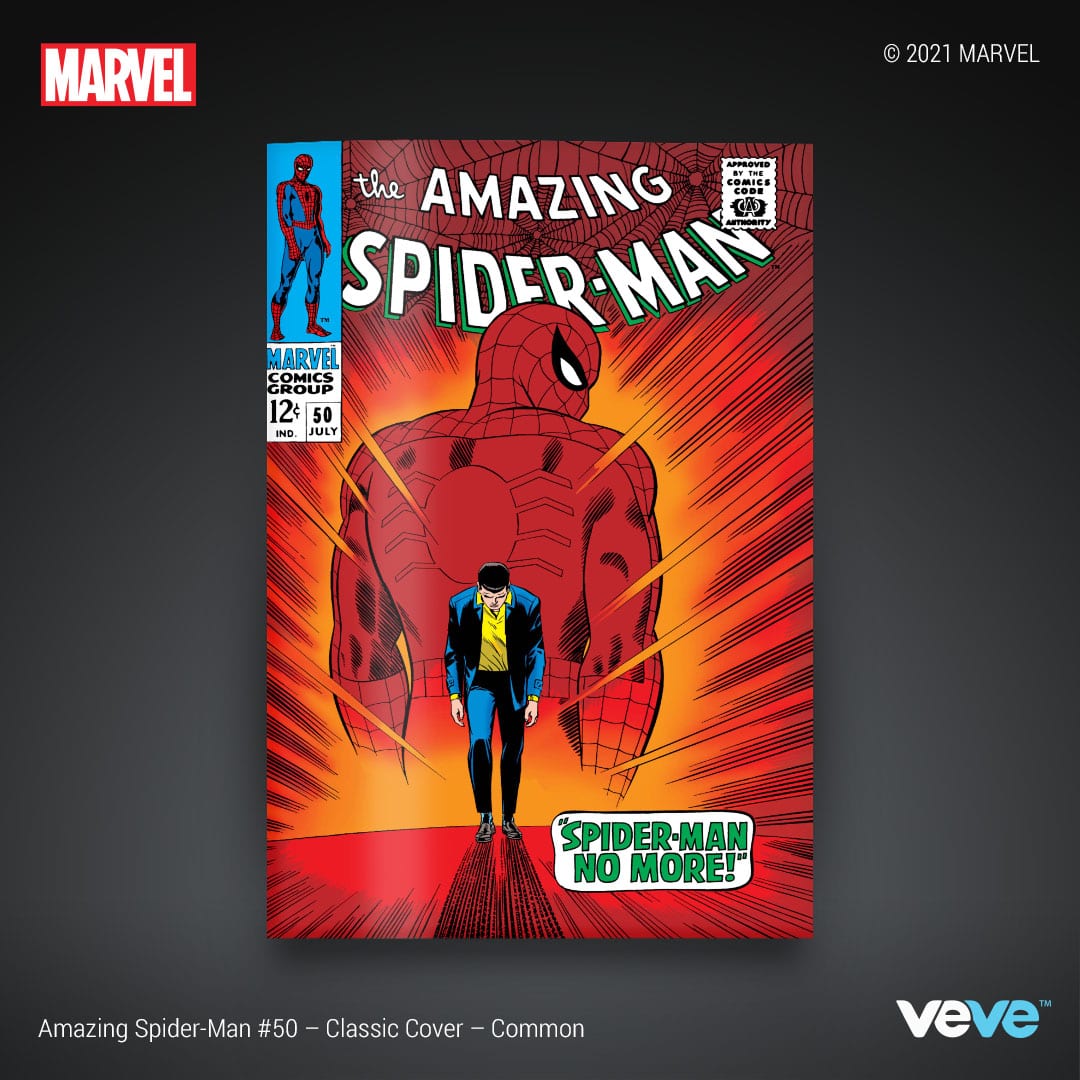
An alley, a garbage can, and a kid in a green jacket walking away with his hands in his pockets. Behind him, a costume folded over the rim of the can, one white eye lens still catching the light. No explosion, no villain, no logo-blocking splash pose. John Romita Sr. built the most reprinted Spider-Man cover of all time out of a man leaving.
Seventy cents of Marvel’s best month
Amazing Spider-Man #50 carried a July 1967 cover date and a twelve-cent price. Stan Lee scripted, Romita penciled, Mike Esposito inked under the name Mickey Demeo. The story is called “Spider-Man No More!” and it does exactly what the title promises: Peter, worn down by J. Jonah Jameson’s campaign against him and by Aunt May’s health and by the sheer grind of it, quits. Crime in the city gets worse. He watches it get worse. He goes back.
Inside that same issue, almost casually, a new crime boss takes over New York. He is enormous, immaculately dressed, and he never throws a punch on panel in his debut. His name is Wilson Fisk. Lee and Romita gave him a cane, a diamond stickpin and the manner of a man who owns the building you are standing in.
Romita had a hole to fill
Steve Ditko left the book with issue #38, and Romita came aboard with #39 in August 1966 - the same issue that unmasked Norman Osborn as the Green Goblin. That reveal solved a mystery and created a problem. Marvel’s best Spider-Man villain had just been used up, and the book was selling well enough that it could not coast.
So the Kingpin arrives eleven issues later, built to be the opposite of the Goblin. No mask, no chemistry accident, no cackling. Fisk has lawyers. He has a legitimate import business and a wife he loves and a public reputation, and the police cannot touch him because there is nothing on paper. You cannot web him to a wall and call the problem solved, which is precisely the point. A costumed villain is a fight. Fisk is a situation.
Lee and Romita made three choices in his debut that every later writer inherited:
- He is rich and public, so the fight happens in courtrooms and boardrooms as often as alleys.
- He is physically enormous but presented as a man, not a super-powered accident.
- His organization survives him. Arrest Fisk and the machine keeps running, which means beating him never quite finishes anything.
That design decision is why he lasted. Powered antagonists in the Spider-Man villain roster escalate until they break the story: an illusionist can only fool you so many times. Fisk scales with the hero’s ordinary life instead, which means he stays dangerous at any power level. Frank Miller understood this immediately and moved him into Daredevil in the early 1980s, where he became the definitive version. Vincent D’Onofrio has played him on screen since 2015, quiet and enormous and terrifying in a room with no fight in it.
The cover nobody stopped copying
Romita’s layout works because it needs no words. A person, walking away. The thing they were, discarded. Anyone who has ever wanted to quit a job reads that image correctly in half a second, with no knowledge of continuity.
Sam Raimi restaged it in Spider-Man 2 in 2004, right down to the trash can in the alley, and the shot landed with audiences who had never held the comic. Marvel has homaged it across decades of covers, on Spider-Man books and on titles with no connection to the character at all. Any time a publisher wants to signal that a hero is done, this is the shorthand they reach for.
It is, in my opinion, the better half of the issue. The Kingpin debut is historically bigger. The cover is the thing people carry around in their heads.
Part of why it keeps working is the restraint. Romita gives the costume one highlight and leaves the rest of the can in shadow, and Peter is drawn small, from behind, with no expression to read. A modern cover would put his tearful face in the foreground and lose the whole effect. The reader supplies the feeling, which is the oldest trick in illustration and the hardest to hold your nerve on.
Why a clean copy is hard
Nothing about 1967 favored preservation. Amazing Spider-Man #50 shipped to newsstands, spinner racks and drugstore counters, was read by kids, and was returned for credit as stripped covers when it did not sell. The direct market that later taught buyers to bag and board a book did not exist yet. Copies got rolled into back pockets.
The physical result is familiar to anyone who has looked at Silver Age census numbers. Plenty of mid-grade copies survive. Genuinely high grades do not, and the ones that exist usually show the same tells: chipping along the spine, a color-break crease at the corner, tanning where newsprint met sunlight for fifty years.
For context on how far the top of that market can go, a CGC 9.6 copy of Amazing Fantasy #15 sold for $3.6 million through ComicConnect in 2021. That is the ceiling of the hobby and nobody is pretending a 1967 issue sits next to it. But the same logic drives both: a book that mattered, printed on disposable paper, bought by children.
What a licensed digital edition actually is
VeVe releases officially licensed digital comics from Marvel, and Amazing Spider-Man #50 is among the issues that have appeared there. It is worth being precise about what that means, because the word “digital” does a lot of lazy work elsewhere.
A licensed digital edition is a numbered copy of the real book. You read the full issue page by page in the app, full screen, at a resolution the newsprint never managed, and your particular edition number is recorded publicly rather than sitting in a private account database. If you have ever wondered why collectors care so much about which number they pulled, we broke that down in what mint numbers mean. The reading experience itself is a different animal from a scan, and how VeVe digital comics work covers the mechanics.
What it is not is a substitute for a slabbed 1967 newsstand copy, and it does not try to be. It is a way to actually read the issue, own a specific edition of it, and put it on a shelf with the rest of your Marvel material.
New collectors get US$10 in credit toward a first piece with no card required, which is enough to start somewhere sensible. The details are on our free credit page.
The part that still works
Read the issue cold and the surprise is how quiet it is. Peter quits in the third act of his own life, not in a battle. He walks past a mugging, hears about it later, and the guilt does the rest. Lee and Romita understood that the character was never really about the villain of the month.
Fisk went on to run New York in three different media. The cover went on to be borrowed by everyone. And the thing at the center, a tired nineteen-year-old deciding whether to pick the suit back up, still reads exactly the way it did on a spinner rack in 1967.