Amazing Spider-Man #13 and the first appearance of Mysterio
Amazing Spider-Man #13, cover-dated June 1964, is the first appearance of Mysterio. Quentin Beck is a film stuntman and special-effects technician who uses illusions, smoke and stagecraft against Spider-Man, and he has no superhuman powers of any kind.
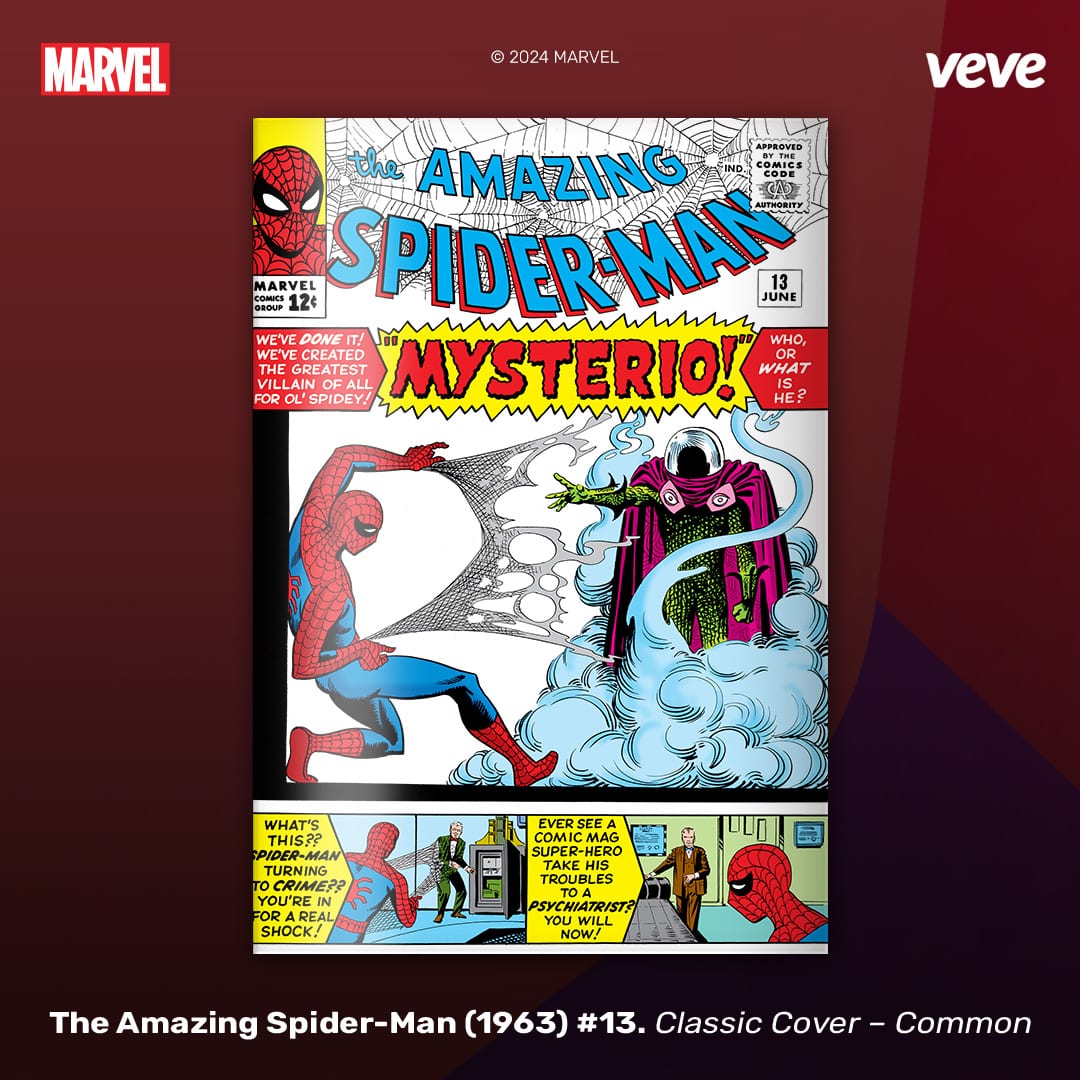
Quentin Beck’s job title is the character. Stuntman and special-effects technician, which in 1964 meant a man who knew how to build a convincing monster out of foam and wire, how to light a set so the wires vanish, and how to make an audience believe something that is not happening. He wanted to act. He was not good enough. So he took the only skills he did have and pointed them at a superhero.
Amazing Spider-Man #13 carries a June 1964 cover date, Stan Lee and Steve Ditko, a year and change into the series. By that point the rogues gallery already had a flying thief, a man with mechanical arms and a shape-shifter. Beck is the one who showed up with nothing.
The con inside the issue
The story opens with Spider-Man apparently committing robberies around the city, and the smart move Lee makes is to let Peter doubt himself. He has no memory of the crimes, he cannot explain them, and he genuinely starts to wonder whether something is wrong with him. That uncertainty is the whole first act, and it is a more modern piece of writing than a lot of what surrounds it in 1964.
Then Mysterio arrives in public as the man who will stop Spider-Man, which gets him the press, the credibility and a clean shot at the fight he wants. He works in fog. Spider-Man cannot see, cannot land a hit, and cannot trust what he is looking at.
Beck loses because he talks. Spider-Man records a confession and plays it back, which is a wonderfully unglamorous ending for a villain whose entire practice is spectacle. Nothing about the defeat is physical.
Why an ordinary man was the right idea
Marvel in 1964 was in the middle of an arms race with itself. Every new villain needed a bigger power, and that escalation has a ceiling. Beck broke the pattern by having no power at all, and it turned out to be the most flexible thing in the catalogue.
Look at what an illusionist lets a writer do. He can drop Spider-Man into a haunted house, into deep space, into a memory, into a courtroom that is not there. The villain’s ability is functionally the ability to change what kind of story you are reading, and that is a tool no amount of super strength can match.
- He needs no origin retelling, because the origin is a career and a grudge.
- He can lose badly and return intact, since nothing about him was ever real to begin with.
- He scales to any budget, from a smoke machine in an alley to a citywide hoax.
- He works against heroes other than Spider-Man, which is why he has turned up in books across the line.
The most celebrated Mysterio story of the last thirty years is not even a Spider-Man comic. Kevin Smith and Joe Quesada built the 1998 Daredevil arc Guardian Devil around him, using him as a man engineering an entire spiritual crisis for someone else’s benefit, and it remains the best argument for what the character can carry.
The fishbowl should not work
A domed glass helmet with no visible face, over a green bodysuit, with a purple cape and a cloud of mist around the feet. Written down it is absurd, and collectors have been laughing at it since the Johnson administration. It has also never been redesigned in any meaningful way, because it does three things at once that are hard to get from anything else.
The dome removes the face. No eyes, no expression, nothing to read, which is genuinely unsettling on a page full of characters whose emotions you can see. It also reads as a prop, correctly, since Beck is a man in a costume in a way that Doctor Octopus is not. And it is unmistakable in silhouette from across a room, the same trick that keeps the Vulture in rotation after six decades.
Jake Gyllenhaal wore it in Spider-Man: Far From Home in 2019, in a film that became the first Spider-Man picture to pass $1 billion worldwide. The adaptation updated his effects from stagecraft to drone projection and doctored footage, which is exactly the right update, because a 1964 villain built out of fake images turned out to be pointed straight at the century we ended up in.
Sixty-year-old paper and what survived
Amazing Spider-Man #13 sold for twelve cents from wire spinner racks in drugstores and bus stations. Unsold copies were not stored for anyone’s benefit. Distributors stripped the covers for credit and pulped the rest, so the only copies that exist are the ones somebody bought and happened not to destroy. Comic shops and non-returnable ordering did not arrive until the 1970s.
Newsprint from 1964 browns from the edges inward, the two staples rust, and a book that lived in a stack under a bed has a rolled spine forever. Third-party grading did not begin until 2000, which means every high-grade copy on the census spent about four decades with nobody treating it as anything but a comic.
The record that anchors this whole corner of the market is a CGC 9.6 copy of Amazing Fantasy #15, sold for $3.6 million at Heritage Auctions in September 2021. Issues from the first two years of the ongoing series sit a long way below that, reaching five and six figures in the top grades, while readable mid-grade copies remain the normal way most people own 1964. If you are working through the rogues in order, the Spider-Man villains collectors guide lays out who arrived in which issue.
The licensed digital edition
VeVe releases officially licensed Marvel digital comics, and this issue is one of them. A licensed digital edition is a numbered copy from a fixed edition that you read full-screen in the app, pages in printed order, with the edition number recorded on a public ledger so any individual copy can be identified.
For an issue like this one, the reading is the point. Ditko’s fog sequences depend on being able to sit with a page and work out what you are actually being shown, and a sealed grading holder makes that impossible by design, since opening it ends the grade. How mint numbers work covers the numbering side if that is unfamiliar, and the wider Marvel shelf has plenty of the surrounding run.
Start a free VeVe account if you want to look through it. New collectors get US$10 in credit toward a first piece, no card required, with the details on our free credit page.
A failed actor who got the last laugh
Beck never wanted to rule anything. He wanted an audience, he wanted to be taken seriously, and he built a career out of being better at illusions than anyone gave him credit for. Every time a writer brings Mysterio back, that same wound is sitting there ready to use.
The joke is that he won the argument. A man who insisted that the effects were the real skill would find the twenty-first century entirely familiar, and Spider-Man still cannot be sure what he is looking at.