Amazing Spider-Man #300 and the arrival of Venom
Amazing Spider-Man #300, cover-dated May 1988, is Venom's first full appearance. David Michelinie wrote it and Todd McFarlane drew it as a double-sized anniversary issue, and it remains one of the most submitted comics in CGC's history despite its enormous 1988 print run.
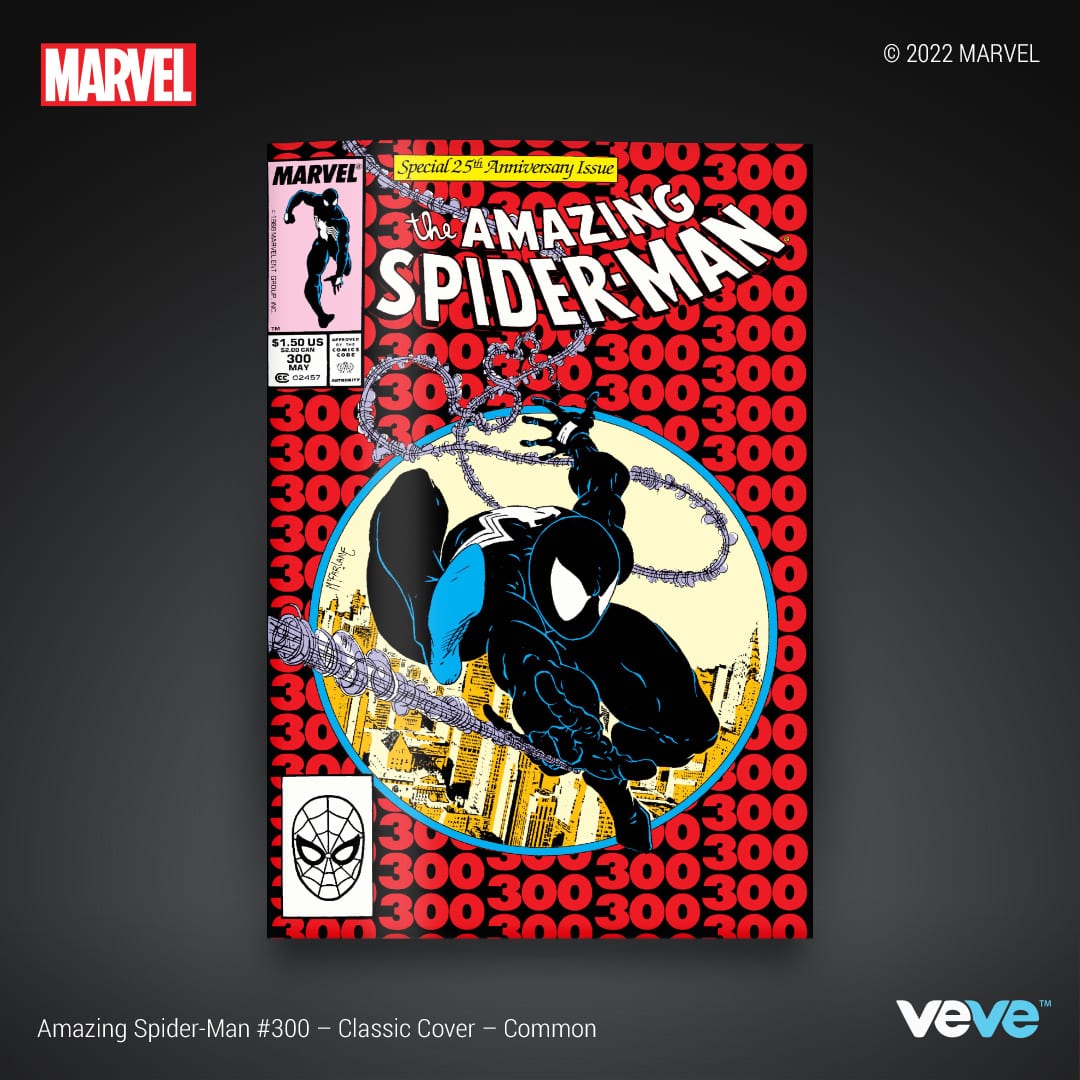
You can identify this book from across a shop. Almost all black, the logo rendered in heavy black letters with a red outline instead of Marvel’s usual red-on-white, and a grinning white-eyed mass filling the frame with the black-suited figure crouched in front of it. Todd McFarlane crowded the art in from every edge until the whole thing reads like a wraparound even though it is a single cover. That was deliberate. Anniversary issues are supposed to shout.
The anniversary Marvel got right
Amazing Spider-Man #300 carried a May 1988 cover date and ran double-sized. David Michelinie wrote it, McFarlane drew it, and it delivers a full origin rather than a gimmick: Eddie Brock, a reporter who staked his career on naming the wrong man as the Sin-Eater, watching Spider-Man catch the real one and destroy him in the process. Brock goes to a church intending to pray. The thing in the rafters, discarded and furious, comes down to meet him.
Venom is the neatest piece of villain construction Marvel had managed in decades. Two rejects with the same grievance, wearing the same shape as the hero, twice his size and immune to his spider-sense. Michelinie had been seeding the pieces for months, and McFarlane drew the creature with a tongue and a jaw that no previous Spider-Man villain had needed.
Not the first appearance, exactly
Strictly speaking Venom shows up before this. A hand and part of an arm appear in issue #298, McFarlane’s debut on the title. Issue #299 ends on a full-body reveal in the last panel, a page that has caused thirty years of argument between collectors about what counts.
The sequence, if you are keeping score:
- Issue #298: a hand and part of an arm, nothing else.
- Issue #299: a full-body reveal on the last page, with no origin and no explanation attached.
- Issue #300: the origin, the name, the fight and the face on the cover.
Issue #300 is where the character exists: named, explained, given a face and a motive and twenty-odd pages to use them. Cameo appearances are footnotes. The book people actually want is the one where the thing on the cover is the thing in the story.
The suit itself had arrived four years earlier, in Amazing Spider-Man #252, as a costume change with no explanation attached. It took until #300 for Marvel to work out what it had. Peter ends this issue back in red and blue, which is its own small piece of stagecraft: the anniversary issue that returns the character to factory settings by handing his old clothes to somebody who hates him.
The Spider-Man everybody draws now
McFarlane’s Spider-Man does not stand like a person. He crouches on gargoyles with his knees above his shoulders, fingers splayed, spine doing something anatomically impossible. The eye lenses are huge. The webbing is not the tidy dotted-line convention of the 1970s but a mess of hand-drawn strands that McFarlane inked individually, the way a real web is a mess.
Draw Spider-Man today, in a comic or a game or a film pose, and you are almost certainly drawing some version of that. It became the default so completely that most people do not know it had an author. We went further into how that happened in our piece on the Spider-Man everyone draws.
The commercial half of the story is just as big. McFarlane left for Spider-Man #1 in 1990, a launch that sold in the region of 2.5 million copies across its variants, and by 1992 he was one of the founders of Image Comics. Issue #300 is the point where an artist on a monthly book became a name that moved print runs on his own.
What 1988 actually printed
This is where key-issue mythology and reality part company. By 1988 the direct market was mature. Comic shops bought non-returnable, buyers knew to bag and board, and Amazing Spider-Man was one of the best-selling titles in the country. Hundreds of thousands of copies went out and a great many of them were put away carefully by people who suspected an anniversary issue might matter.
So #300 is not rare. It is one of the most submitted books in CGC’s entire history, with a graded population running into the tens of thousands, and finding a copy has never been the problem.
Finding a clean one is. Black covers are merciless. Every spine tick, every corner blunt, every white speck where the ink flaked off shows up like a flaw in paint, and 1988 newsprint plus a double-sized spine did not help. The gap between a 9.4 and a 9.8 on this book is enormous, and the gap in what people will pay reflects that.
Through the 2021 and 2022 run-up, top-graded 9.8 copies repeatedly cleared five figures at Heritage Auctions and ComicConnect, with the strongest results reaching into the tens of thousands, before the market cooled again. High-grade scarcity on a book with a huge print run is a strange thing to explain to a newcomer, and it is entirely about condition rather than quantity.
Demand keeps arriving from outside comics, too. The 2018 Venom film took more than $850 million worldwide, and every wave of screen attention sends another round of people looking for the issue where he started.
Owning the issue as a licensed digital edition
VeVe publishes officially licensed Marvel digital comics, and Amazing Spider-Man #300 is one of them. A licensed digital edition is the complete book as a numbered copy: every page readable full screen in the app, the art at a size that finally does McFarlane’s line work justice, and your edition number recorded on a public ledger rather than sitting in a company database. If the numbering side is new to you, start with what mint numbers mean.
It is a different object from a slabbed 1988 copy and it is not trying to imitate one. What it does is let you read the issue at a scale newsprint never allowed and keep a specific numbered edition of it alongside the rest of your Marvel material.
If you want to look around the app before deciding anything, start a free VeVe account. New collectors get US$10 in credit toward a first piece, no card required, and the free credit page explains how it works.
Why he stuck
Marvel has launched hundreds of villains since 1988 and almost none of them stayed. Venom stayed because he is a structural joke about the hero: the same silhouette, the same powers, none of the guilt. Peter Parker spends his life apologizing. Brock never has, not once.
That is the engine, and it is why he outgrew the villain roster entirely and now carries his own books, his own films and his own half of the symbiote side of the mythology. Not bad for a costume Peter threw away.