Amazing Spider-Man #2 and the first appearance of the Vulture
Amazing Spider-Man #2, cover-dated May 1963, is the first appearance of the Vulture, Adrian Toomes. The issue also introduces the Terrible Tinkerer in its second story and is where Peter Parker starts selling photographs to the Daily Bugle.
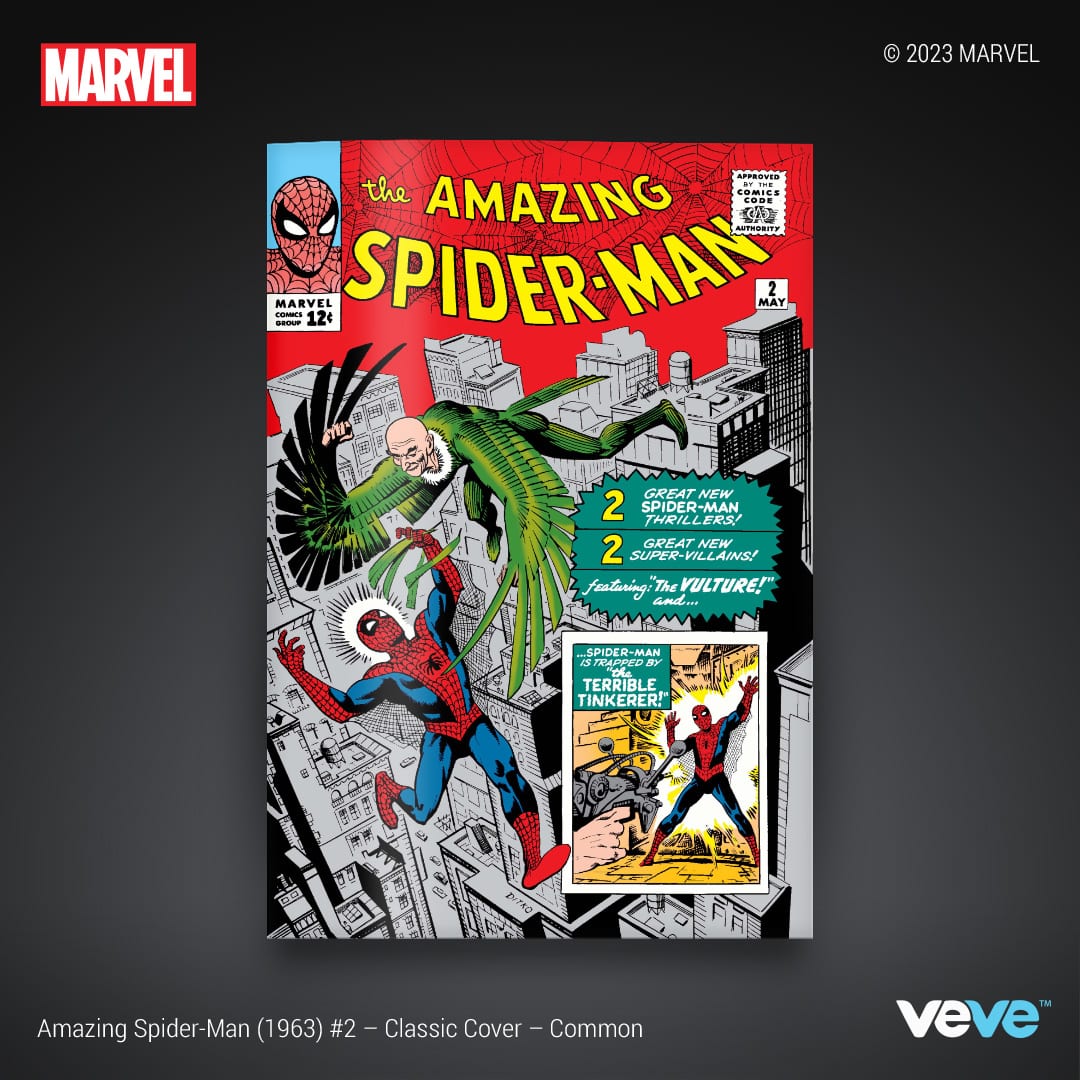
Picture the pitch. A bald man in his sixties, no muscles, no cape, strapped into a green set of wings with a feathered collar that reaches his ears. He robs banks by flying out of the window. On paper it sounds like a joke, and Steve Ditko drew it so well that the Vulture has been in continuous rotation for more than sixty years while dozens of flashier villains from the same decade have vanished entirely.
Amazing Spider-Man #2 carries a May 1963 cover date, two months behind the first issue. Stan Lee wrote, Ditko drew, and the book was still bi-monthly at that point, which meant every issue had to earn the next one.
Two stories, one lasting villain
The lead story is a straight chase. Adrian Toomes flies, steals, taunts the police over the radio, and Spider-Man cannot get near him in the air. What makes the issue matter beyond the debut is what Peter does about it: he cannot beat the Vulture, so he photographs him, and he walks the pictures into the Daily Bugle and sells them to the man who has spent the previous issue calling him a public menace.
That is the origin of the job. Everything about Peter Parker’s working life, the darkroom, the camera on the tripod, the arguments about rates, the sheer indignity of being paid to slander yourself, starts in this issue and not in the one before it.
The back-up story introduces the Terrible Tinkerer, a small-town repairman apparently working with aliens who turn out to be men in masks. Phineas Mason is a much lesser character than Toomes, but he found a permanent role eventually as the man other villains go to when they need gear built or fixed. Half the hardware in Spider-Man’s rogues gallery has his fingerprints on it.
The first villain who came back
Doctor Octopus, the Sandman, the Lizard, all of them arrived within the next year and all of them stayed. But the Vulture got there first in one specific way: he is the villain Lee and Ditko chose to bring back, in Amazing Spider-Man #7, cover-dated December 1963. Before that, a Marvel villain was largely a one-issue problem. Bringing Toomes back established that this book would have a cast of antagonists rather than a queue of them, and the full rogues gallery grew out of that decision.
It helped that he was easy to bring back. He has no origin that needs explaining, no tragedy, no cure. He is an angry old engineer with a working set of wings, and he can walk out of prison and into the next story whenever the plot wants him.
Why the design refuses to die
Strip a character down to a black shape on a white wall and see if it still reads. That is the test the Vulture passes and most 1963 villains fail.
- The silhouette is unmistakable at any size, because nothing else in comics has that collar.
- The costume tells you his power in one glance, which matters enormously on a cover seen from across a shop.
- The green and purple palette locks him visually into Spider-Man’s world without copying anyone else in it.
- He is old, and the age is the point. A frail man who becomes deadly the second his feet leave the floor is a better visual idea than another musclebound thug.
Ditko understood what he had. Look at how he stages the flight scenes: Toomes is almost always drawn from below, arms spread, coat of feathers catching the wind, while Spider-Man is stuck on a rooftop looking up. The whole fight is about altitude, and the layouts say so before the dialogue does.
Michael Keaton’s version in Spider-Man: Homecoming in 2017 kept that read almost exactly, traded feathers for salvaged alien tech, and the film took about $880 million worldwide. A design has to be doing something right to survive a fifty-four year gap and a total change of material.
What a 1963 newsstand book looks like now
Comics of this vintage were not stored, they were consumed. They rode wire spinner racks in drugstores at twelve cents, sold to children, and any copy that did not sell had its cover torn off for distributor credit while the rest was pulped. Nobody was bagging anything. The idea that a monthly comic might be worth keeping in flat, dark, low-humidity storage arrived years later.
So the survivors run rough. Rolled spines, tanned newsprint, staple rust, a name written in pen across the top of the cover by a kid in Ohio. Professional grading did not exist until 2000, which means every high-grade early Spider-Man book on the census spent its first four decades entirely unsupervised and got lucky.
The headline number for the character belongs to his debut: a CGC 9.6 copy of Amazing Fantasy #15 sold for $3.6 million at Heritage Auctions in September 2021. The first dozen issues of the ongoing series sit well below that and still reach five and six figures at the top of the grading scale, while a well-loved reader copy remains something a normal person can find at a convention. That gap between a pressed 9.4 and a readable 4.0 is the whole story of Silver Age collecting.
The licensed digital edition
VeVe publishes officially licensed Marvel digital comics, including this issue. What that means in practice is a numbered copy from a fixed edition, read full-screen in the app with the pages laid out as printed, and the edition number written to a public ledger so the specific copy you hold is identifiable to anyone who cares to look.
The appeal is straightforward. You get to actually read it. A graded physical copy is sealed by definition, which is a strange fate for a book whose entire purpose was to be read on a bus, and the digital edition puts the pages back in front of you without the newsprint aging in your hands. We go into how the app handles pages and panels in our piece on reading comics in AR, and the glossary covers the terminology if editions and mint numbers are new to you.
The old man is still the best idea in the issue
Toomes works because he is not trying to rule anything. He wants money, he has built the one machine that lets him take it, and he resents every young person who assumes he is finished. That resentment is playable in any decade, which is why writers keep reaching for him.
Read the issue and you can see it land in real time. Spider-Man wins on the ground and loses in the air, and the Vulture leaves with the last word. Sixty-odd years on, the most durable thing Lee and Ditko built in 1963 might be the man who flies away, and Spider-Man has never quite stopped looking up.