tokidoki and the world Simone Legno built
tokidoki was founded in 2005 by Italian illustrator Simone Legno with Pooneh Mohajer and Ivan Arnold. The name is Japanese for 'sometimes' and the style blends Japanese kawaii with Italian design. VeVe carries the tokidoki Sushi Cars line, including Turbo Toro, Octo-Cart, Maki Machine, Ikabriolet and Ebi-GT.
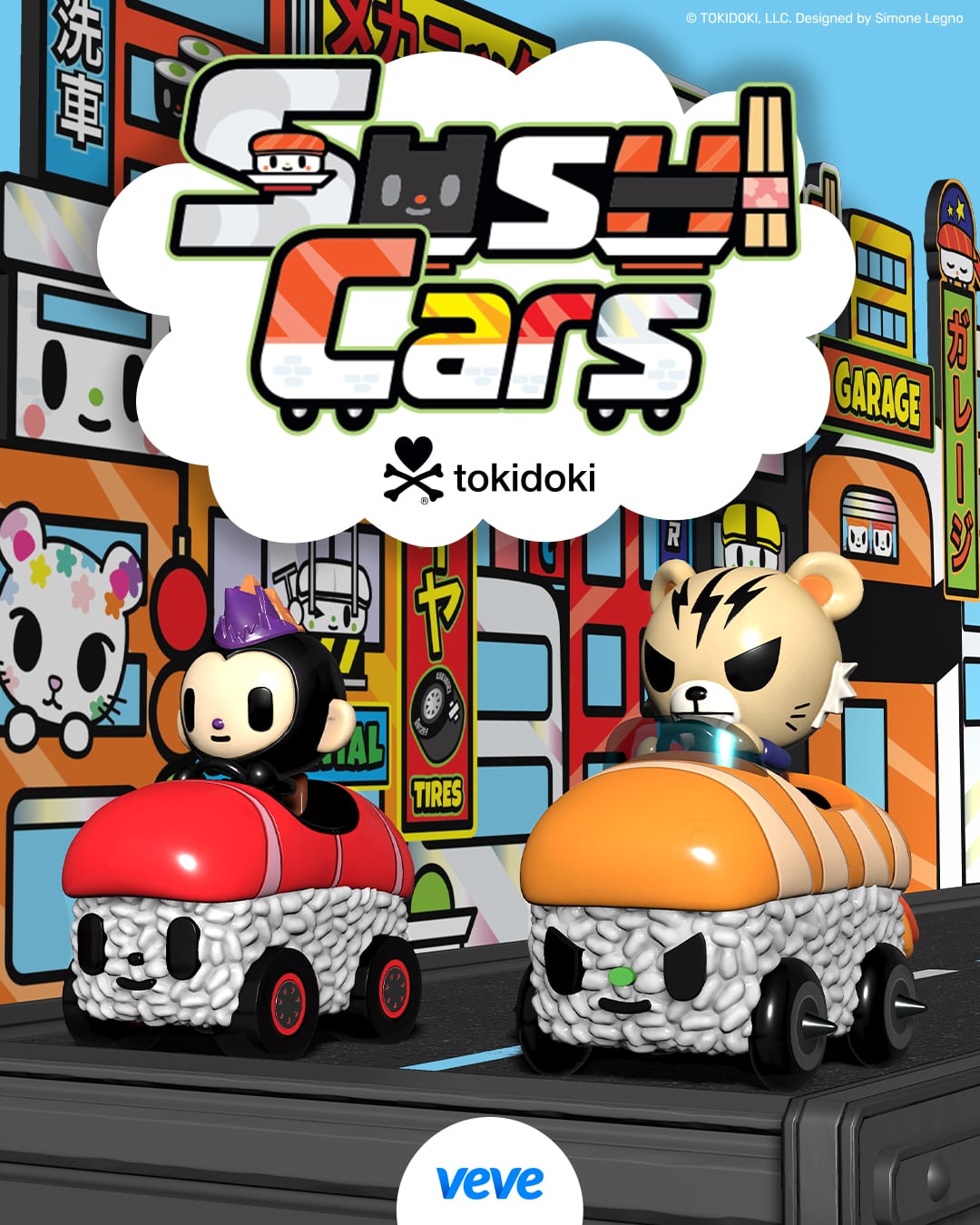
A tuna belly with wheels. That is not a description most brands would let out of the room, and it is the single best argument for how tokidoki works, because Turbo Toro is a car made of fatty tuna and it is instantly readable as both things at once. Sushi and supercar, same silhouette, no explanation required.
Twenty years of that. The company has been running since 2005 and the trick has never really changed.
Rome, an obsession, and a word that means sometimes
Simone Legno is Italian, from Rome, and he was never anywhere near the Japanese toy industry when he started. He was a kid in Italy who became fixated on Japan from a distance, the way a lot of people did in the 1980s and 1990s through anime broadcasts and imported design, and he taught himself the visual language before he ever saw the place. In the early 2000s he put his illustrations on a personal website under the name tokidoki, which is Japanese for “sometimes”. The site found an audience it was not built for.
In 2005 he went into business with Pooneh Mohajer and Ivan Arnold and moved to Los Angeles. Mohajer had co-founded the nail polish brand Hard Candy in the 1990s, so the partnership put a working consumer-products operator next to an illustrator with a following and no distribution. That combination is the reason tokidoki became a company rather than a well-liked blog.
What the hybrid actually is
Call it kawaii and you have said about half of it. The Japanese half is real: rounded heads oversized against the body, dot eyes, simplified limbs, characters designed to be legible at the size of a keychain. The lineage runs back through Sanrio and forty years of Japanese character design where the point is instant emotional recognition with no facial detail at all.
The Italian half is the part people miss. Legno’s work is heavier on line quality, denser in its pattern-making, and much more willing to be a little morbid. Skulls turn up constantly. So do cactus spines, tattoos and a general flash-art sensibility that owes more to Mediterranean street imagery than to anything from Tokyo. The palettes run hot and saturated where a lot of kawaii design runs soft.
Put them together and you get characters that are cute at a glance and slightly strange at second look. That gap is the style. It is why a tokidoki print does not read as a Sanrio knock-off even when the shapes are close, and it is why the brand has been able to sit on a Marvel collaboration, a Hello Kitty collaboration and a Barbie collaboration without any of them looking like a mismatch. The long-running LeSportsac bag line is what put the artwork in front of a mainstream retail audience in the first place.
Unicorno, and why a platform character is the perfect collecting structure
Unicorno is the clearest example of the method. It is a unicorn figure, a fixed body shape, produced as a blind-box vinyl toy in series after series. Each release is the same silhouette wearing a different concept: a different colourway, a different mane, a different set of markings, a different name. The body is a canvas and the series is the work.
This is the platform-toy idea, which came out of the Hong Kong and Tokyo art toy scene around the turn of the century and turned up in Bearbrick, Dunny and Munny before tokidoki got to it. The art toy history is worth reading if you want the full chain. What matters for a collector is the structure it creates.
A platform character has no natural stopping point. There is no roster to complete, no canon to respect, no scheduling conflict where a variant contradicts a story. If Legno wants a Unicorno based on a dessert, a season, a mood or a collaboration partner, it ships. Mermicorno, Moofia, Donutella and the Cactus Friends all extend the same logic sideways into new families. For someone who collects, that means the set is genuinely open-ended and you get to decide where your own edges are, which is a better problem than most franchises hand you. Our guide to building a themed collection is largely about drawing those edges on purpose.
The blind box is the other half of the structure. Not knowing which variant is in the box changes the act of opening it, and it is a deliberate design decision rather than a sales trick, though it is obviously also a sales trick. How blind boxes work covers the mechanics and the odds.
Owning the character is the whole business
Here is the thing that separates tokidoki from most of what sits next to it on a shelf.
Legno owns these characters. There is no studio, no film rights holder, no licensor with approval over whether Donutella can appear on a lunchbox. That is the designer toy model in a sentence: the artist owns the intellectual property, so the artist decides where it goes. Collaborations become partnerships between two owners rather than a licensee asking permission.
Compare that to a character from a film or a comic, where every appearance runs through a rights holder whose priorities are set by a release schedule. Neither arrangement is better, but they produce different objects. Licensed pieces are tied to canon and to a story people already know. Artist-owned pieces can go anywhere, which is how you end up with a unicorn dressed as a slice of watermelon and nobody objecting. VeVe carries both kinds, and the tokidoki hub sits alongside a lot of heavily licensed material.
The Sushi Cars, name by name
The VeVe Sushi Cars line is five characters, and the naming is doing more work than it first appears. Each one is a specific piece of sushi crossed with a specific kind of vehicle, and the pun holds in both languages.
- Turbo Toro takes toro, the fatty tuna belly and the expensive cut, and gives it a performance chassis
- Octo-Cart is tako, octopus, built as a small open cart with the tentacles doing the work
- Maki Machine is the rolled cut, which happens to already be a cylinder, which happens to already look like a wheel
- Ikabriolet folds ika, squid, into cabriolet, the convertible body style
- Ebi-GT is ebi, shrimp, wearing the grand tourer badge from long-distance sports cars
Maki Machine is the one that shows the thinking. A sushi roll is a cross-section that already reads as a wheel, so the design barely has to reach. Ikabriolet is the best pun of the set and I will not be arguing about it.
What it is like to collect this
Digital tokidoki pieces behave like everything else in the app: a numbered edition, the number recorded against your account, viewable full-screen and in augmented reality on a table in front of you. What mint numbers mean covers why collectors care about the digits, and the rarity tiers explain how edition sizes are set across a release.
If you have never opened an account, start a free VeVe account and look at the art before you decide anything. New collectors get US$10 in credit toward a first piece, no card required, and the free credit page explains how it works.
Legno has been drawing variations on the same handful of shapes for two decades and they still look like nobody else’s. That is not a small thing. Most character brands drift, get redesigned by a committee, or quietly stop looking like themselves around year eight. A tuna belly with wheels is exactly as odd now as it would have been in 2005, and it is odd on purpose.