Captain America, a collecting history
Captain America Comics #1 was cover-dated March 1941, published by Timely Comics and created by Joe Simon and Jack Kirby, with a cover showing Cap punching Hitler roughly nine months before Pearl Harbor. It reportedly sold close to a million copies, and high-grade surviving copies have sold at public auction for well past $3 million.
The cover came first. Before the character had a personality, a supporting cast or a single issue of history, there was a drawing of a man in a flag suit hitting Adolf Hitler in the face, and it was on newsstands roughly nine months before the United States entered the war. Everything Captain America has been since is downstream of that one image.
March 1941
Captain America Comics #1 carried a cover date of March 1941. The publisher was Timely, the company that would later become Marvel. The creators were Joe Simon and Jack Kirby, two young men in a young industry, and the cover they produced is still the most reproduced image in American comics after Action Comics #1.
It reportedly sold close to a million copies. Put that number next to anything on the shelves today and it stops sounding like a comics statistic and starts sounding like a national event, which in a small way it was. Simon and Kirby had made a political statement on a newsstand at a moment when the country had not decided what it thought.
Not everyone approved. Simon and Kirby received hate mail and threats over the cover, enough that it became a genuine problem rather than an anecdote. The story that gets told, and it is well documented, is that Mayor Fiorello La Guardia of New York contacted them personally and told them the city would see that nothing happened to them. That is a remarkable footnote for a comic book, and it tells you how much weight a cover could carry in 1941.
Bucky Barnes was in that first issue too, in a role nobody in 1941 would have predicted would still be causing plot complications eighty years later.
The shield changed, and that is a collecting detail
The shield on Captain America Comics #1 is not the one you picture. It was a triangle, closer to a heraldic shield, and it lasted exactly one issue. MLJ Magazines already published a character called The Shield who wore something similar, objections followed, and by the second issue Cap was carrying the round disc that has been his signature ever since.
Small change, large consequence. That single-issue triangular shield is one of the clearest visual tells in comics for distinguishing the true first appearance from everything after it, and artists still reach for the triangle when they want to signal a 1941 setting.
Simon and Kirby left Timely a handful of issues in, over money, and took their talents to National, the company that became DC. The character they left behind ran through the war, faded with the genre, was briefly revived in the mid-fifties as a Communist hunter, and then went quiet.
Frozen, then found
Captain America came back in Avengers #4, cover-dated March 1964, pulled out of the North Atlantic in a block of ice. Stan Lee and Jack Kirby had Kirby back on a character he had co-created twenty-three years earlier, which is its own strange piece of comics symmetry.
The revival did something clever that the hobby is still living with. Instead of pretending the gap had not happened, it made the gap the point. Cap woke up in a country he did not recognise, mourning a partner and a war everyone else had moved on from. That single decision turned a patriotic mascot into a character with an interior life, and it is the version every subsequent adaptation is built on.
For how that era of Marvel came together more broadly, Fantastic Four #1 is the issue that set the conditions for Avengers #4 to exist at all.
What the paper market did with it
Captain America Comics #1 is one of a very small group of books that operate at the top of the physical comics market. Surviving high-grade copies are genuinely scarce. Wartime paper was poor, the print run was read rather than preserved, and an eighty-year-old newsstand comic in near-perfect condition is close to an accident of history.
High-grade copies have sold at public auction for well past $3 million, handled by houses including Heritage Auctions. That is documented history about the physical book, a market with its own rules and its own buyers, and it sits alongside a handful of other Golden Age keys. The most valuable comics ever sold piece covers that group and what separates them, and the comics section covers the issues that matter most for readers rather than bidders.
What those results really measure is cultural weight rather than paper. Nobody pays that for the staples. They pay for the fact that the image on the front was a statement before the country had made one.
The modern shelf
The interesting thing about collecting Cap now is how many valid versions there are, all of them defensible. The 1941 original with the triangle. The wartime Timely run. The thawed 1964 Avenger. The seventies drifter phase where he quit and called himself Nomad. The nineties armour. The Winter Soldier era. The Sam Wilson run. Each of those is a different character wearing similar clothes.
That variety is what makes a Captain America row work better than a row of one character in one costume. You are displaying eighty years of a country arguing with itself through a man in a flag suit, which is a more interesting shelf than it sounds when written down.
The Captain America hub collects the versions that have appeared as digital pieces, and the Marvel franchise page puts them in the context of the wider line.
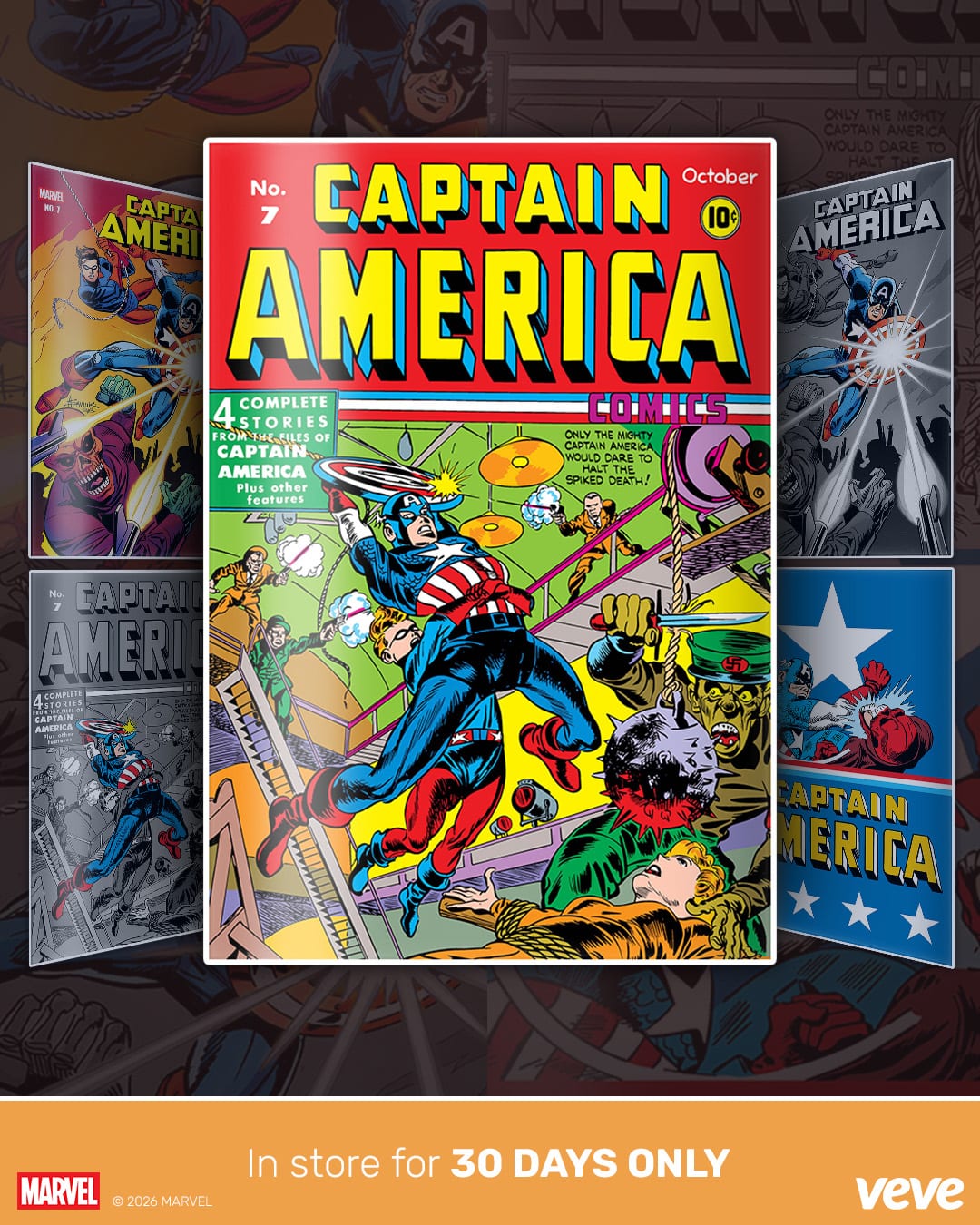
The Captain America #7 comic piece
Comic pieces sit differently from figures, and they are worth understanding on their own terms. A figure is a character. A comic is an object with a cover, an issue number, a place in a run and a story inside it. The Captain America #7 piece is the second kind, which means it behaves more like the paper comics above it in this article than like the character art beside it.
For collectors who came in through figures, comics are often the part that clicks late. You are not collecting a likeness. You are collecting an issue, with all the numbering, ordering and run-building instincts that come with that, and those instincts are old and deeply satisfying. Anyone who has ever filled a gap in a long box knows exactly what I mean.
One thing worth understanding before you go further into any licensed line is what the licence actually guarantees about the art and the rights behind it. Why official licences matter covers that, and it is the difference between a piece with a chain of permission behind it and a picture of a character.
Eighty-five years from one punch
Simon and Kirby were in their twenties. They drew a cover to make a point, got threats for it, and got a phone call from the mayor. Then the character outlasted the war, the company name, the industry that produced him and both of his creators.
The cover still works, which is the part I find remarkable. Take away the context, the history and the auction results, and it is still a well-drawn man hitting a bad man very hard. Some images do not need a footnote.