The places of Solo Leveling and why they collect so well
Solo Leveling locations like the Altar, Hapjeong Station and the Cartenon Temple have been released as VeVe digital collectibles alongside the characters. They work as display pieces because a gate or a dungeon entrance is a scene you can stand inside in augmented reality, rather than a figure you look at from outside.
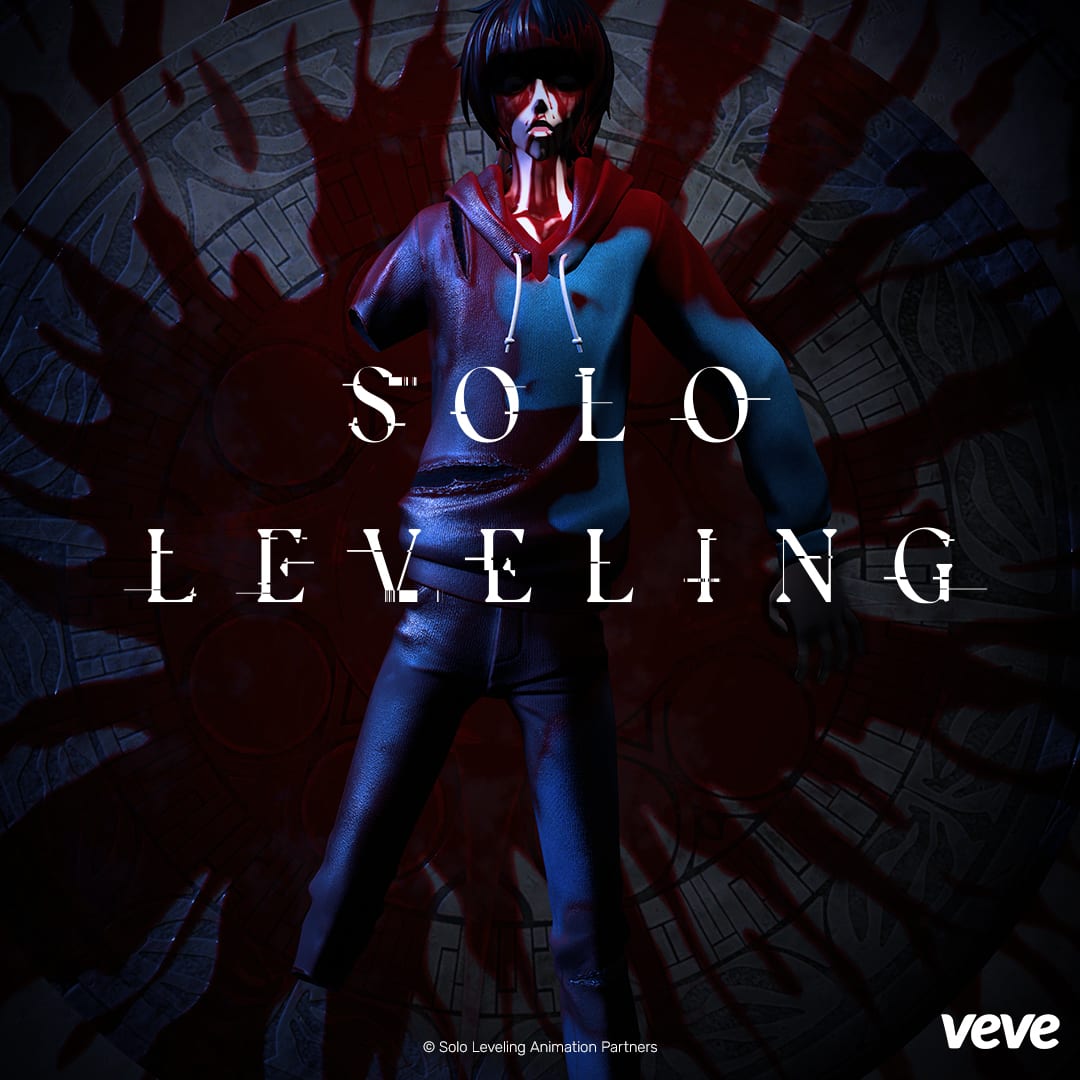
Most collecting lines are built out of faces. You buy the hero, then the rival, then the villain, then the version of the hero with the better coat. Solo Leveling gives you that, and it also gives you something most licensed lines never bother with: the rooms. The stone altar. The subway platform. The temple with the columns that go up further than they should.
That is unusual, and it changes what a shelf looks like.
A web novel, a webtoon, and an artist who died too young
The history is worth getting right, because Solo Leveling did not arrive as an anime. It started in 2016 as a Korean web novel by an author writing under the name Chugong. The webtoon adaptation followed in 2018, drawn by Jang Sung-rak, who published as DUBU, working with his studio Redice. That version is the one that travelled. By the time the series wrapped its webtoon run it had reportedly passed 14 billion views worldwide, which puts it among the most-read comics ever published in any format, on any continent.
DUBU died in 2022. He was 37. The work continued with his studio, and the A-1 Pictures anime premiered in January 2024, but the visual grammar of Solo Leveling is his, and it shows in every piece of art the franchise has produced since.
Worth understanding if you collect this line: the webtoon format itself pushed him toward a particular kind of image. Webtoons are read on a phone, scrolling down, one continuous vertical strip instead of a grid of panels on a page. There is no page turn. There is no two-page spread. What there is instead is distance, and a good webtoon artist uses it. You scroll through empty black. You keep scrolling. Then the thing arrives.
That produces a style built on verticality and on arrival. Columns. Staircases. Doorways framed dead centre. A figure at the bottom of a very tall space. Once you have noticed it, you cannot stop noticing it in the Solo Leveling franchise art.
The Altar, and the room where everything turns
Becoming a Player is the moment the whole series hangs on. Jinwoo, the weakest hunter alive, is trapped in a hidden dungeon under a D-rank one, in front of a stone altar carved with three commandments and a row of statues that are absolutely going to move. He is going to die there. Then the system window appears and offers him the job.
As a collectible, the Altar is a peculiar thing to own, and that is the appeal. It is not a trophy of a victory. It is the room where a person decided to keep going. The art carries the weight that scene has for anyone who read the webtoon at the right hour of the night, and it holds up on its own as an object even if the person looking at it has never heard of Sung Jinwoo, because it reads as a temple interior with something wrong about the light.
Put it next to a Sung Jinwoo piece and you get a before and an after in the same frame. That is a display decision no character line alone can give you.
Hapjeong Station, or what happens when a gate opens on the commute
Hapjeong is a real station on the Seoul Metro. That matters more than it sounds like it should.
Solo Leveling’s premise is that gates open in the world we already have, in places people were already standing, and the story is at its best when it refuses to move somewhere cinematic first. A dungeon break at a transit interchange means office workers, tiled walls, fluorescent strips, turnstiles, and then something enormous coming through a hole in reality next to the escalator. The horror in that scene is architectural. It is the ordinary detail that sells it.
For a collector, a station piece does a job a monster piece cannot. It provides the baseline. It is the thing the fantasy is measured against, and without it the fantasy has no scale.
The Cartenon Temple and the pleasure of pure architecture
The Cartenon Temple is the other end of the register: no commuters, no tile, just scale for its own sake. It is the kind of environment that exists in a story so the reader can feel small, and it is drawn accordingly, with the vertical emphasis that the scroll format rewards.
There is a long tradition of collecting buildings rather than the people in them. Model railway scenery, architectural miniatures, castle kits, the entire hobby of the dioramist. The reason has always been the same. A building is patient. A character has one pose forever, and after a month your eye has finished with it. A structure has depth, and depth keeps giving you new angles for years.
Why a place displays differently from a person
Here is the practical part, and it is the reason I would push any new Solo Leveling collector toward at least one location piece.
A character figure is an object you look at. You stand outside it, you find its best angle, you put it at eye level and you are done. A location is an object you look into. In augmented reality that difference becomes literal, because a gate or a temple interior can be placed at floor scale in a room you are standing in, and then the collectible has an inside.
A few things follow from that, and they are worth knowing before you start arranging:
- Locations want floor space and height, not a shelf. Put the Altar on a table and it reads as a paperweight.
- They photograph best with a character piece placed small inside or beside them, because that is what supplies the scale.
- They are the only pieces in a line that reliably work as backdrops for everything else you own.
- One is plenty. Two locations in the same view compete, and both lose.
The wider principles are covered in our guide to displaying digital collectibles, but the short version is that a location earns its keep by making the rest of the set look better.
Collecting the world instead of the cast
If you want a Solo Leveling set with an actual shape to it, the locations are the spine. Pick the moments rather than the power levels. The Altar for the decision, Hapjeong for the intrusion of the ordinary, the Cartenon Temple for the scale, and then whichever version of Jinwoo matches the chapter of the story you care about most. That is a collection with an argument in it, which is the whole point of building around a theme rather than buying whatever appears.
Our overview of the Solo Leveling line on VeVe covers the character side in more detail, including how the anime adaptation shifted what the art looks like.
What stays with me about this franchise is how much of its emotional weight sits in empty rooms. DUBU spent a lot of pages on architecture that nobody was standing in yet, because he knew the scroll would make you wait, and the waiting is where the dread lives. A collecting line that includes the rooms understands what it adapted. Not many of them do.