Amazing Spider-Man #4 and the debut of the Sandman
Amazing Spider-Man #4, cover-dated September 1963, is the first appearance of the Sandman, Flint Marko, and the first appearance of Betty Brant. Spider-Man beats him by sucking him into a vacuum cleaner, which remains one of the odder finishes in the run.
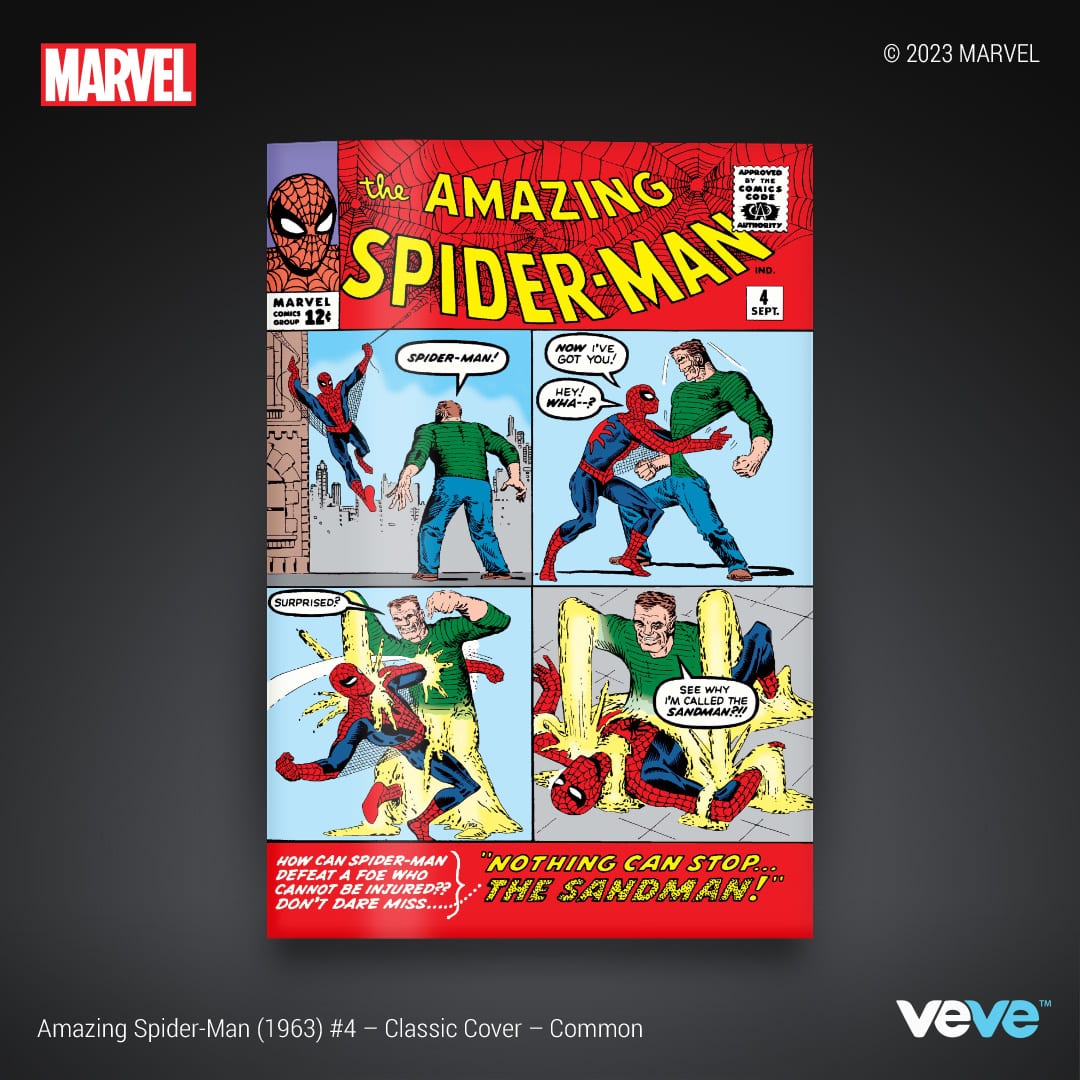
Sand is a nightmare to draw. It has no edge, no shine, no single line you can commit to, and in 1963 you had four colours and a screen of dots to work with. Steve Ditko solved it by rendering the Sandman as texture instead of form, stippling him into grain where a normal villain would have had a contour, and letting his arms fall apart into streams mid-panel. Sixty years of artists have been copying that solution ever since.
Amazing Spider-Man #4 carries a September 1963 cover date. The series had just gone monthly. Stan Lee and Ditko were four issues in and already three villains deep, having run through the Vulture and Doctor Octopus in the two issues between this one and the first.
An escaped convict on a beach
Flint Marko’s origin takes barely a page. He breaks out of prison, hides on a beach next to a nuclear testing site, and whatever is in the sand rewrites him. No suit, no gadget, no lab accident he was working in. He was simply in a bad place on a bad day, which gives him a lower centre of gravity than most of the early rogues gallery and makes him read as a career criminal who caught a break rather than a genius who built one.
He does the obvious things with it. He walks through a keyhole as a stream of dust, hardens a fist into concrete, and mocks Spider-Man for punching something that will not stay punched. Then the ending arrives, and Spider-Man defeats him with a vacuum cleaner, which is either the most charming thing in the issue or the silliest depending on how much patience you have for 1963. I love it. The whole appeal of a shape-shifter is that force does nothing, so the solution has to be lateral, and a janitor’s vacuum bag is about as lateral as it gets.
The other first appearance
Betty Brant is in this issue too, and over the long run she may have mattered more. She is Jameson’s secretary, she is the first person at the Bugle to treat Peter as a person rather than a freelancer, and she becomes the first real romance in the book, years before Gwen Stacy or Mary Jane exist on the page.
The relationship fails for an honest reason. Her brother dies in the crossfire of Peter’s world, and afterwards she cannot live next to that risk, which is a far more grown-up ending than a misunderstanding or a rival. Marvel has kept her employed in the Bugle newsroom ever since, and a lot of the paper’s texture as a place with staff and deadlines comes from her.
Why a shape-shifter was hard to beat and harder to draw
There is a structural problem with the Sandman that the early issues bump into immediately. A villain who can turn to dust cannot really be captured, cannot be punched, and cannot lose a fight in any conventional way, so every appearance needs an invented finish. That is exhausting for a monthly book. It is also why he ages so well. Every writer who picks him up has to think of something, and thinking is better than another rooftop brawl.
For the artist the difficulty runs the other way. A costumed villain is a silhouette you can reuse a hundred times. The Sandman has no silhouette:
- His edges have to be redrawn from scratch in every panel, because grain does not hold a shape.
- His scale is unstable, so the panel composition has to tell you whether he is a man or a sandstorm this second.
- Colour cannot help much, since he is one flat brown against whatever else is on the page.
Ditko’s answer was the half-state. He rarely draws Marko fully solid or fully dispersed, and the in-between is what sells it: a face that is still a face while the shoulder underneath has already gone to powder.
What the long career did with him
He joined the first Sinister Six in the 1964 Amazing Spider-Man Annual, which is where the rogues gallery stopped being a list and became a cast. He joined the Frightful Four against the Fantastic Four in 1965. Then, unusually for a Silver Age heavy, he reformed properly in the 1980s after Marvel Two-in-One put him in a conversation with the Thing in 1982, and he spent years as something close to an ally before writers walked it back.
Thomas Haden Church played him in Spider-Man 3 in 2007 and returned for Spider-Man: No Way Home in 2021, which crossed $1.9 billion worldwide. The sand formation sequence in the 2007 film is a direct translation of what Ditko was doing with dots in 1963, just with a much larger budget.
The collecting reality of an early monthly
These were disposable objects. Twelve cents, sold from a wire rack in a drugstore, read to pieces and thrown away, and any copies the retailer did not shift had their covers stripped for distributor credit while the interiors went to the pulper. Nothing about the supply chain was designed to produce a mint copy in 2026.
That is the whole reason grade is such a cliff for Silver Age Marvel. Newsprint from 1963 tans, staples rust, and the spine of a book that a kid rolled into his back pocket never comes back. Third-party grading did not begin until 2000, so every copy now sitting in a 9.4 holder got there by four decades of luck.
The character’s benchmark price belongs to his creator’s other book: a CGC 9.6 copy of Amazing Fantasy #15 sold for $3.6 million at Heritage Auctions in September 2021. The early ongoing issues land far below that and still reach five and six figures in top grades, while mid-grade copies with honest wear stay findable at conventions. If you like this corner of the run, the Lizard’s debut two issues later has the same distribution story attached.
The licensed digital edition
VeVe releases officially licensed Marvel digital comics, and this issue is among them. A licensed digital edition is a numbered copy from a fixed edition that you read full-screen in the app, pages in printed order, with the edition number recorded publicly so the individual copy can be identified.
The honest pitch is the reading. Ditko’s sand work rewards being looked at closely, panel by panel, and that is exactly what a sealed grading slab prevents, since cracking the case ends the grade. A digital edition lets you sit with the art without worrying about the paper. Our comparison of digital and physical comics goes through what each format gives up, and what mint numbers mean covers how the numbering works if that part is new.
A criminal who got out of the way
Marko is the least ambitious major villain Spider-Man has. He never wants an empire. He wants to be left alone with money, and the tragedy that keeps getting written into him is that a man made of sand cannot stop moving even when he wants to stand still. Not bad for a one-page origin on a beach, and a good reason the Sandman keeps coming back long after slicker villains stopped getting called.