Street Fighter Collectibles on VeVe: Ryu to M. Bison
Street Fighter collectibles on VeVe are officially licensed Capcom digital figures built on the Street Fighter V character designs. The lineup covers the core roster - Ryu, Ken, Chun-Li, Guile, M. Bison, Sakura and Akuma - as numbered editions you can view in AR. Each figure drops with a published rarity tier and edition count.
Every fighting game collector has a main. Not a favourite exactly, more like a default: the character your hands go to before your brain catches up. Mine is Guile, which says embarrassing things about how I played in 1993. The nice part about the Street Fighter lineup on VeVe is that it is built around exactly that instinct. You do not collect the series. You collect your guy.
What Street Fighter figures are on VeVe
The Capcom-licensed digital figures use the Street Fighter V designs, which is the version of these characters most people picture now: heavier silhouettes, more visible muscle, costumes redesigned with texture rather than flat colour blocks.
The roster covers the pillars of the series.
Ryu is the obvious anchor. White gi, red headband, the character the entire franchise is drawn around, and usually the first figure anyone in a new Street Fighter line picks up.
Ken Masters is the counterweight. Same fighting style, blond hair, red gi, and a completely different personality expressed almost entirely through stance. Collectors who buy Ryu tend to want Ken within a week. They look wrong apart.
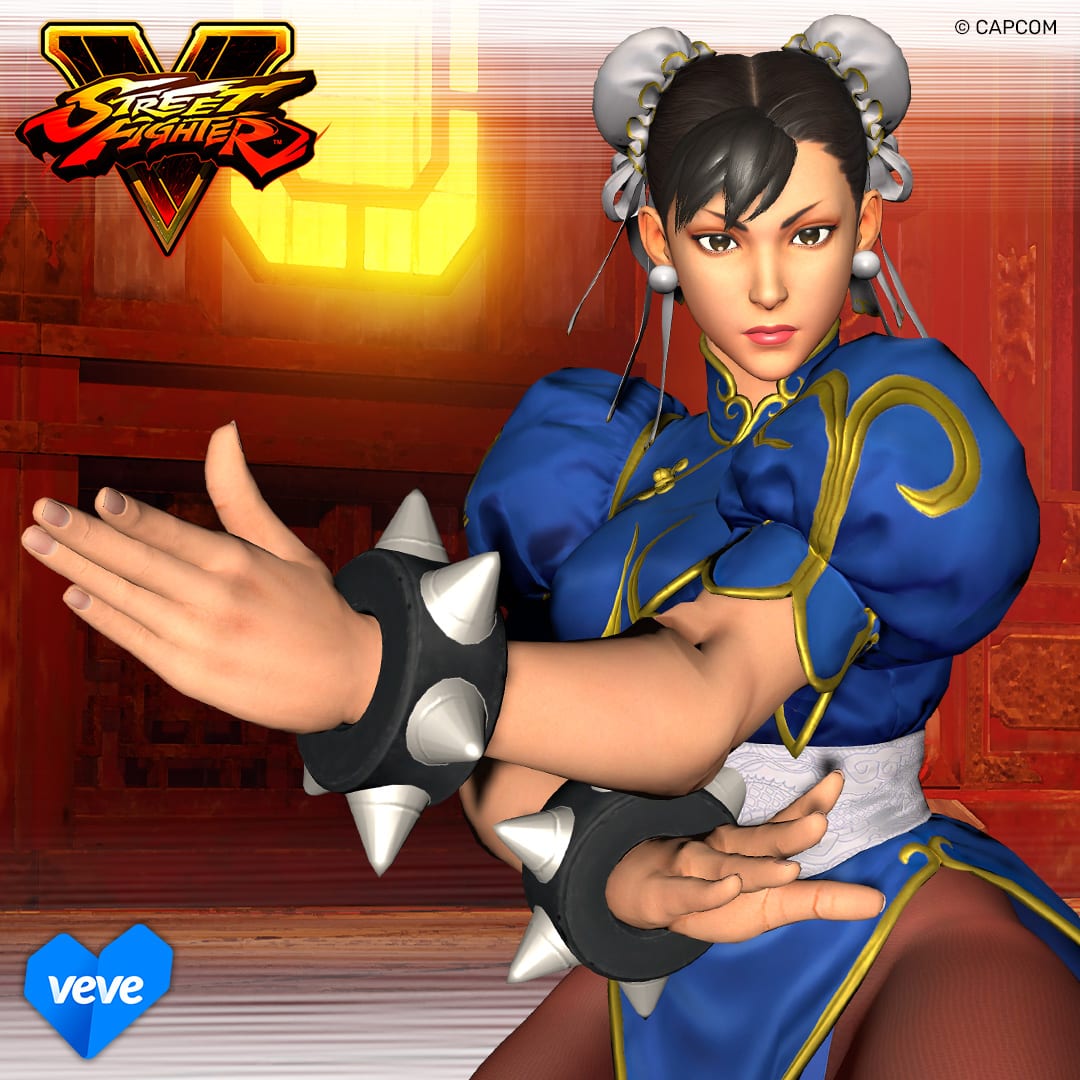
Chun-Li is the one I would argue matters most historically, and I will get to why below. Blue qipao, spiked bracelets, the thighs that became a running joke among artists because Capcom drew them as a statement about power rather than decoration.
Guile brings the flat-top and the sunglasses-and-dog-tags Americana that dated instantly and then came all the way back around to being great.
M. Bison is the final boss, cape and all. If you are building a shelf that tells a story, you need an antagonist, and Bison is the one the series keeps returning to.
Sakura is the schoolgirl Ryu fan who became a fan favourite in her own right after Street Fighter Alpha 2 in 1996. She is the pick for collectors who came in through the Alpha games rather than SFII.
Akuma is the wild card. He first showed up as a hidden boss in Super Street Fighter II Turbo in 1994, the kind of secret that spread by playground rumour before anyone could look it up, and he has been the series’ dark-mirror character ever since.
Each figure drops as a numbered edition with a published rarity tier, so you can see where your piece sits in the run rather than guessing.
Why Street Fighter is a collecting franchise at all
The first Street Fighter hit arcades in 1987. It is not a good game. Two enormous pressure-sensitive pads that punished your hands, one playable character, and controls that responded when they felt like it. What it did have was a shape: two fighters, a health bar each, a best-of-three.
Then in 1991 Capcom released Street Fighter II: The World Warrior, and arcades changed overnight. Eight playable characters with genuinely different move sets, six attack buttons, and special moves you performed with joystick motions rather than button mashes. The quarter-munching part was almost incidental. The real shift was that SFII made arcade play competitive and social. You were not fighting the machine, you were fighting the person who put their coin on the cabinet edge.
That is the reason this franchise generates collectors thirty-five years later. People are not attached to a game. They are attached to a room.
Chun-Li and the thing people get wrong about her
Chun-Li was the first playable woman in a fighting game, arriving with Street Fighter II in 1991. That fact gets repeated a lot, and it is usually repeated flatly, as though it were a box Capcom ticked.
Look at how she was actually designed and it reads differently. She is not a joke character or a speed-only lightweight. Her Spinning Bird Kick and Lightning Legs made her one of the strongest picks in SFII, and her design language is built entirely around leg strength rather than the usual shorthand. Her stated job in the fiction is Interpol officer investigating her father’s disappearance. The character had a reason to be in the tournament that was not decorative.
Thirty-five years of fan art, cosplay and figure lines followed from that. When people talk about Street Fighter’s cultural reach outside of gaming, Chun-Li is usually the piece that got there first.
How people collected Street Fighter before figures
Useful background if you are coming to the digital pieces cold, because the collecting culture here predates the merch.
Arcade cabinets are the trophy tier. An original SFII cabinet is a large, heavy, electrically temperamental object that needs a garage and a tolerance for repairing 1991-era monitors. People do it anyway, and restored cabinets are the centrepiece of most serious Street Fighter collections.
Arcade flyers are the sleeper category. Operators received paper flyers advertising new cabinets, most got binned, and the survivors carry art you cannot find anywhere else. They are cheap, flat, and easy to store, which makes them the best entry point into physical arcade collecting that exists.
The 1994 live-action film with Jean-Claude Van Damme and Raul Julia is its own strange sub-hobby. The film is not good by any conventional measure. Raul Julia, in his final completed role, plays M. Bison with so much committed conviction that the movie has been rescued by affection. Posters, press kits and the tie-in toy line all circulate among collectors who know exactly what they are buying and love it regardless.
Then the modern statue lines arrived, and the pattern that governs almost all of this became obvious: people buy the character they played, not the character that is objectively coolest. That pattern carries straight into digital.
Picking your first Street Fighter piece
My honest advice, and it is the same advice I would give at a convention table. Do not start with the character you think a collection should have. Start with the one you picked on the cabinet.
If that was Ryu, get Ryu, and accept that Ken is coming eventually. If you were the person who picked Guile purely to spam Sonic Booms, own it. If you came in through Alpha, Sakura will mean more to you than a Ryu ever will, no matter how many people call Ryu the essential one.
There is a second approach I like: collect the fight. One hero, one villain, displayed as a matchup. Ryu against Bison, or Ryu against Akuma, works far better on a shelf than four heroes standing in a line. Every figure line eventually teaches you that opposition reads better than assembly.
Browse the full roster on the characters page or the Street Fighter franchise hub to see what is currently in the ecosystem, and keep an eye on the drop calendar for new releases. If the digital side of game collecting is new to you, we covered how it works and what to check in video game collectibles, what collectors should know.
Collecting Street Fighter on VeVe
New collectors get US$10 in free credit on VeVe, no card required, which is enough to browse the store properly and pick up your first piece without committing anything. Go get your main.