The ships and droids that built the Star Wars shelf
Star Wars hardware covers ships like the Millennium Falcon, X-wing, TIE Fighter and T-47 airspeeder, walkers like the AT-AT, and droids from R2-D2 and C-3PO to BB-8, IG-11 and the GNK power droid. They collect differently from figures because most were built as miniatures rather than costumes, and because a vehicle sets the scale of everything displayed around it.
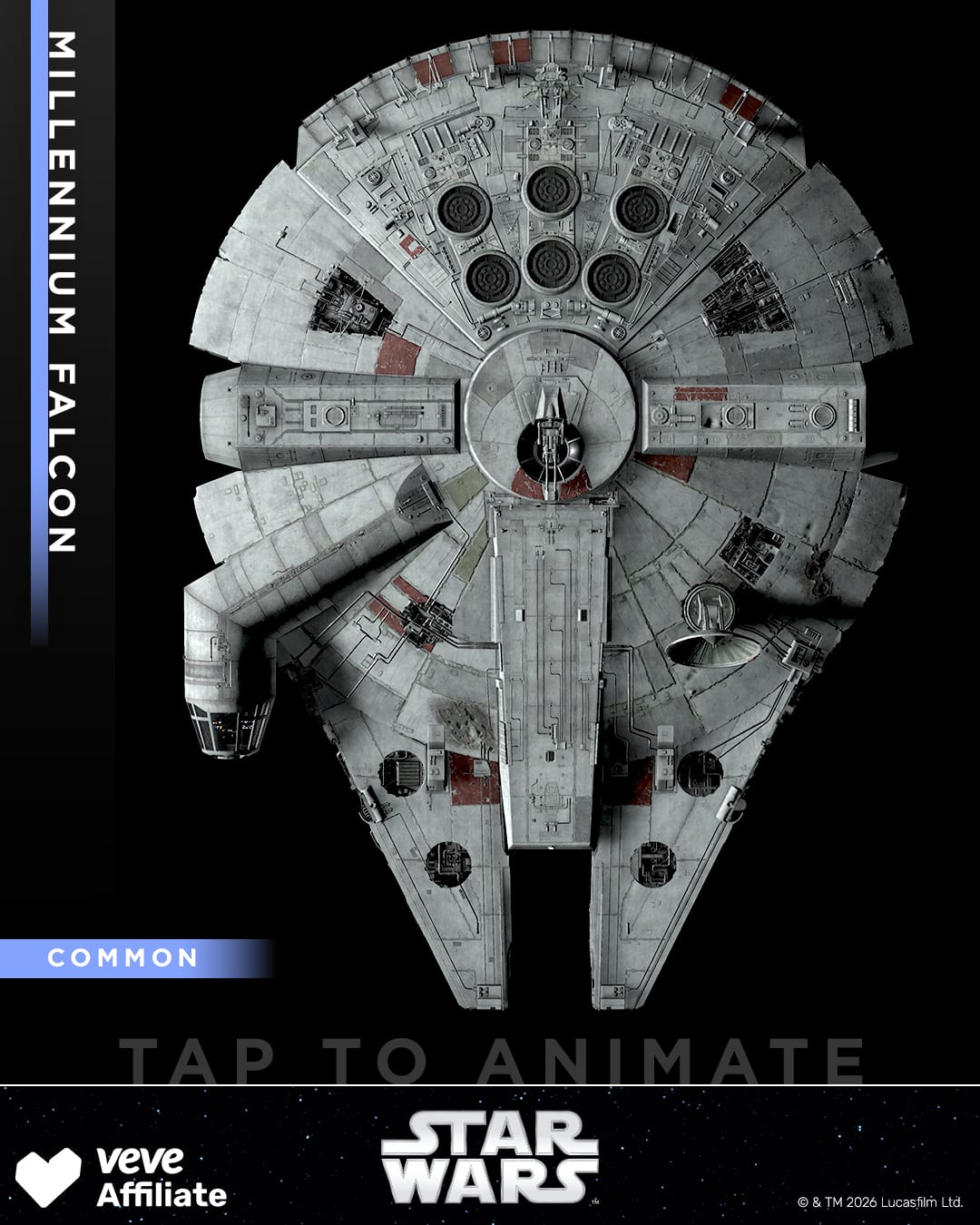
Ask someone to picture Star Wars and about half of them picture a ship. The saga sold an enormous number of characters, but the objects that got stuck to bedroom ceilings and painted on school bags were the hardware. There is a reason for that, and it goes back to a warehouse in Van Nuys where a group of model makers invented most of what a spaceship looks like in film.
The model shop did the worldbuilding
Industrial Light and Magic was set up in 1975 because nobody else could shoot what the script required. John Dykstra’s crew built the Dykstraflex, a motion control camera rig that could repeat an identical move over and over, which is the only way to composite a dogfight out of separately filmed elements without everything sliding around.
What made the ships look real, though, was cheaper than that. The crew bought commercial plastic model kits by the crate, mostly tanks and aircraft, and glued the parts onto the surfaces of the miniatures to create detail. The industry nickname for those bits is greebles. Look closely at the hull of the Millennium Falcon and you are looking at engine blocks, gun barrels and tank treads from kits you could have bought at a hobby shop in 1976. The Falcon is not a sleek design. It is a lived-in one, and that texture came from other people’s model kits.
The consequence for collectors is that Star Wars hardware carries more visible craft than most film design. Every panel is a decision somebody made with a scalpel.
Kenner’s Falcon and what a big toy does to a room
Kenner put the Millennium Falcon into shops in 1979, and it changed the shape of the line. Up to then Star Wars collecting was a wall of small carded figures. The Falcon was a slab of grey plastic big enough that a child had to negotiate for floor space to own it.
That is the essential fact about vehicle collecting and it has never stopped being true. A figure joins a shelf. A vehicle rearranges one. The Falcon set the scale for everything around it, and every figure you already owned suddenly had somewhere to be.
Walkers, and the months nobody saw
The AT-AT sequence in The Empire Strikes Back, released in 1980, is still the most impressive practical work in the saga, and it is impressive precisely because it looks laborious. The AT-AT walkers were miniatures animated frame by frame across a miniature snowfield, under Dennis Muren with Phil Tippett leading the animation. Stop motion has a distinctive stutter, so the team developed go motion, blurring each frame by moving the model slightly during exposure. The walkers read as heavy because they were moved by hand, one position at a time, by people who understood weight.
The harpoon and tow cable shots took an extraordinarily long stretch of the schedule. Every element in them is separate: the T-47 airspeeder miniature, the walker, the cable, the snow, the background plate. The cable alone was a nightmare, because a physical line has to behave like a line under tension across shots that were filmed weeks apart. Months of work produced roughly thirty seconds of screen time, and almost nobody watching has any idea.
Mention this to anyone who thinks hardware is the boring part of a collection. The snowspeeder is a fifteen-second idea that cost a season of somebody’s life.
The fighters, and why they read at a glance
The X-wing and the TIE Fighter are a masterclass in silhouette. Joe Johnston and Colin Cantwell shaped them so that in any frame, at any distance, at any angle, you know instantly which side is which. Curved and split versus flat and hexagonal. Four engines versus one central ball. Rebel ships are asymmetrical and worn, Imperial ships are symmetrical and clean.
That legibility is exactly why they display well. Put an X-wing and a TIE together and the composition does the storytelling without a caption. It is the same trick that makes a chess set look right.
The speeder bike from Return of the Jedi in 1983 pulled off a different trick entirely. The chase through the Endor redwoods was shot by Garrett Brown walking slowly through the forest at Del Norte in northern California with a Steadicam rig, one frame at a time, and the footage was then played back at speed. No motors. No rig. A man walking carefully through trees, turned into the fastest sequence in the film.
Droids collect like characters but display like objects
A droid occupies a strange middle ground. R2-D2 and C-3PO carry more plot than most of the human cast, and they are the two elements Lucas lifted most directly from Kurosawa’s The Hidden Fortress, where the story is told from the perspective of two squabbling peasants at the bottom of the hierarchy. Kenny Baker was inside the R2 unit. Anthony Daniels was inside the gold suit for the whole saga and never stopped being the only person who could do the voice.
BB-8 arrived in 2015 as a genuine surprise, because it rolled. Not a composite, not a puppet dragged on wire. A functioning physical unit moving on set, which is why the cast reacts to it so naturally.
IG-11 from The Mandalorian in 2019 is the direct descendant of IG-88, the assassin droid that stands in a lineup in The Empire Strikes Back for a few seconds and has been a fan obsession ever since, mostly because it looks assembled rather than designed. And then there is the GNK power droid, the walking battery that gonks. It has no lines, no arc and no purpose beyond existing, and collectors adore it for exactly that reason. Every good collection needs one piece that is a joke you are in on.
How to arrange hardware so it works
Vehicles want negative space and a low vantage point. Figures read best at eye level, but a ship read from slightly below looks like it is passing overhead, which is how you saw it in the cinema. In AR that translates to putting hardware on the floor and figures on the table, and it is the single change that most improves a Star Wars display.
Pair by scale, not by faction. A Falcon and an AT-AT are both enormous, and they anchor opposite corners nicely. Fighters cluster. Droids belong near the figures they follow around, not in a droid section, because they were written as companions and they look wrong in a row.
The wider Star Wars collecting run has always split into people and things, and most collectors start with people and drift toward things. That is not a loss of interest in the characters. It is what happens when you notice the craft.