How Star Wars turned one helmet into endless troopers
A trooper variant is the same basic armour silhouette rendered in a new finish, material or cultural style. Star Wars has been licensing these since the Kenner toy line of 1978, and VeVe has released art across the run, including the Edo Stormtrooper and Samurai Darth Vader, plus Crimson, Shadow, Mimban, Death, Night and Scout Troopers and the Imperial Royal Guard.
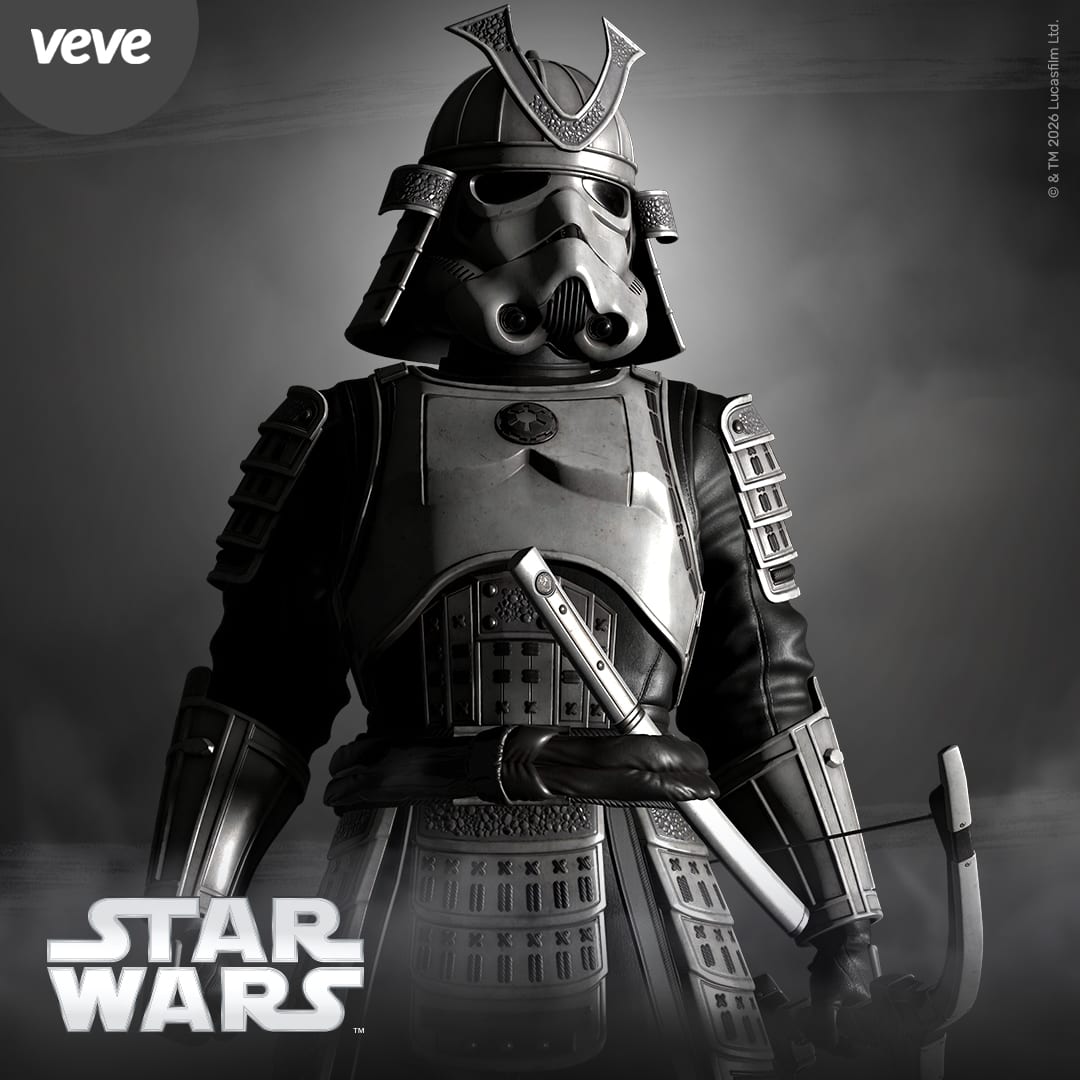
There is one helmet in Star Wars that everybody can draw from memory, and almost nobody owns just one version of it. The Stormtrooper silhouette has been recut, repainted, weathered, armoured in lacquer and dragged through mud for nearly five decades. That repetition is not laziness. It is one of the oldest structures in collecting, and it works because the eye learns the shape first and then starts hunting for the differences.
The variant habit started with the toys
When Kenner shipped the first Star Wars action figures in 1978, following the famous Early Bird mail-away that got them through a Christmas they had no product for, the Stormtrooper was in the opening twelve. It was also the figure kids bought more than once. One was a character. Four was a corridor.
Kenner worked out very quickly what that meant. A hero mould is expensive and sells once per household. A trooper mould is expensive and sells five times. Every toy company that has held the licence since has run the same arithmetic, which is why the aftermarket is full of repaints, convention exclusives and store-specific colourways that share a single body sculpt.
The design itself came from Ralph McQuarrie, whose early paintings put the troopers in white plate with a lightsaber and a shield before the idea settled into the version that boards the Tantive IV in the first minutes of the 1977 film. The physical armour was vacuum-formed by Andrew Ainsworth at his London workshop, a detail that stopped being trivia in 2011 when the UK Supreme Court ruled in a long-running case between Lucasfilm and Ainsworth over whether the helmets counted as sculptures under British copyright law. Few pieces of movie costume have their own case law.
The Japanese line, and the history underneath it
The Edo Stormtrooper and Samurai Darth Vader look at first like a fun crossover. They are closer to a return trip.
Akira Kurosawa’s The Hidden Fortress, released in 1958, follows two bickering peasants across a war-torn countryside while the important people around them fight a war they barely understand. George Lucas has talked for decades about how much that film shaped his script, and the clearest inheritance is structural: telling a galactic civil war from the point of view of the two lowest-ranking characters in it. Those two are the droids. Lucas also approached Toshiro Mifune, Kurosawa’s regular lead, about a role, which his family confirmed publicly years later.
The visual borrowing runs just as deep. Vader’s helmet takes the flared neck and faceplate of a samurai kabuto. The chest box and layered plates read as armour in the Japanese sense rather than the medieval European one. When Bandai launched its Meisho Movie Realization line in 2014, rebuilding Vader as a samurai general and the troopers as ashigaru foot soldiers in Edo-period lacquer, it was not inventing a mashup. It was closing a loop that opened in 1958.
That is what makes the Edo pieces worth owning as a pair rather than singly. Set the samurai Vader beside the plain white trooper and the whole design lineage becomes visible in about two seconds.
The finishes, and where each one actually comes from
Not every variant has the same pedigree, and knowing which is which changes how you display them.
- The Death Trooper arrived in Rogue One in 2016. Black armour, taller frame, Imperial special forces assigned to Director Krennic, with comms run through a modulator that turned their speech to static.
- The Shadow Trooper is older than that, a black-armour idea with roots in the Blackhole stormtroopers of the 1970s newspaper strip and a long life in games and toy exclusives since.
- The Crimson Trooper is the purest expression of the repaint tradition. Red armour with no battlefield to explain it, existing because red next to white looks superb and always has.
- The Mimban Trooper comes from Solo: A Star Wars Story in 2018, a mudtrooper of the Mimban trenches in a rebreather and a filthy brown overcoat. The only variant here designed to look miserable.
- The Night Trooper turned up in Ahsoka in 2023, part of Thrawn’s remnant forces on Peridea, weathered and half-abandoned after years with no supply line.
- The Scout Trooper is from Return of the Jedi in 1983. Lighter armour, open lower face, built around the speeder bike.
- The Imperial Royal Guard is not a trooper at all in rank terms, but it earns its place, because that crimson robe was designed specifically to break up a room full of white plate.
If you want the fuller breakdown of the core ranks and how they fit together, the trooper collecting guide covers them individually.
Why one shape in many finishes satisfies people
Collecting runs on comparison. A shelf of unrelated objects is a pile. A shelf of the same object in eleven treatments is a set, and a set gives your eye somewhere to go.
This is the same instinct behind coin collectors chasing mint marks, or a record collector holding six pressings of one album. The base object stops being the point. The delta becomes the point. You are no longer looking at a Stormtrooper, you are looking at what lacquer does to a pauldron versus what Mimban mud does to it, and that comparison is only available if you own both.
Digital collecting suits this better than shelf space ever did. Physical army building hits a wall fast, because eleven boxed figures is a cupboard problem. Eleven variants in an AR display is a scroll. The difference matters more than people expect once a set passes about six pieces.
Where to start if you are building the run
Own the plain white one first. Everything here is a variation on it, and variations only read as variations when the original is sitting next to them. After that, the pairs do the most work: white beside Crimson, Death Trooper beside Night Trooper for the two ends of Imperial decay, Scout Trooper beside the Royal Guard for the lightest and heaviest things a soldier in this universe wears.
The Edo and samurai pieces are the ones to place last and separately. They are a comment on the rest of the shelf rather than part of it, and they look better with a gap around them.
Whatever order you go in, the broader Star Wars run will keep giving you new finishes on the same silhouette, because it has done so continuously since 1978 and nobody involved has any reason to stop. That is the quiet pleasure of a variant collection. It is never finished, and it was never designed to be.