Fantastic Four #48: Galactus and the Silver Surfer Arrive
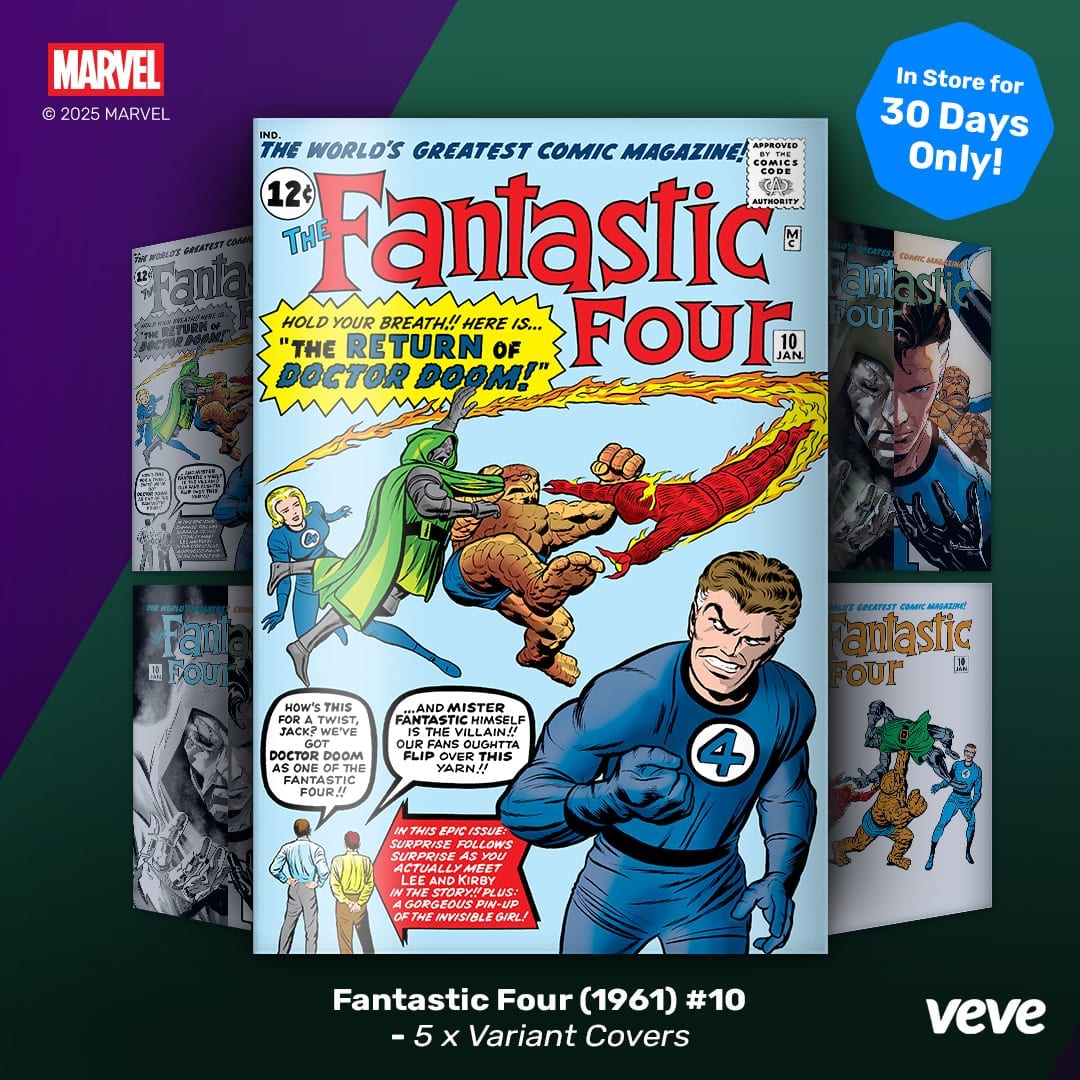
Fantastic Four #48, cover dated March 1966, introduced Galactus and the Silver Surfer and opened the three-part story known as the Galactus Trilogy. Stan Lee and Jack Kirby created it, and VeVe carries licensed Fantastic Four digital comics including issues #3, #6, #7, #9 and #10.
A silver figure on a surfboard streaks across the sky over New York, and behind him comes something far bigger. Jack Kirby had been drawing increasingly strange cosmic ideas into the Fantastic Four for years by 1966. In issue #48 he stopped holding back.
What happens across the trilogy
The story that begins in Fantastic Four #48 runs through issue #50, three consecutive issues given to a single threat. The Watcher, a silent alien observer already established in the series, warns the team that Galactus, a being who consumes planets to sustain himself, is coming for Earth. His herald, the Silver Surfer, arrives first to scout the planet.
The Surfer was not in Lee’s plot. Kirby added him during the drawing process, a herald riding a surfboard through space, and the character proved striking enough that Lee built dialogue and a personality around him after the fact. That is the Marvel Method working exactly as it was designed to: Kirby inventing at the drawing board, Lee finding the voice once the pages existed. The Surfer’s eventual turn against his master, moved by what he finds on Earth, gives the trilogy its emotional center and set up one of Marvel’s most enduring characters from what began as an unscripted addition.
Why this story and not an earlier cosmic tale
Fantastic Four had been building toward something like this for years, introducing the Watcher, the Inhumans and increasingly strange cosmic concepts through 1965 and early 1966. Galactus is the culmination of that momentum rather than an isolated idea. He is not a supervillain in the conventional sense. He does not hate Earth or want to conquer it. He needs to eat, and Earth happens to be food, which is a scale of menace nothing in superhero comics had attempted before. Doctor Doom threatens the team. Galactus barely notices they exist.
That indifference is what made the story land. The FF cannot fight their way out of this one, and the resolution, a desperate gambit involving a cosmic weapon called the Ultimate Nullifier, only works because Galactus chooses to be reasoned with rather than because the team defeats him outright.
What it did to the wider Marvel universe
Galactus and the Silver Surfer opened up an entire register of Marvel storytelling that had not existed before: cosmic-scale threats operating on rules closer to physics than to crime. Every subsequent Marvel event involving planetary or universal stakes, and there have been many, works in territory this trilogy staked out first. The Surfer went on to headline his own series within two years and remains one of the few Kirby-designed characters whose visual concept, chrome skin, a surfboard, a herald’s burden, has never been meaningfully redesigned.
Collecting the trilogy
Fantastic Four #48 sits in a strong but distinct collecting bracket from the true Silver Age foundational keys like Fantastic Four #1. By 1966 Marvel’s circulation had grown substantially and more copies survive in mid-to-high grade than for the company’s 1961 and 1962 launches, though pristine copies remain genuinely scarce.
High-grade copies have performed well at auction, with strong CGC 9.6 and above examples selling for solid five-figure sums at Heritage Auctions in recent years. That price reflects the trilogy’s standing as one of the most acclaimed runs of the entire Silver Age, not pure scarcity. Kirby’s cosmic period, broadly the mid-to-late 1960s, is widely regarded by collectors and historians as his creative peak, and this trilogy is usually the first example cited.
Reading the Fantastic Four on VeVe
VeVe carries licensed digital editions of early Fantastic Four issues in its comics lineup, including #3, #6, #7, #9 and #10, letting collectors read the build-up to this cosmic era directly in the app. The Fantastic Four hub covers the wider Marvel catalogue on VeVe, and the what mint numbers mean piece explains how each digital edition’s numbering works if that side of collecting is new to you.
To look around the app before deciding anything, start a free VeVe account. New collectors get US$10 in credit toward a first piece, no card required, and the free credit page has the details.
A herald who was never supposed to exist
The Surfer’s entire history, his own book, his tragic exile on Earth, decades of stories about redemption, began as a figure Kirby added at the drawing board because he decided Galactus needed a herald. Galactus is the bigger idea by any measure, a planet-sized appetite with no malice attached to it. But the character everyone kept was the one nobody planned.