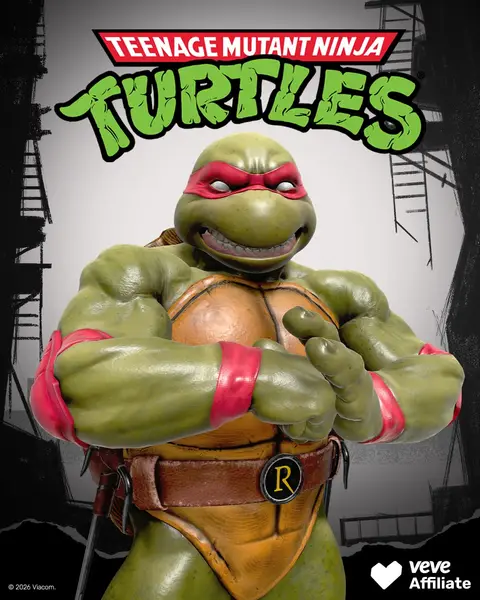
Raphael
The sai-wielding brother who never learned to cool off.
The angriest of the four from the very first issue, where all the brothers wore identical red bandanas.
Affiliate partner link - we may earn a commission at no cost to you. New collectors get US$10 free credit; terms apply on VeVe's site. No card required. Full disclosure.
Why Raphael matters to collectors
Raphael was the first turtle to get a solo book, and that was not an accident. He is the one the writers reach for whenever the story needs conflict inside the family rather than outside it. Collectors gravitate to him for the same reason artists do: a character who is permanently one bad day from walking out gives you more expressive sculpts than a character who always does the right thing.
Key issues and milestones
- Raphael #1 (Mirage one-shot) (1985) - The first solo turtle book, which also introduces Casey Jones.
- Teenage Mutant Ninja Turtles animated series (1987) - Red bandana, sarcasm dialed up, and the brother who talks to the audience.
- Teenage Mutant Ninja Turtles (film) (1990) - The film gives him the central emotional arc, including the rooftop fight with Casey Jones.
- TMNT: The Last Ronin #1 (2020) - IDW's dark future story built on an old Eastman and Laird idea, and a genuine modern indie key.
In the original Mirage comics all four brothers wore red - Raphael kept the colour when the toy line assigned everyone else a new one, so he is the only turtle whose mask never changed.
Collecting Raphael through the years
The 1985 Raphael one-shot is one of the more interesting books in the Mirage catalogue, because it carries Casey Jones's first appearance in a print run far smaller than anything Marvel or DC was doing at the time. It has been reprinted often, so identifying the original is the usual first lesson. On the toy side, the 1988 Playmates Raphael suffers the classic accessory problem: the sai are small, easy to lose and expensive to replace with originals, which is why complete loose figures get a second look. Mirage-era convention exclusives and the later IDW variant covers gave the character a second collecting wave that had nothing to do with the vintage market.
Raphael on VeVe
Raphael appears in VeVe's TMNT character figure series and in the Dojo Discipline series, where the framing is training-focused rather than combat-focused. His releases tend to use lower, coiled stances that suit the character. Rarity tiers follow the standard structure across the TMNT licence, with scheduled drops in the app and a limited premium edition at the top of most releases.
TMNT figure series releases and the Dojo Discipline series, with poses that lean into his aggressive stance. Check the drop calendar for upcoming TMNT releases - drops sell out in minutes, and reminders keep you ahead of them.
New to digital collecting? Start with what VeVe is and why first appearances are the rookie cards of comics.
Before you collect Raphael
- Claim your free US$10 - new collectors start with credit toward a first piece, no card required.
- Is VeVe legit? - our honest review, including the parts VeVe would rather we skipped.
- How to start on VeVe - signup through first drop, step by step.
- Are VeVe collectibles worth it? - who genuinely enjoys this hobby, and who should pass.
Raphael collector FAQ
Where can I buy Raphael digital collectibles?
Raphael digital collectibles release on VeVe through scheduled drops and the in-app marketplace. TMNT figure series releases and the Dojo Discipline series, with poses that lean into his aggressive stance.
What is Raphael's first appearance?
Raphael first appeared in TMNT #1 (Mirage) (1984). The angriest of the four from the very first issue, where all the brothers wore identical red bandanas.
Are Raphael collectibles on VeVe officially licensed?
Yes. Every TMNT collectible on VeVe is produced under official license with the rights holder - that licensing is the core difference between VeVe and unlicensed NFT projects. More on licensed vs unlicensed.
Are Raphael digital collectibles NFTs?
Technically yes - VeVe collectibles are NFTs recorded on blockchain for provenance. In practice they work like licensed digital collectibles: bought in-app with a custodial wallet, no crypto knowledge needed. How VeVe NFTs actually work.