X-Men
Marvel's mutants - the deepest key-issue well in comics.
Stan Lee and Jack Kirby introduce Professor X, Cyclops, Marvel Girl, Beast, Angel and Iceman in one issue.
Affiliate partner link - we may earn a commission at no cost to you. New collectors get US$10 free credit; terms apply on VeVe's site. No card required. Full disclosure.
X-Men on VeVe: the official art
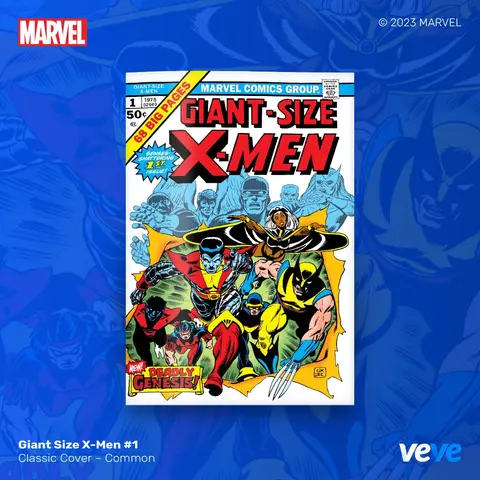
3 images from VeVe's official partner feed · tap to enlargeMost releases come in several rarities, from Common up to Secret Rare, each with its own edition size. VeVe shows every tier and what is still available: see X-Men on VeVe (opens in a new tab).
Why X-Men matters to collectors
No franchise generates key issues like the X-Men. The 1963 debut, the 1975 relaunch that introduced Storm and Nightcrawler, Wolverine's arrival in Hulk #181, the Dark Phoenix saga - each era minted grails that anchor entire collections. The X-Men are also comics' great allegory, which is why every generation rediscovers them and every rediscovery pulls new collectors toward the same handful of issues.
Key issues and milestones
- The X-Men #1 (1963) - The original five, plus Magneto, in a single Silver Age debut.
- The Incredible Hulk #181 (1974) - Wolverine's first full appearance - the Bronze Age grail.
- Giant-Size X-Men #1 (1975) - The relaunch that saved the franchise: Storm, Nightcrawler, Colossus and Thunderbird debut.
- The X-Men #137 (1980) - The death of Phoenix - the climax of the most celebrated X-Men story ever told.
Giant-Size X-Men #1 exists because Marvel wanted to sell comics internationally - the new team was deliberately multinational (Kenyan, German, Russian, Canadian, Japanese, Irish, Native American) as a sales strategy that accidentally created the most beloved lineup in franchise history.
Collecting X-Men through the years
X-Men collecting tracks the franchise's own boom-and-bust arc. The original 1963 run was nearly cancelled, which kept print runs modest and made early issues genuinely scarce. The Claremont era turned Uncanny X-Men into the best-selling book of the 1980s, and the 1991 X-Men #1 launch became the best-selling single comic issue in history. The 90s animated series and the 2000 film each pulled a fresh wave of collectors back to Giant-Size X-Men #1 and Hulk #181, and every casting rumor still moves interest in first appearances today.
Read X-Men comics on VeVe
VeVe also runs a digital comic store, separate from its collectible drops. Search it for X-Men comics Single issues we checked on 25 September 2026 ran from US$3.99 to US$8.98, so a new collector's US$10 credit covers one outright.
X-Men on VeVe
VeVe's X-Men catalogue centers on digital comics: Giant-Size X-Men #1 as a landmark first-appearance book, classic Uncanny X-Men and Jean Grey covers spanning the Silver and Bronze Age, and Wolverine content that bridges into the figure line. Comic drops release in rarity-tiered cover sets, so the same issue exists as Common through Secret Rare covers with very different edition sizes.
X-Men digital comics on VeVe include the era-defining Giant-Size X-Men #1 and classic Jean Grey covers, released through scheduled drops alongside Wolverine figures. Check the drop calendar for upcoming Marvel releases - drops sell out in minutes, and reminders keep you ahead of them.
New to digital collecting? Start with what VeVe is and why first appearances are the rookie cards of comics.
Before you collect X-Men
- Claim your free US$10 - new collectors start with credit toward a first piece, no card required.
- Is VeVe legit? - our honest review, including the parts VeVe would rather we skipped.
- How to start on VeVe - signup through first drop, step by step.
- Are VeVe collectibles worth it? - who genuinely enjoys this hobby, and who should pass.
X-Men collector FAQ
Where can I buy X-Men digital collectibles?
X-Men digital collectibles release on VeVe through scheduled drops and the in-app marketplace. X-Men digital comics on VeVe include the era-defining Giant-Size X-Men #1 and classic Jean Grey covers, released through scheduled drops alongside Wolverine figures.
What is X-Men's first appearance?
X-Men first appeared in The X-Men #1 (1963). Stan Lee and Jack Kirby introduce Professor X, Cyclops, Marvel Girl, Beast, Angel and Iceman in one issue.
Are X-Men collectibles on VeVe officially licensed?
Yes. Every Marvel collectible on VeVe is produced under official license with the rights holder - that licensing is the core difference between VeVe and unlicensed NFT projects. More on licensed vs unlicensed.
Are X-Men digital collectibles NFTs?
Technically yes - VeVe collectibles are NFTs recorded on blockchain for provenance. In practice they work like licensed digital collectibles: bought in-app with a custodial wallet, no crypto knowledge needed. How VeVe NFTs actually work.