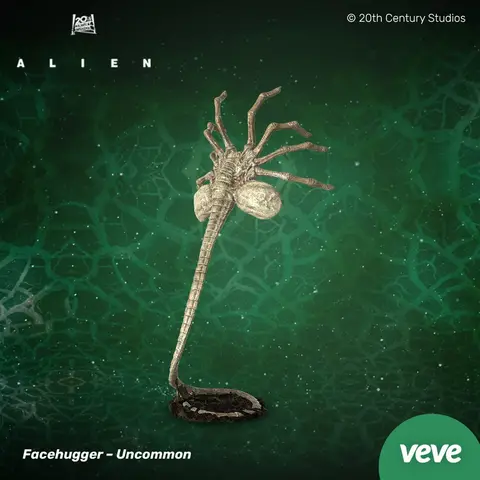
Facehugger
The stage everyone remembers first.
The second stage of the life cycle, and the reason the first act of the film works.
Affiliate partner link - we may earn a commission at no cost to you. New collectors get US$10 free credit; terms apply on VeVe's site. No card required. Full disclosure.
Why Facehugger matters to collectors
The Facehugger is the part of the design that does the horror work. It is small, it moves fast, and what it does is worse than being eaten. Giger built it from spider legs, a fleshy body and a tail, and it reads as biologically plausible in a way that most creature props do not. As a collectible it is the odd one out: a piece that only makes sense next to the others.
Key issues and milestones
- Alien (1979) - Kane's helmet comes off, and the film's whole structure follows from what is underneath.
- Aliens (1986) - The medlab sequence puts two of them loose in a sealed room with Ripley and Newt.
- Alien 3 (1992) - A Facehugger aboard the escape ship undoes the ending of the previous film in the opening minutes.
- Alien: Romulus (2024) - A full room of them, staged with practical effects rather than digital ones.
The effects crew built the creature's underside from real shellfish and animal organs to get the wet texture right, which is also why the props from the shoot did not survive long.
Collecting Facehugger through the years
Facehugger props and replicas have been a staple of the prop-replica market since the 1990s, and full-scale versions turn up as wall pieces, desk pieces and even chest-mounted costume rigs. Licensed lines have generally sold it as an accessory to the adult creature rather than a standalone item, which means loose examples get separated from their sets constantly. Original screen-used props from the 1979 shoot are rare enough that provenance documentation matters more than condition.
Facehugger on VeVe
VeVe carries the Facehugger as a 20th Century Studios figure released in the same family as the Xenomorph, the Chestburster and the Ovomorph egg. Collected together they form the creature's life cycle, which is how most Alien collectors want to display it. Standard scheduled drops with tiered rarities apply.
A 20th Century Studios figure, released alongside the wider Alien life-cycle pieces. Check the drop calendar for upcoming Alien releases - drops sell out in minutes, and reminders keep you ahead of them.
New to digital collecting? Start with what VeVe is and why first appearances are the rookie cards of comics.
Before you collect Facehugger
- Claim your free US$10 - new collectors start with credit toward a first piece, no card required.
- Is VeVe legit? - our honest review, including the parts VeVe would rather we skipped.
- How to start on VeVe - signup through first drop, step by step.
- Are VeVe collectibles worth it? - who genuinely enjoys this hobby, and who should pass.
Facehugger collector FAQ
Where can I buy Facehugger digital collectibles?
Facehugger digital collectibles release on VeVe through scheduled drops and the in-app marketplace. A 20th Century Studios figure, released alongside the wider Alien life-cycle pieces.
What is Facehugger's first appearance?
Facehugger first appeared in Alien (1979). The second stage of the life cycle, and the reason the first act of the film works.
Are Facehugger collectibles on VeVe officially licensed?
Yes. Every Alien collectible on VeVe is produced under official license with the rights holder - that licensing is the core difference between VeVe and unlicensed NFT projects. More on licensed vs unlicensed.
Are Facehugger digital collectibles NFTs?
Technically yes - VeVe collectibles are NFTs recorded on blockchain for provenance. In practice they work like licensed digital collectibles: bought in-app with a custodial wallet, no crypto knowledge needed. How VeVe NFTs actually work.