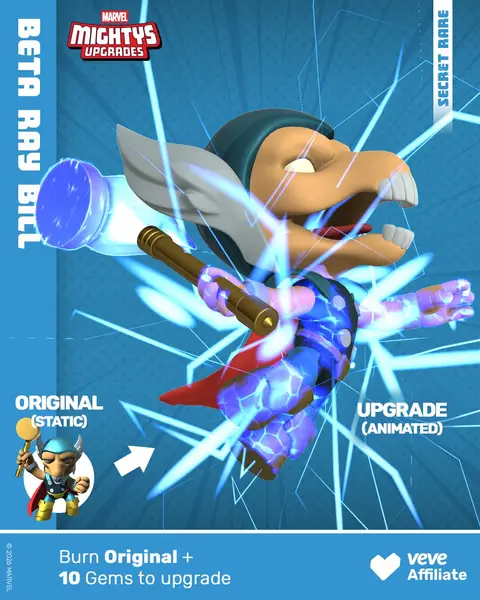
Beta Ray Bill
The alien who lifted the hammer on his first appearance.
Walt Simonson opens his run by putting an alien nobody had ever seen on the cover, holding Mjolnir.
Affiliate partner link - we may earn a commission at no cost to you. New collectors get US$10 free credit; terms apply on VeVe's site. No card required. Full disclosure.
Why Beta Ray Bill matters to collectors
Thor #337 is one of the great opening statements in comics. Simonson took over the book and immediately had a horse-faced alien cyborg prove worthy of Mjolnir, beat Thor in a fair fight, and get his own enchanted hammer out of it. Forty years on, Bill is still the character readers point to when they want to explain why worthiness is a better rule than strength.
Key issues and milestones
- Thor #337 (1983) - First appearance, with the cover logo smashed by Bill's hammer - one of the most copied cover ideas of the decade.
- Thor #338 (1983) - The origin, which explains why a cyborg guardian was built to look like that in the first place.
- Thor #339 (1983) - Stormbreaker is forged, and Bill leaves the book as an equal rather than a rival.
- Beta Ray Bill #1 (2021) - Daniel Warren Johnson writes and draws a solo series that treats him as a tragic figure rather than a novelty.
Simonson designed him deliberately to look monstrous so that readers would assume he was the villain for as long as possible, then had him pass the worthiness test in the same issue.
Collecting Beta Ray Bill through the years
Thor #337 is one of the definitive 1980s Marvel keys and one of the last first appearances from that decade that people still discover. It was a normal newsstand monthly in 1983, so copies are common and grade separates them, with the white logo area on the cover being the first thing to show wear. The three-issue arc from #337 to #339 tends to be collected as a set. Simonson's full run is widely regarded as the best sustained stretch in the title's history, and complete runs turn up affordably.
Read Beta Ray Bill comics on VeVe
VeVe also runs a digital comic store, separate from its collectible drops. Search it for Thor comics Single issues we checked on 25 September 2026 ran from US$3.99 to US$8.98, so a new collector's US$10 credit covers one outright.
Beta Ray Bill on VeVe
Bill appears in VeVe's Marvel Mightys line, where the equine skull shape and the armour plating make for a far stranger silhouette than the rest of the Asgard set. That contrast is the point - in a lineup of Thor, Loki and Odin, he is the one that looks wrong on purpose. Marvel Mightys drop on schedule with tiered rarities.
A Marvel Mightys release. Check the drop calendar for upcoming Marvel releases - drops sell out in minutes, and reminders keep you ahead of them.
New to digital collecting? Start with what VeVe is and why first appearances are the rookie cards of comics.
Before you collect Beta Ray Bill
- Claim your free US$10 - new collectors start with credit toward a first piece, no card required.
- Is VeVe legit? - our honest review, including the parts VeVe would rather we skipped.
- How to start on VeVe - signup through first drop, step by step.
- Are VeVe collectibles worth it? - who genuinely enjoys this hobby, and who should pass.
Beta Ray Bill collector FAQ
Where can I buy Beta Ray Bill digital collectibles?
Beta Ray Bill digital collectibles release on VeVe through scheduled drops and the in-app marketplace. A Marvel Mightys release.
What is Beta Ray Bill's first appearance?
Beta Ray Bill first appeared in Thor #337 (1983). Walt Simonson opens his run by putting an alien nobody had ever seen on the cover, holding Mjolnir.
Are Beta Ray Bill collectibles on VeVe officially licensed?
Yes. Every Marvel collectible on VeVe is produced under official license with the rights holder - that licensing is the core difference between VeVe and unlicensed NFT projects. More on licensed vs unlicensed.
Are Beta Ray Bill digital collectibles NFTs?
Technically yes - VeVe collectibles are NFTs recorded on blockchain for provenance. In practice they work like licensed digital collectibles: bought in-app with a custodial wallet, no crypto knowledge needed. How VeVe NFTs actually work.